Leaders must constrain AI costs before they undermine AI returns.
- Gartner client? Log in for personalized search results.
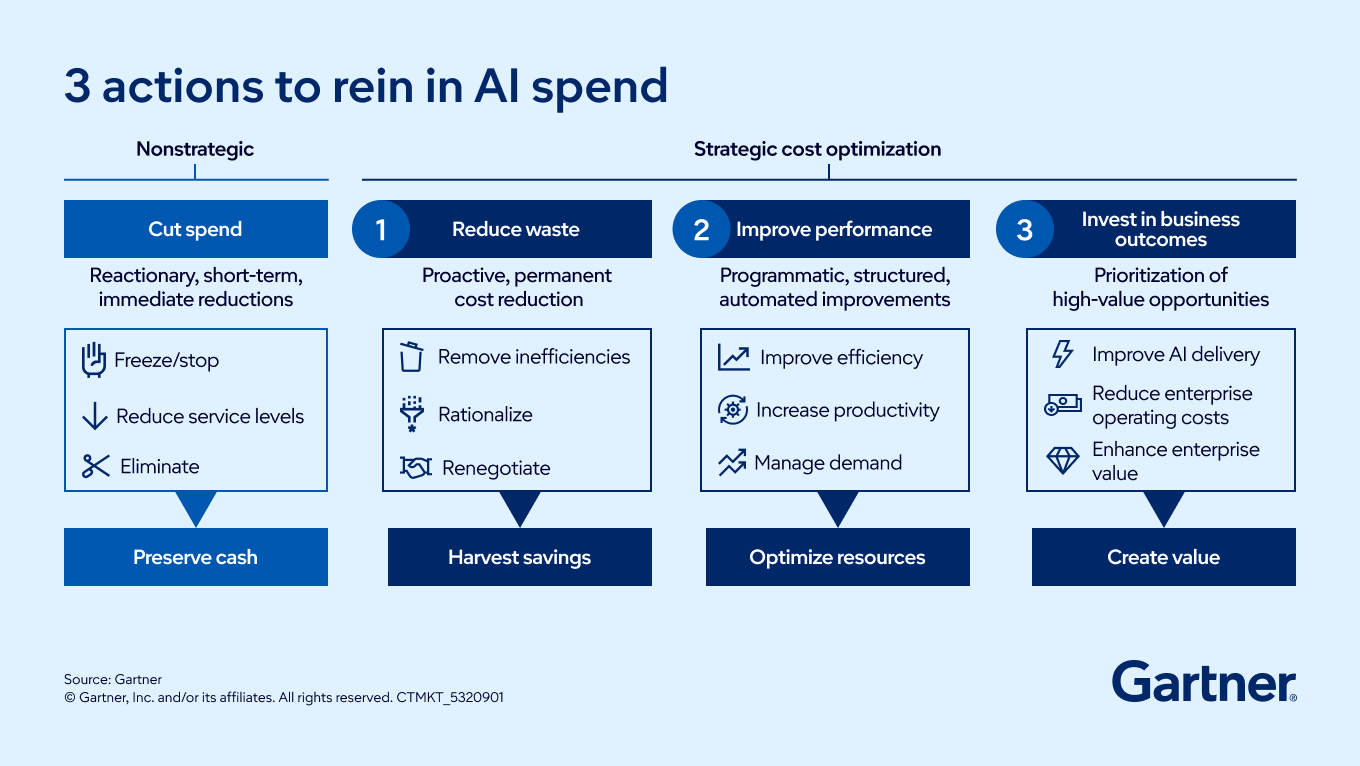
AI spend is doubling, but uncontrolled costs threaten ROI
Many organizations assume that realizing more AI value requires spending more on AI. The real challenge is not the level of investment. It is the discipline behind it. Gartner predicts that AI spend will more than double to $5.6 trillion by 2030 as organizations expand AI use cases, embed AI into core processes and invest in both technical and human readiness. At the same time, many leaders still struggle to connect spending to outcomes. According to Gartner insights, 84% of CFOs struggle to measure AI ROI, leaving organizations vulnerable to misallocated investments and initiatives that fail to deliver meaningful business impact. “AI value erosion is often not due to technology failure, but rather cost creep due to human factors,” says Lydia Clougherty Jones, Vice President Analyst at Gartner. Organizations can no longer focus exclusively on AI value creation while treating AI cost control as a secondary concern.
You might also like this webinar: Data and Analytics 2030: The Vision for an AI‑Native Enterprise
How leaders can rein in AI spend without limiting value
Controlling AI spend is not about reducing AI adoption. It’s about reducing waste, improving performance and directing investment toward the outcomes that matter most. Organizations should take the following three actions now to prevent uncontrollable AI spend in the near-term future.
Reduce waste before cutting investment
Many organizations waste AI budgets long before they run out of funding.
AI initiatives often focus on proving technical feasibility rather than achieving measurable business outcomes. As a result, leaders fund low-impact use cases, maintain redundant tools and struggle to demonstrate ROI.
To reduce waste, organizations should:
- Prioritize AI use cases based on measurable business outcomes
- Engage business stakeholders early in the evaluation process
- Identify and eliminate underutilized AI tools
- Consolidate overlapping applications and platforms
- Detect reasoning drift to reduce incorrect outputs and debugging costs
- Continuously renegotiate vendor contracts and benchmark pricing
Organizations can often unlock meaningful savings without reducing capabilities simply by improving governance, eliminating duplication and ensuring AI investments remain aligned with business priorities.
Improve performance to get more from existing resources
Many AI cost challenges stem from inefficient use of resources rather than insufficient budgets.
Leaders should treat AI efficiency, productivity and demand management as one connected system. The highest-performing organizations simplify work, automate processes and redirect freed capacity into higher-value activities.
Several actions can improve performance:
- Standardize AI use-case prioritization
- Reinvest capacity gains created through automation
- Track AI value metrics consistently
- Use AI to automate delivery pipelines, infrastructure, operations and security activities
- Match model complexity to task complexity instead of defaulting to the most expensive models
This shift from “tokenmaxxing” to “valuemaxxing” is becoming increasingly important. Nearly all corporate AI usage currently occurs on the most expensive models, even when lower-cost alternatives can deliver comparable outcomes for less complex tasks.
Organizations that use AI for analysis and data management report up to 42% and 33% improvements in business value, respectively, demonstrating the importance of focusing AI investment where it can generate measurable returns.
Invest AI spend where outcomes matter most
The organizations creating the highest AI value are not necessarily spending less. They are spending more deliberately.
Gartner insights show that high AI-value organizations plan to spend 5.6 times more on AI and AI foundations than low AI-value organizations. The difference is not investment volume alone. It is an investment discipline.
Leaders should focus AI spend on:
- Outcome-driven use cases tied to executive priorities
- Foundational data and analytics capabilities
- Data management, governance and talent development
- AI-ready data that can scale across business units
- FinOps practices that improve cost transparency and forecasting
Organizations that are most satisfied with AI outcomes spend approximately 30% more on data management, governance and talent than on AI technology compared with organizations reporting the lowest satisfaction levels.
Data quality also plays an important role in controlling costs. Gartner predicts that by 2027, organizations that prioritize semantics in AI-ready data could achieve up to an 80% increase in AI accuracy and a 60% reduction in costs.
The lesson for leaders is clear: How organizations allocate AI spend matters more than how much they spend.
What’s next in managing AI spend and value
Establishing AI cost optimization by prioritizing high-value use cases while selecting the right pricing and deployment models is just one critical step in delivering on the mission-critical priority of rethinking analytics and AI through agentic transformation.
Other steps in that journey include:
Assessing the impact of GenAI and agentic AI on data and analytics (D&A) use cases by evaluating how AI changes the creation and delivery of data and analytics products, transforms operating models and shifts the skills needed across D&A teams.
Determining new capabilities to support D&A and AI deployment by identifying which GenAI and agentic AI capabilities to prioritize across data, analytics, governance and AI platforms, while understanding their maturity, risks and implementation requirements.
Assessing the impact on practices, processes, organization and skills by implementing new data and AI engineering, data management and governance practices that support emerging agentic AI requirements and ways of working.
Prioritizing agentic AI investments in D&A by evaluating expected benefits and costs, improving investment discipline and directing funding toward use cases with the greatest business impact.
Evolving platforms and technology solutions for agentic AI by creating a roadmap to enhance existing D&A platforms or adopt new technologies that support agentic AI deployment at scale.
Driving adoption, governance and value realization by establishing outcome-driven metrics, strengthening governance practices and tracking progress to ensure AI investments deliver measurable business outcomes.
Together, these actions help D&A leaders move beyond managing AI costs and build the capabilities required to scale agentic AI effectively, demonstrate value and sustain long-term business impact.
Rein in AI spend FAQs
How much will AI spend grow by 2030?
Gartner forecasts that AI spending will more than double by 2030, reaching $5.6 trillion across technology categories. Growth will be driven by expanded use cases, deeper process integration and increased investment in technical and human readiness.
What are the most effective ways to control AI spend?
Organizations can rein in AI spend by reducing waste, improving performance and investing in business outcomes. Key actions include eliminating redundant tools, prioritizing high-value use cases, improving governance, renegotiating vendor contracts and adopting FinOps practices.
Why is AI spend becoming harder to manage?
Many organizations focus heavily on AI value creation while paying less attention to cost control. Gartner found that only 27% of respondents in the 2025 Gartner Agentic AI Survey identified pricing as a top purchasing factor, while 84% of CFOs struggle to measure AI ROI. As AI adoption expands, unmanaged costs can quickly erode value.
Attend a Conference
Accelerate growth with Gartner conferences
Gain exclusive insights on the latest trends, receive one-on-one guidance from a Gartner expert, network with a community of your peers and leave ready to tackle your mission-critical priorities.

Drive stronger performance on your mission-critical priorities.