CSCOs: Lead the transformation to build an AI-ready supply chain that delivers resilience, agility and performance.
- Gartner client? Log in for personalized search results.
Make supply chain AI foundational to enterprise success
Supply chain leaders recognize AI as essential to future competitiveness, but most supply chain organizations lack a clear foundation. CSCOs must drive change by prioritizing data readiness, talent development and governance. Building a supply chain AI foundation is not about deploying tools, it’s about shaping the operating model, upskilling teams and governing data for scale and trust.
You might also like this webinar: Building AI as the Foundation for Supply Chain Competitive Advantage
Why supply chain AI must evolve now
Supply chain complexity, talent shortages and volatility demand new approaches. AI is not plug-and-play; it requires intentional investment in master data management, workforce strategy and ethical governance. To drive higher adoption, better outcomes and sustainable advantage, CSCOs must embed supply chain AI into business strategy.
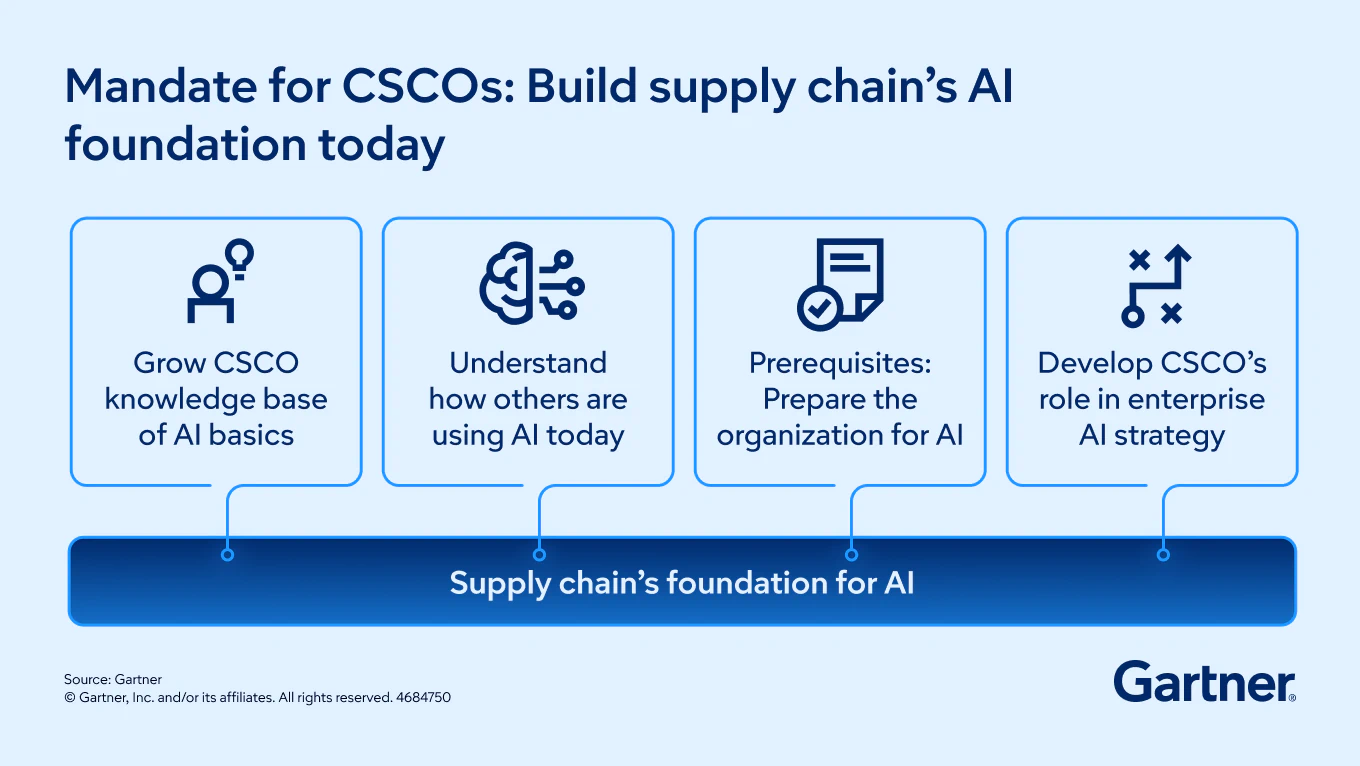
The Gartner perspective? To establish a supply chain AI foundation, CSCOs should focus on four priorities: Expand their AI expertise, learn from industry leaders, assess organizational AI readiness and advance their role in enterprise AI strategy.
How to build supply chain’s AI foundation: Four essential actions
Grow CSCO knowledge base of AI basics. Invest time in learning core AI concepts, terminology and use cases. Build foundational understanding to lead confidently and make informed decisions.
Understand how others are using AI today. Study peer organizations and industry leaders to see how supply chain AI is being applied. Identify proven approaches, lessons learned and potential pitfalls.
Prerequisites: Prepare the organization for AI. Assess readiness by addressing gaps in data, talent and governance. Establish frameworks, clarify roles and ensure your supply chain is equipped for AI adoption.
- Develop CSCO’s role in enterprise AI strategy. Position the CSCO as a key architect of enterprise AI. Shape business models, embed supply chain priorities in digital strategy and champion ethical governance.
What “good” looks like in global supply chains
Leaders who excel at supply chain AI:
Drive higher performance and reliability through faster response times, accurate diagnostics and reduced downtime.
Enhance customer satisfaction and workforce agility with improved order fulfillment, streamlined processes and reduced training needs.
Achieve substantial cost savings and operational efficiency across the supply chain.*
*Gartner clients have exclusive access to use cases demonstrating these outcomes with CSCO Playbook: Building Supply Chain’s Foundation for AI.
How to start building a supply chain AI foundation
Assess your AI maturity using frameworks like Gartner’s AI Maturity Model.
Secure master data ownership and treat data as a P&L-level asset.
Implement hybrid governance, centralized policy-setting with decentralized management.
Upskill leaders and teams on AI foundations, value, engineering and governance.
Build multidisciplinary teams, centers of excellence and communities of practice.
Institutionalize ethical governance and measure adoption and outcomes.
What to do next to architect the AI-driven supply chain
By virtue of its rich data assets and highly repeatable processes, the supply chain is inevitably moving toward an AI-driven future. Leading CSCOs will pursue a two-pronged approach by delivering AI-enabled value today through narrow, practical use cases while also building the blueprints that establish the foundations for tomorrow’s AI-driven supply chain. This is critical to delivering on the mission-critical priority of architecting the AI-driven supply chain.
The steps in that journey include:
Becoming part of the enterprise‑level AI conversation by overcoming peers’ underestimation of supply chain’s strategic role through increased AI literacy, stronger cross‑functional competencies and partnerships that drive joint‑win deployments.
Building a supply chain AI roadmap that balances long‑term transformation and near‑term ROI by assessing AI maturity, identifying and prioritizing use cases, anticipating risks and aligning investments to measurable outcomes.
Building an AI‑ready workforce by preparing leaders and frontline teams for the uneven impact of AI across functions, redesigning workflows, roles and organizational structures, and linking upskilling, hiring and partnering to supply chain business needs.
Developing an AI‑enabled trading partner ecosystem through shared data frameworks, integrated workflows and transparent governance that supports trust, collaboration and joint value creation across the end‑to‑end network.
Enabling AI‑driven workflow and process change by understanding how AI transforms business processes, decision making and operating models through decision augmentation and automation.
Establishing a robust data foundation for AI by applying AI‑powered tools to improve data quality, adopting modern architectures such as lakehouses and data fabrics, and using natural language interfaces to accelerate insight generation and decision support.
Reconciling the desired AI future state with the existing supply chain technology stack by defining integration strategies, evaluating vendor capabilities and making informed build‑versus‑buy decisions across plan, source, make and deliver.
Supply chain AI FAQs
What are the first steps for CSCOs to build a supply chain AI foundation?
Start by assessing AI maturity, preparing data, upskilling talent and aligning supply chain AI strategy with enterprise goals.
How should CSCOs prepare supply chain data for AI?
Secure master data ownership, implement hybrid governance, focus on data quality and accessibility and ensure compliance with ethical and regulatory standards.
How can CSCOs address talent challenges in a supply chain AI environment?
Incentivize employees to grow with AI, preserve talent, foster human-AI symbiosis and build multidisciplinary teams for governance and execution.
Attend a Conference
Experience Supply Chain conferences
With exclusive insights from Gartner analysts on the latest trends, sessions curated for your role and unmatched peer networking, Gartner conferences help you accelerate your priorities.
3 – 5 May 2027
Gartner Supply Chain Symposium/Xpo™
Orlando, FL

Drive stronger performance on your mission-critical priorities.