By Sam Berndt | November 29, 2024
![[ALT TEXT]](https://emt.gartnerweb.com/ngw/globalassets/en/supply-chain/blog/beyond-supply-chain/images/beyond-supply-chain-genai-pradox-november.jpg)

Robots in Your RACI
March 13 2026


By Sam Berndt | November 29, 2024
If there’s one thing my friends and family know me for, it’s my fixation on creating and tracking new year’s resolutions. One year I actually had 52 — one for each week of the year — and did pretty well keeping most of them (though I’ll confess that flossing every single day still eludes me). So, it’s true to form for me to get a bit reflective now that we’re coming up on another annual milestone — November 30, 2024, the two-year anniversary of ChatGPT’s public release.
While generative AI (GenAI) is obviously much larger than a single chatbot, the public fascination with ChatGPT at its initial release kicked started this moment of massive enterprise interest, huge levels of budgetary spend and fundamental changes in the supply chain vendor landscape. So, as we close out another year defined by GenAI hype, it’s worth taking a step back and asking ourselves: “Did we achieve what we set out to, and what should we hope for in the year ahead?”
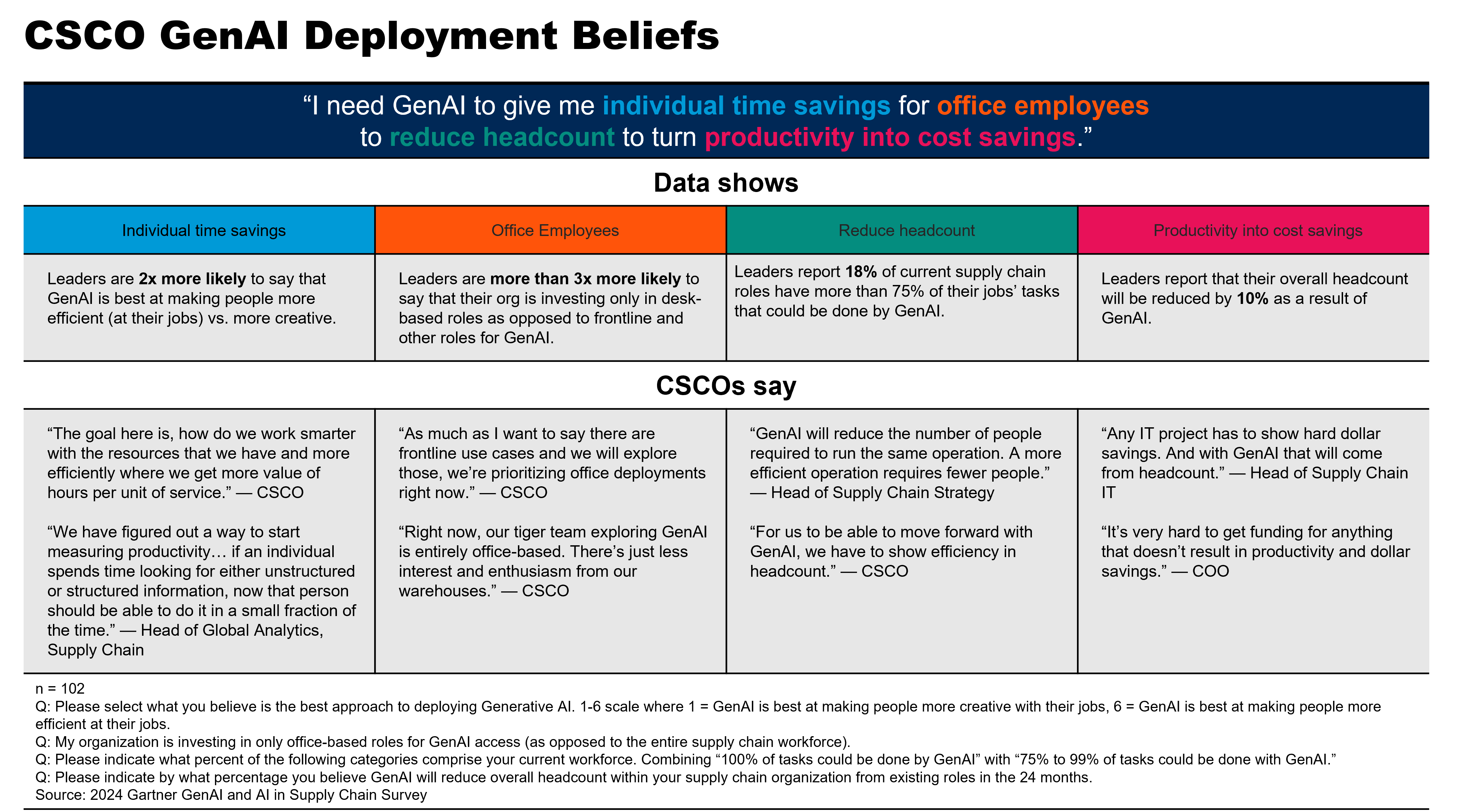
In preparation for 2024’s planning cycle, we asked CSCOs what benefits they expected to get from their GenAI investments. The #1 expected benefit was a 20% increase in productivity, analogous to time savings for most CSCOs discussing GenAI. So, how did we do?
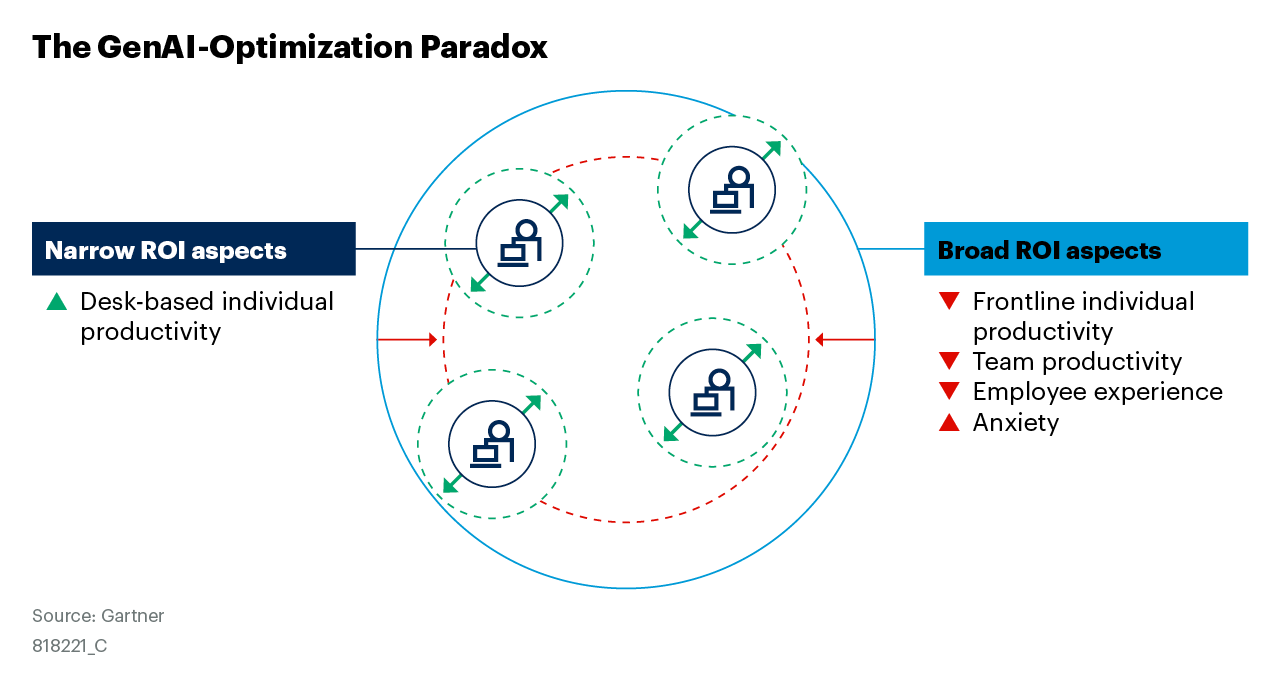
Our research shows CSCOs are on their way but have a rough road ahead. The average individual contributor in supply chain reports that GenAI tools saved them about four hours a week (or 10% of a 40-hour work week)1. However, that average hides a lot of unpleasant noise in the findings; we see employees reporting high levels of anxiety about GenAI and declining employee experience. Individual time savings also aren’t aggregating at the team level, nor are they equal across employee segments. In short, the whole is less than the sum of the parts.
We call this situation an optimization paradox: the more an organization optimizes their GenAI deployments towards making desk-based individual contributors faster at their current job, the worse things become. This is the equivalent of having a resolution to get to the gym more, but never making it beyond the smoothie bar at the front. The point of the goal was to improve your overall fitness, not just go to the location.
AI, GenAI and any technology needs to be deployed in a way that works for your organization instead of trying to replace it. In our research interviews on the topic, I see too many leaders trying to draw the connection between productivity and cost savings (often through headcount reductions). This makes AI a threat to their people, not an enhancement.
This attitude drives our optimization paradox. GenAI is a technology that will continue to evolve, likely impacting how we work in surprising ways yet to be seen. As such, our 2025 resolution should be to deploy this technology in a way that makes people feel comfortable and supported, not replaceable.
However, you may ask: doesn’t that ignore the reality that we all have productivity and ROI metrics to meet?
Our latest GenAI research — captured in Supply Chain Executive Report: The GenAI Productivity Paradox (subscription required) — not only demonstrates what this approach might look like, but further proves that it delivers greater and more sustainable productivity results than the typical “race to the bottom” between employees and GenAI. So here’s to a 2025 in which GenAI truly augments and enhances our people, and helps us deliver on bold productivity expectations.
You can also listen to our podcast on the topic on Gartner.com, Apple Podcasts and Spotify.
Sam Berndt
Sr Director, Research
Gartner Supply Chain
sam.berndt@gartner.com
1. 2024 Gartner GenAI and AI in Supply Chain Survey. Q7 – “Thinking about the below tools or deployments you use, how did they impact the number of hours of work it takes to complete your tasks in a typical week, compared to when you did not have these tools?”. N=157 individual contributors.
Download toolkit: Impact of Generative AI on Supply Chain
Beyond Supply Chain
Subscribe on LinkedIn to receive the biweekly Beyond Supply Chain newsletter.