AI literacy — a result of employee skills, trust and real-world use — is the missing link between AI hype and real business value.
- Gartner client? Log in for personalized search results.
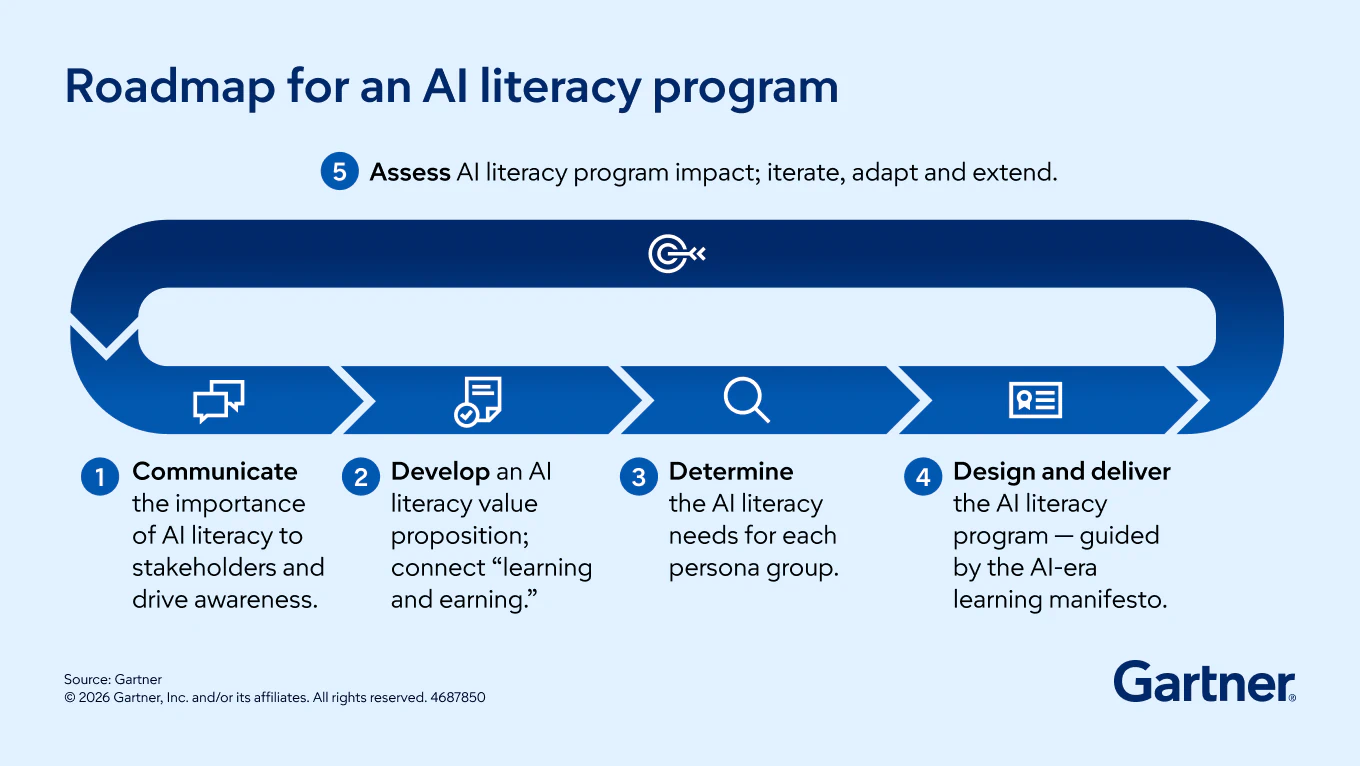
AI literacy gaps block ROI and stall enterprise AI progress
Most organizations fall short of their AI ROI goals because employees lack the skills to use AI effectively. Only 30% of executive and AI leaders say their CEOs praise AI investment returns. The disconnect is clear — 81% of CIOs say GenAI skill gaps will block their 2025 objectives, while 63% of employees haven’t used GenAI in critical tasks.
You can’t unlock AI’s business value with a workforce that doesn’t know how to use AI responsibly, understand its risks and connect it to business outcomes. Compounding the problem, AI literacy programs often are too theoretical, ignore change management, overlook employee fears and fail to link learning to results.
Five steps to use AI literacy to drive real business outcomes
A strong AI literacy program is iterative, outcome-driven and role-based. Here’s how to build one that works.
Step 1. Communicate the importance of AI literacy.
Start with a compelling case for AI literacy. Frame benefits for each stakeholder — from the board to frontline employees. Secure buy-in by showing how AI literacy fuels scalable deployment, strategic impact, value creation, democratization and responsible use. Use targeted messaging to win approval, funding and staffing.
Step 2. Develop an AI literacy value proposition.
Tie “learning to earning.” Design learning narratives for each employee persona, co-created with business managers, HR and change leaders. Link every learning activity to high-value AI use cases and business outcomes. An AI literacy program succeeds when employees see how new skills drive real results.
Step 3. Determine AI literacy needs for each persona group.
One-size-fits-all doesn’t work. Assess current literacy for each role — executives, business experts, AI specialists and end users. Identify skill gaps tied to the organization’s value proposition. Build learning experiences around core categories, with depth matched to each group’s needs.
Step 4. Design and deliver the program.
To keep pace with AI’s rapid change, use agile learning methods: 10% formal training, 20% social learning (communities of practice) and 70% on-the-job experience (coaching, hackathons, real-world projects). Combine these to quickly build and retain skills that drive strategic outcomes.
Step 5. Iterate, adapt and extend based on impact.
Review your roadmap regularly. Assess stakeholder priorities, emerging use cases, skill gaps and effectiveness of training, social learning and on-the-job application. Adapt to business shifts, risks, regulations and technical advances. Staying aligned with enterprise goals builds a workforce that can responsibly and effectively leverage AI for strategic impact.
What to do next to build the AI-human workforce
AI is fundamentally changing how work gets done, requiring CIOs to lead the evolution from a human‑only workforce to an integrated human‑AI labor model that delivers sustained business value. This is critical to delivering on the mission-critical priority of building a human‑AI workforce that aligns technology, talent and operating models with enterprise strategy.
The steps in that journey include:
Defining an AI‑driven talent strategy by aligning vision, goals, transformation pace and success metrics for the human‑AI workforce with business and stakeholder priorities, and securing cross‑functional leadership buy‑in to drive accountability and enterprise engagement.
Assessing the future readiness of the workforce, evaluating current skills, capability gaps and change readiness using continuous feedback and external benchmarks to inform targeted talent investments.
Designing the organizational balance of technology and human resources, developing future team structures, operating models, processes and governance that effectively integrate AI, human capabilities and external partners while addressing ethical, legal and risk considerations.
Scaling human readiness for AI, implementing upskilling, reskilling and change management programs that foster trust, transparency and adoption, and building a culture of continuous learning across all levels of the organization.
- Evolving human‑AI labor force agility, monitoring and refining workforce strategies through data‑driven insights, adaptive governance and continuous improvement to ensure ongoing alignment with enterprise goals and advancing AI capabilities.
AI literacy FAQs
Why is AI literacy critical for ROI from AI investments?
Gartner business and technology insights show less than 30% of executive and AI leaders report CEO satisfaction with AI ROI. The main barrier? Employees lack the skills to use AI effectively. Without AI literacy, organizations can’t scale AI, drive value nor meet strategic goals. Closing skill gaps is essential to realizing returns on your AI investments.
How can CIOs tailor AI literacy programs for different roles?
Gartner recommends assessing current literacy for each group — executives, business experts, AI specialists and end users. Identify unique skill gaps and design targeted learning experiences. One-size-fits-all programs miss the mark. Appropriate customization ensures every role gets the right depth of training to drive adoption and outcomes.
What’s the best way to measure the success of an AI literacy program?
Measure business outcomes, not just completion rates. Gartner recommends linking learning activities to high-value use cases and strategic goals. Regularly assess skill gaps, stakeholder priorities and program effectiveness. Adapt your approach as business needs and technology evolve.
Attend a Conference
Experience Information Technology conferences
With exclusive insights from Gartner experts on the latest trends, sessions curated for your role and unmatched peer networking, Gartner conferences help you accelerate your priorities.
21 – 23 Sep 2026
Gartner CIO & IT Executive Conference
São Paulo, Brasil

Drive stronger performance on your mission-critical priorities.