CIOs: Lead the shift to an agile, AI-ready workforce that drives enterprise resilience and value.
- Gartner client? Log in for personalized search results.
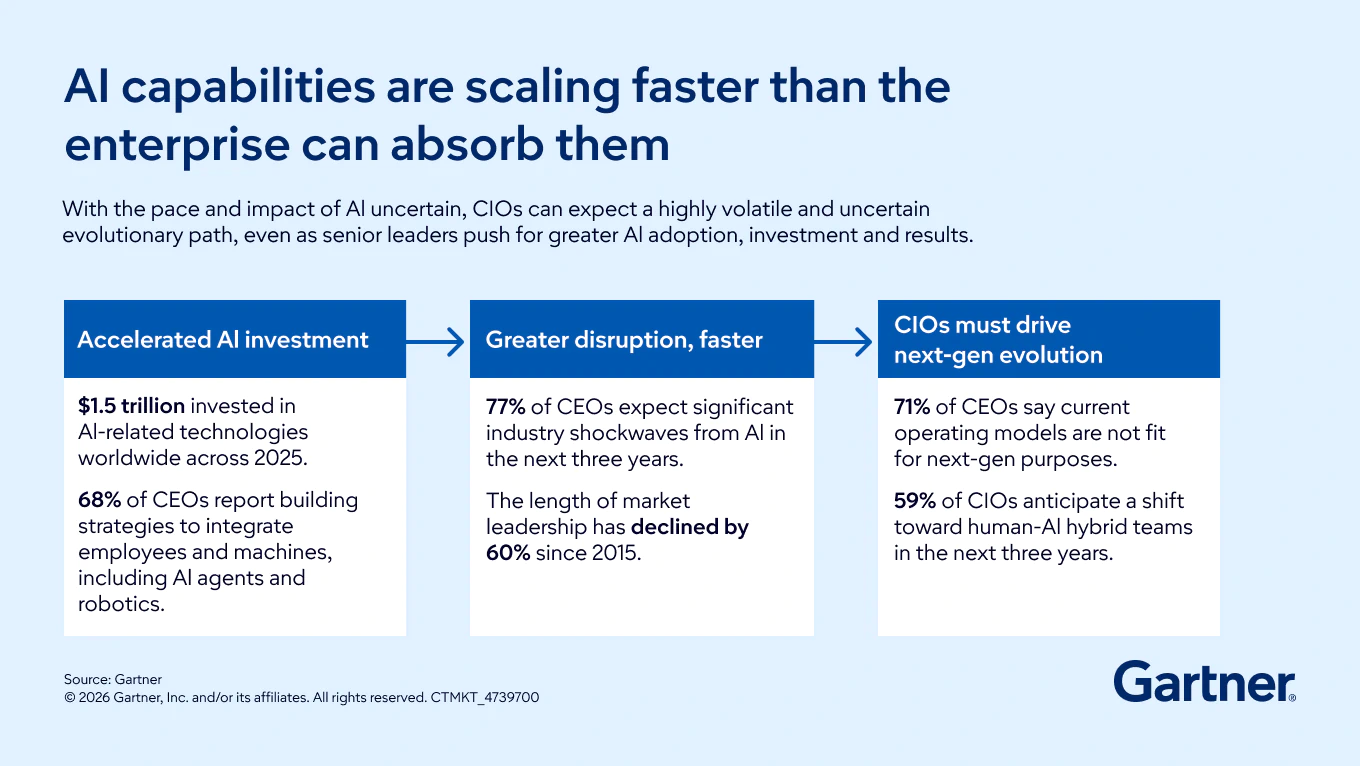
AI is moving fast but workforce agility is falling behind
AI ambitions are accelerating at the top, but the workforce is struggling to keep pace. While CEOs are investing heavily in AI and expecting major industry disruption, execution gaps in skills and talent are becoming increasingly visible. CIOs must bridge this gap by aligning leadership, investing in both people and technology, and fostering trust throughout the organization.
Shift focus from automation to expanding workforce potential
AI has moved from hype to reality, fundamentally reshaping how work gets done. Already, Gartner insights find that 24% of enterprises have scaled AI across multiple business units, and the share of technology work managed by AI agents is expected to nearly triple from 3% to 8% in just three years. With 88% of CEOs increasing AI investments and 79% anticipating significant industry transformation within the next three years, CIOs are under pressure to embed AI into core business processes.
Gartner insights show that as AI autonomy grows, an increasing amount of the IT work done today can be delegated to AI. CIOs must reframe the conversation; rather than asking what work AI can take away, they should lead the exploration of what new possibilities AI unlocks for their human workforce. This shift moves the focus from automation to capacity creation, enabling organizations to pursue opportunities that were previously out of reach.
3 essential actions for CIOs
1. Reallocate capacity
As AI takes on more routine work, CIOs must ensure the resulting capacity is channeled toward high-value activities. As CIOs shift to human-AI blended teams, it’s critical to partner with HR and finance to measure, govern and strategically invest this new capacity in innovation and growth, rather than simply filling time with more tasks.
2. Foster emotional adaptation
The transition to an AI-augmented workforce brings both excitement and anxiety. Gartner insights show that nearly 90% of employees are willing to adapt to new ways of working, if they trust how change is managed. CIOs need to prioritize transparent communication and upskilling, building trust and resilience so employees feel confident navigating AI-driven change.
3. Redesign work
Gartner finds that over half of CIOs report feeling pressured because the speed at which new skills are needed is outpacing the available talent, making workforce readiness a major bottleneck. CIOs must reimagine work, rethink job roles and redesign the flow of work between humans and AI, emphasizing innovation, problem-solving and meaningful connection, and ensuring employees see a valuable future for themselves in the organization.
What “good” looks like in large enterprises
Leaders who excel at building a human-AI workforce:
- Develop teams that are adaptable, innovative and skilled in both technology and soft skills.
- Create future-focused career paths that motivate and retain top talent.
- Strengthen internal talent pipelines to ensure ongoing workforce readiness.
- Help employees find meaningful roles and purpose in an AI-augmented environment.
- Identify the common, portable capabilities that can weave across jobs, and enable IT employees to adapt as work and jobs change.
- Build an internal mobility strategy around versatile capability portfolios.
How to get started
Assess your workforce’s AI readiness and trust dynamics.
Define a shared measurement model for capacity created by AI.
Partner across HR and finance to govern capacity and talent development.
Upskill leaders and teams in AI fluency, adaptability and emotional resilience.
Redesign work and jobs to preserve optionality across a wide range of possible AI futures.
Invest in future career portfolios and a robust internal talent pipeline.
Continuously diagnose bottlenecks and adapt strategies to unlock each stage of transformation.
What to do next to build the human-AI workforce
AI is fundamentally changing how work gets done, requiring CIOs to lead the evolution from a human‑only workforce to an integrated human‑AI labor model that delivers sustained business value. This is important to deliver on the mission-critical priority of building a human‑AI workforce that aligns technology, talent and operating models with enterprise strategy.
The steps in that journey include:
Defining an AI‑driven talent strategy by aligning vision, goals, transformation pace and success metrics for the human‑AI workforce with business and stakeholder priorities, and securing cross‑functional leadership buy‑in to drive accountability and enterprise engagement.
Assessing the future readiness of the workforce, evaluating current skills, capability gaps and change readiness, using continuous feedback and external benchmarks to inform targeted talent investments.
Designing the organizational balance of technology and human resources, developing future team structures, operating models, processes and governance that effectively integrate AI, human capabilities and external partners while addressing ethical, legal and risk considerations.
Scaling human readiness for AI, implementing upskilling, reskilling and change management programs that foster trust, transparency and adoption, and build a culture of continuous learning across all levels of the organization.
Evolving human‑AI labor force agility, monitoring and refining workforce strategies through data‑driven insights, adaptive governance and continuous improvement to ensure ongoing alignment with enterprise goals and advancing AI capabilities.
Recommended resources for Gartner clients*
*Note that some documents may not be available to all Gartner clients.
Human-AI workforce FAQs
What are the first steps for CIOs to build a human-AI workforce?
Start by assessing workforce AI readiness, building trust, upskilling talent and aligning human-AI strategy with enterprise goals.
How should CIOs prepare employees for AI-driven change?
Decide your human foundation. Focus on enduring sources of workforce value in an unpredictable AI future. Focus on clear communication, upskilling, emotional adaptation and building trust in leadership and the change process.
How can CIOs address talent challenges in a human-AI environment?
Develop future career portfolios, revamp the employee value proposition, and invest in both technical and soft skills such as adaptability, innovation and resilience.
Attend a Conference
Experience Information Technology conferences
With exclusive insights from Gartner experts on the latest trends, sessions curated for your role and unmatched peer networking, Gartner conferences help you accelerate your priorities.
21 – 23 Sep 2026
Gartner CIO & IT Executive Conference
São Paulo, Brasil

Drive stronger performance on your mission-critical priorities.