Find out how CIOs outperform by mastering these five proven AI practices.
- Gartner client? Log in for personalized search results.
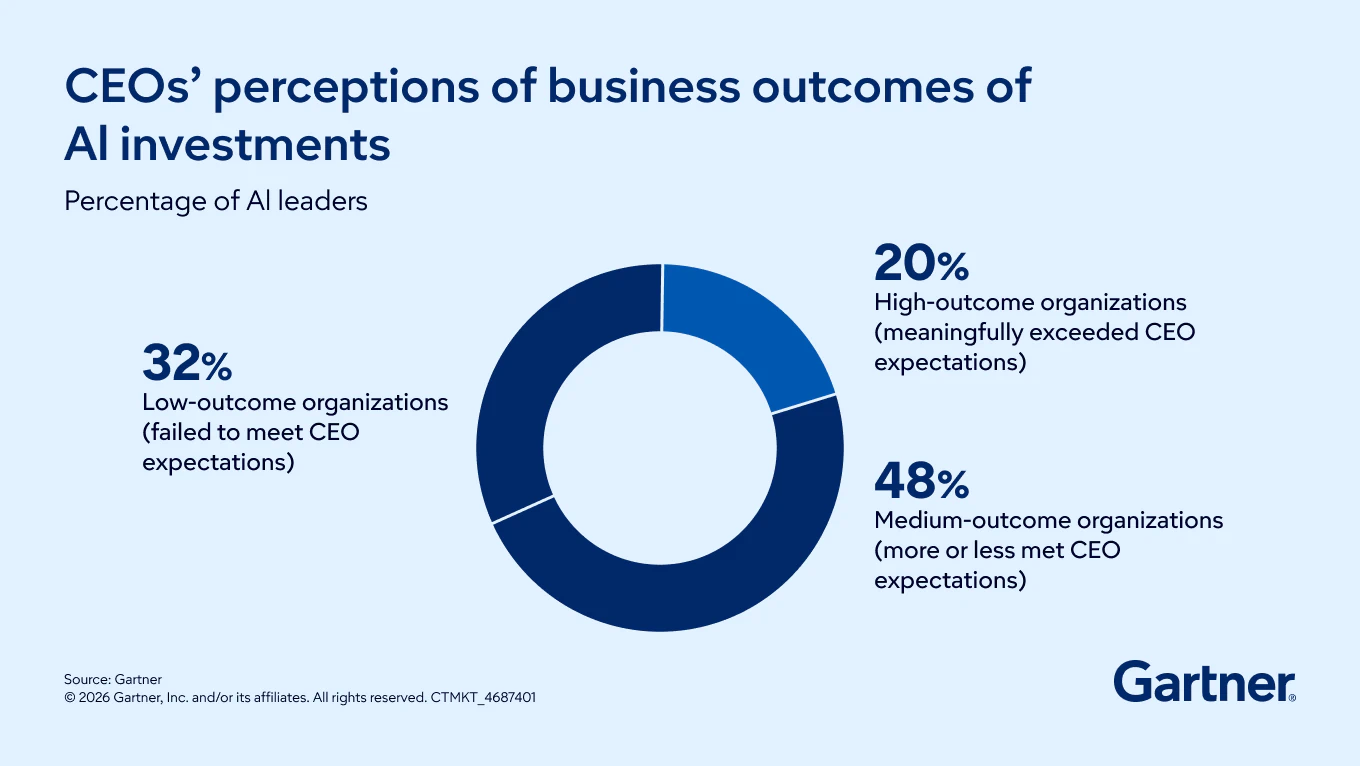
High AI outcomes demand CIO-led strategy and trust
According to Gartner, only 20% of organizations surpass their CEOs’ expectations for AI outcomes. CIOs in this group excel by embedding AI strategy across the enterprise, structuring dedicated teams, fostering business trust, and implementing robust metrics and portfolio management to track and maximize value.
As CEOs and boards increasingly expect AI investments to produce tangible value for the enterprise, use the opportunity to take ownership of AI strategy and cultivate trust throughout the business. This positions the organization to exceed executive expectations and use AI for competitive advantage.
5 practices to drive strong AI outcomes
As a CIO, you can strengthen your organization’s AI capabilities to realize key business outcomes, including revenue growth, human capital effectiveness, customer experience, risk mitigation, asset utilization and cost reduction.
Practice No. 1: Integrate AI strategy across every business unit.
Three in five organizations that have meaningfully exceeded the CEO’s expectations for business outcomes of their AI initiatives have an integrated enterprisewide AI strategy. Foster this integration by prioritizing workforce AI literacy, managing AI-driven change and ensuring your AI roadmap aligns with business goals.
Practice No. 2: Build and manage dedicated, cross-functional AI teams.
Half of high-outcome organizations orchestrate a managed network of dedicated AI teams. These teams span business, technical and functional units, ensuring tight collaboration and strategic focus. As CIO, you can champion fusion teams, upskill for AI engineering and adopt a product-centric approach to delivery.
Practice No. 3: Build your business unit’s trust in the technology.
Sixty-nine percent of high-outcome organizations report that their business units trust and are ready to use AI technology. As CIO, you have the opportunity to be intentional about transparent communication, garner C-suite support, and drive collaboration between business and IT teams to identify meaningful change that AI can bring to the business and the operating model, and also find key metrics to track.
Practice No. 4: Quantify AI benefits with robust, regular metrics.
Eighty-six percent of organizations that drive strong AI outcomes measure AI benefits often or always — 40 points higher than low performers. Establish clear success metrics, map AI value to business outcomes and create a portfolio based on business cases.
Practice No. 5: Leverage advanced portfolio management techniques.
Four in five high-outcome organizations use advanced portfolio management techniques, incorporating continuous improvement, innovation alignment and financial operations practices. Focus on curating a balanced AI portfolio, integrating AI FinOps for cost optimization and focusing on strategic portfolio management to effectively link strategy to execution to achieve superior business outcomes.
What to do next to accelerate enterprise AI value realization at scale
AI has moved from experimentation to execution, requiring CIOs to translate growing AI investments into tangible business outcomes at scale. As enterprises push beyond pilots, CIOs must act as value orchestrators — ensuring AI drives operational efficiency, unlocks new growth opportunities and improves profitability. That mandate marks the starting point of a broader journey CIOs must lead to fully deliver on the mission‑critical priority of accelerating enterprise AI value realization at scale.
The steps in that journey include:
Establishing a standardized AI use-case prioritization framework. Come up with clear criteria based on business value and feasibility; this helps CIOs consistently identify which AI opportunities to pursue, scale or stop — improving investment discipline.
Creating a high‑value AI portfolio aligned to business outcomes. This means building a balanced portfolio of AI initiatives that directly support financial and strategic goals, rather than a collection of disconnected experiments.
Defining and enforcing value metrics. CIOs must establish clear measures for ROI, cost savings and performance improvements, ensuring AI success is quantified, visible and tied to enterprise results.
Deploying, tracking and automating value capture. Shift from one‑off AI projects to a product‑centric mindset, emphasizing continuous deployment, performance tracking and automation to scale long‑term value.
Continuously refining AI solutions to maximize impact. Embed feedback loops into AI systems to improve performance over time, ensuring models evolve alongside business needs and deliver sustained value rather than one‑time gains.
For more on how Gartner helps drive success on this and other mission‑critical priorities for CIOs, speak to us today.
AI outcomes FAQs
What’s the most important practice for CIOs seeking high AI outcomes?
Widespread participation in realizing AI strategy is essential. Gartner business and technology insights show that embedding AI strategy across units ensures relevance and engagement and supports strong AI outcomes. As CIO, you make this integration possible, setting the foundation for superior results.
How can CIOs build trust in AI across the business?
Gartner recommends explicit communication, trust measurement frameworks and C-suite alignment to support confident use of AI across business units. CIOs can lead intentional efforts to build AI readiness, understanding and leadership buy-in.
Why is portfolio management critical for CIOs overseeing AI?
Advanced portfolio management aligns AI initiatives with strategy, drives continuous improvement and optimizes costs. Gartner highlights the need to balance value, feasibility and risk while enforcing financial discipline.
Attend a Conference
Accelerate growth with Gartner conferences
Gain exclusive insights on the latest trends, receive one-on-one guidance from a Gartner analyst, network with a community of your peers and leave ready to tackle your mission-critical priorities.

Drive stronger performance on your mission-critical priorities.