Streamline operations and drive business impact with a unified automation architecture based on the ADOPT principle.
- Gartner client? Log in for personalized search results.


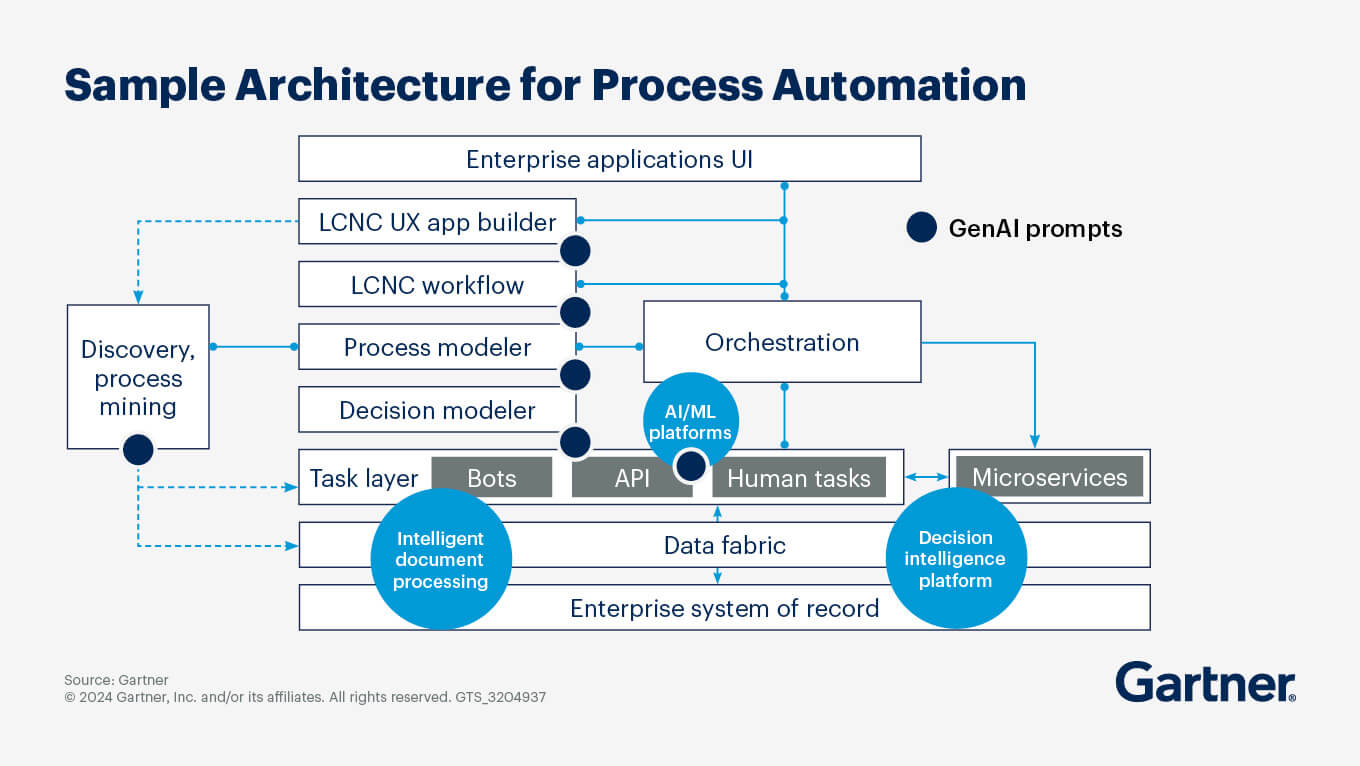
Focus process automation efforts on unification
Many enterprises struggle with fragmented process automation and, as a result, find themselves applying technologies in isolation rather than integrating them into a unified architecture. This leads to low reuse of resources, poor integration, limited scalability and high maintenance costs.
Without a holistic strategy, process automation initiatives often fail to align with business objectives, limiting their potential to drive large-scale, meaningful impact. By adopting a unified automation architecture, application leaders can optimize their technologies for greater efficiency and scalability, while reinforcing their competitive advantage.
Process automation helps align business actions with business objectives
A successful process automation architecture intertwines with the business’s broader strategic imperatives. When the goal is to ensure that every business process propels mission-critical objectives forward, automation is the solution, and the ADOPT principle is the key to unlocking that solution.
Use the ADOPT principle to improve your process automation architecture
Gartner developed the ADOPT model to give business leaders a structured framework for building scalable, efficient process automation architectures. The five core principles are:
Abstraction: Break down complex processes into reusable components.
Discovery: Identify opportunities for automation across the organization.
Orchestration: Coordinate, standardize and manage workflows across platforms and teams.
Platform: Build a solid foundation for process automation, focusing on flexibility, security and scalability.
Tasks: Individualize your approach to task optimization, reusing established components whenever possible.
How to put the ADOPT principle into practice
There are four unique stages a process automation flow should follow based on core capabilities.
Define your process automation vision. Align your automation efforts with quantifiable business goals, such as improving customer experiences or enhancing overall operations.
Run pilot initiatives for quick wins. Start small and scale up after each success, beginning with the most high-impact projects that demonstrate proof of concept and provide immediate value.
Build a modular platform. Select the automation tools that you believe can best adapt and scale as your organization needs’ rise and fall.
Iterate and evolve. Foster a culture of continuous improvement, constantly refining your process automation architecture based on feedback and KPIs.
Understand what a unified process automation architecture is and isn’t
A unified process automation architecture is what you get when you connect an integrated framework with your automation tools and processes — a single system in which all parts seamlessly work together. It allows you to align your automation process flow with business goals and enables reuse and growth through a component-based task configuration.
A unified architecture is not, however, a collection of isolated automation initiatives that operate independently without coordination. A fragmented approach can lead to inefficiencies and higher costs.
This unified approach offers several key advantages:
Scalability: Trust in a single point of truth to more easily manage automations across departments and processes.
Cost savings: Reduce maintenance costs by reusing automation components across similar automation process flows.
Operational efficiency: Streamline workflows and enhance business processes with integrated automation tools.
Ease of innovation: Foster a culture of continuous growth and forward momentum by building a platform that simplifies self-improvement.
Overcome common challenges with process automation technology
Application leaders may run into trouble integrating legacy systems, managing siloed data and navigating conflicting business goals, all of which can cause delays or otherwise derail projects. Other times, the challenge might not even be technological; maybe an employee simply resists using the new tools or processes.
To overcome these hurdles, focus on continuous iteration and work to align your organization’s process automation architecture with its quantified needs. Help ensure that your automation efforts remain both scalable and cost-effective by creating a roadmap, prioritizing high-impact areas for automation and investing in training and communication to help teams embrace the new system.
Process automation FAQs
What are examples of process automation?
Common process automation examples include:
- Robotic process automation that streamlines repetitive tasks like data entry and invoice processing
- AI-powered chatbots that screen and resolve simple customer inquiries
- Supply chain automation for inventory management and order fulfillment
- Automated reporting that supports regulatory compliance
How does a unified process automation architecture benefit businesses?
A unified process automation architecture allows organizations to scale automation efforts, reduce costs, improve operational efficiency and innovate faster. It also enables the integration of new technologies, helps ensure alignment with business objectives and eases leaders along the path toward competitive advantage.
Attend a Conference
Experience Information Technology conferences
With exclusive insights from Gartner experts on the latest trends, sessions curated for your role and unmatched peer networking, Gartner conferences help you accelerate your priorities.
23 – 24 Feb 2026
Gartner CIO Leadership Forum
Phoenix, AZ

Drive stronger performance on your mission-critical priorities.