Stop talking tech; explain the strategic value of emerging technologies like AI to get business partners to buy in.
- Gartner client? Log in for personalized search results.
Why does technology value matter for CIOs?
CxOs understand the transformational impact that new and emerging technologies will have on the business, but they often struggle to relate the generic features and capabilities to the specific needs of their enterprise. CIOs who fail to connect technology benefits to positive business outcomes will find themselves with less budget to invest in emerging technology.
For example, 59% of CEOs believe that AI will be the technology that will most significantly impact their industry over the next three years, but more than half of CIOs think that all CxOs are novices in terms of AI knowledge.
This creates an opportunity for CIOs to educate CxOs on emerging technology value and partner with them to ensure they understand the benefits of technology investments and ultimately to shape the enterprise business strategy.
Show technology value and build support for investment
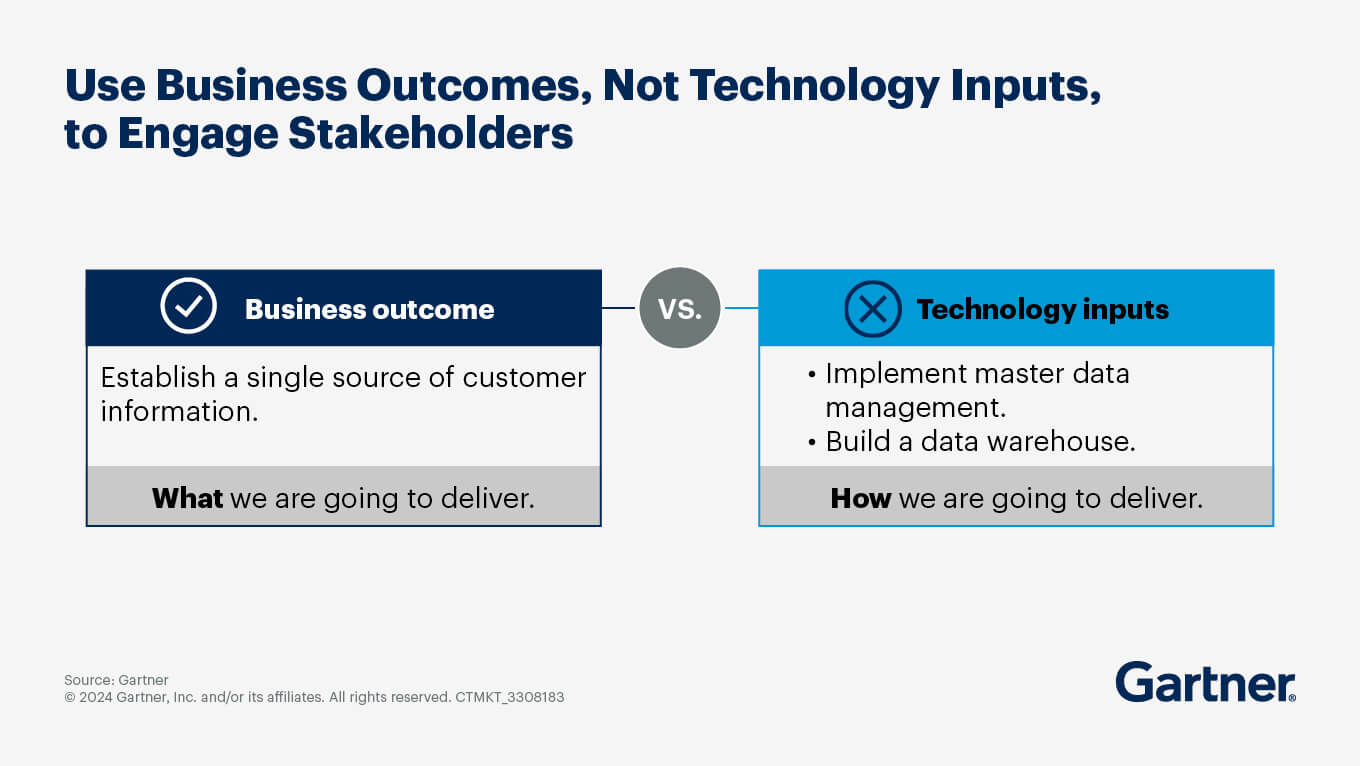
The most effective way for a CIO to gain support from CxO partners or stakeholders is to focus on business impact or outcomes. Non-IT stakeholders will rarely be interested in the technology inputs, which means IT organizations need to focus instead on the business value that the technology will deliver.
Clarify business-driven outcomes
It’s essential that these outcomes are described in nontechnical terms, avoiding references to specific technologies or vendors. Examples include:
Creating online learning modules for use in schools and colleges
Digitizing the account application process
Enabling online payments and reservations for in-store collection
Automating all payables and receivables processes
Enabling immersive digital sales experience for customer
When CIOs work with stakeholders to fully describe the business problem or opportunity, they can more easily define the desired outcome. This outcome should represent the change or improvement in the business capability that technology will enable. But they still need to effectively articulate the technology value in terms of how it will help the business.
Structure stakeholder interactions to highlight technology value
Three common errors CIOs make when presenting technology solutions to stakeholders are:
Focusing on the underlying technology, giving detailed explanations about how the technology works, how the solutions will be implemented and so on.
Assuming the audience understands the problem that needs to be addressed (or the opportunity that could be exploited).
Assuming the audience cares about the problem or opportunity or knows why it is relevant to them.
Regardless of whether the conversation occurs in a one-on-one meeting with a CxO, a broader meeting of stakeholders or a board presentation, use the opportunity to emphasize the business impact of technology and gain support for the solution. To do this:
Make it relevant: Connect the problem or opportunity to enterprise priorities. For example, in a commercial enterprise, growth is likely to be a strategic objective. Begin the interaction by stating that you want to talk about how technology can enable the enterprise to meet its growth targets. In situations where the enterprise strategy may not be clear, CIOs can ensure relevance by connecting to revenue (or mission for the public sector), cost or risk.
Define the problem/opportunity: It is virtually impossible to sell a solution to someone who does not understand or even recognize the problem or opportunity being addressed. Often, when a CIO encounters resistance to or a lack of interest in a proposed solution, it is because the audience:
- Is not aware of the problem (hence, why any solution is required)
- Does not understand what is causing the problem (hence, how it can be solved)
- Does not understand the business impact of the problem (hence, whether the required investment is appropriate)
To avoid any of these situations, spend time ensuring a shared understanding of the problem or opportunity before explaining the solution.
Describe the outcomes: Having established the relevance to their audience and created a shared understanding of the problem or opportunity at hand, the CIO has earned the right to talk about the solution. However, this does not mean providing a detailed technical explanation but rather outlining the solution, then focusing on the business outcomes and impact the technology solution will deliver.
Are you a CIO or IT leader at a midsize enterprise?
See how your peers are navigating AI adoption, vendor decisions and evolving business demands — with tools tailored to your role:
Explore our resources for midsize enterprises
Check out a curated list of Gartner’s most popular research being utilized by your peers
Technology value FAQs
What strategies can help CIOs gain CxO support for technology investments?
CIOs can gain CxO support by showing business value, which is to say aligning technology investments with business outcomes, presenting solutions in nontechnical terms, and focusing on revenue, cost or risk impact.
How can CIOs make emerging technology relevant to business leaders?
CIOs should connect new technologies to enterprise priorities, like growth or cost management, and frame the discussion in terms that resonate with non-technical stakeholders.
What are the biggest challenges CIOs face when presenting technology solutions to the board?
CIOs often struggle with assumptions about stakeholder knowledge, focus on technical details over business impact, and address solutions without explaining the underlying problem.
Attend a Conference
Experience CIO and IT Executive conferences
With exclusive insights from Gartner analysts on the latest trends, sessions curated for your role and unmatched peer networking, Gartner conferences help you accelerate your priorities.
22 – 23 Feb 2027
Gartner CIO Leadership Forum
Phoenix, AZ

Drive stronger performance on your mission-critical priorities.