Gartner predicts that by 2028, 45% of CIOs will lead AI agent systems outside IT, becoming true co-architects of enterprise work resource models. Move first to set benchmarks and capture value.
- Gartner client? Log in for personalized search results.
![[ALT TEXT]](https://emt.gartnerweb.com/ngw/globalassets/en/chief-information-officer/images/infographics/who-belongs-on-the-ai-agent-layer-council.webp)
The AI agent layer is the new frontier for CIOs
The AI agent layer, made up of AI agents and multiagent systems, will rapidly shift how work gets done and who does it, giving CIOs a rare opportunity to redefine their influence. Gartner business and technology insights show CIOs who proactively lead AI agent deployment with their C-suite peers unlock outsize value and strategic influence across business functions.
Hesitate, and you risk a fragmented, unmanaged landscape. Siloed AI agent deployments can expose the enterprise to regulatory penalties, reputational damage and lost ROI. The stakes are high — act now or cede ground to less coordinated efforts.
Build the right AI agent layer council to avoid failure
You need more than IT muscle. Success hinges on forming an AI agent layer council with the right C-suite partners.
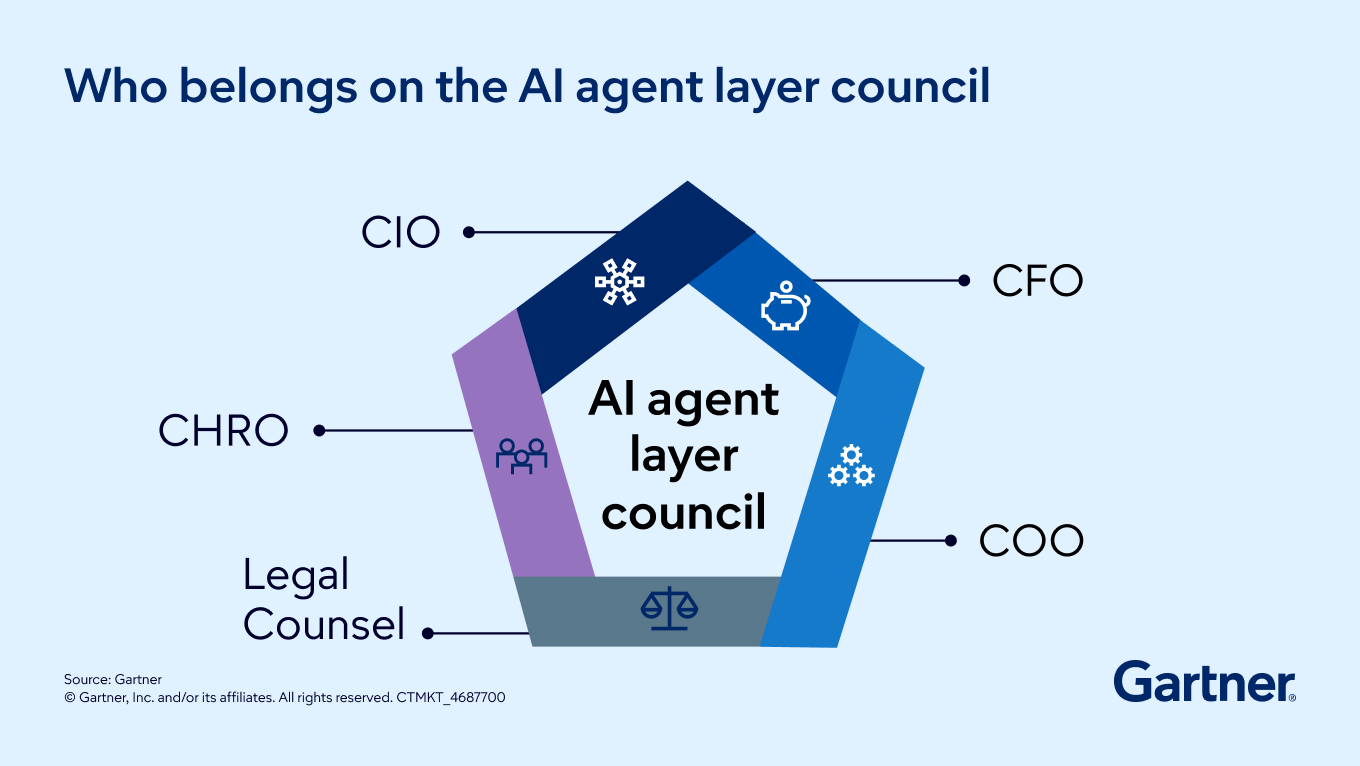
Stack the AI agent layer council with five CxOs
Gartner finds the most effective councils are co-led by the CIO, CFO, COO, CHRO and the general counsel. Each plays a distinct role:
CIOs set standards and harmonize deployments.
CFOs drive cost transparency and optimization.
COOs ensure business outcomes are baselined and improved.
CHROs manage workforce change.
General counsel adapt risk and liability models.
This council setup prevents turf wars, aligns incentives and keeps AI agent deployment on track.
Define clear accountability and shared liability
Don’t let accountability blur. Establish a board-approved RACI for the AI agent layer. Document who controls what, shift risk to capability owners with predeployment gates and require IP indemnity from vendors. Update contracts to include audit rights, provenance tracking and safeguards to cap liability.
These steps mirror major regulatory frameworks, including the EU AI Act and the U.S. National Institute of Standards and Technology’s AI Risk Management Framework (NIST AI RMF), to help organizations identify, assess and manage risks associated with AI systems.
Track outcomes, not just adoption
Use outcome-driven metrics (ODMs) by department — like cost per resolved claim, percentage increase in finalized policies and behavioral improvements such as reducing drudgery. Gartner insights show that tracking legal/risk metrics (such as overrides per 1,000 decisions, vendor indemnity rates and incident reports) is essential for defensible, value-focused AI agent deployment.
Make time for workforce learning
Proactively co-lead the job redesign effort with the CHRO. Lower the barrier to entry by upskilling IT service desk associates to become digital coaches, and measure the behavioral outcomes that matter such as employee engagement and AI overdependence rather than just AI adoption.
What to do next to accelerate enterprise AI value realization at scale
AI has moved from experimentation to execution, requiring CIOs to translate growing AI investments into tangible business outcomes at scale. As enterprises push beyond pilots, CIOs must act as value orchestrators — ensuring AI drives operational efficiency, unlocks new growth opportunities and improves profitability. That mandate marks the starting point of a broader journey CIOs must lead to fully deliver on the mission‑critical priority of accelerating enterprise AI value realization at scale.
The steps in that journey include:
Establishing a standardized AI use case prioritization framework. Clear criteria based on business value and feasibility help CIOs consistently identify which AI opportunities to pursue, scale or stop — improving investment discipline.
Creating a high‑value AI portfolio aligned to business outcomes. This means building a balanced portfolio of AI initiatives that directly supports financial and strategic goals, rather than a collection of disconnected experiments.
Defining and enforcing value metrics. CIOs must establish clear measures for ROI, cost savings and performance improvements, ensuring AI success is quantified, visible and tied to enterprise results.
Deploying, tracking and automating value capture. Shift from one‑off AI projects to a product‑centric mindset, emphasizing continuous deployment, performance tracking and automation to scale long‑term value.
Continuously refining AI solutions to maximize impact. Embed feedback loops into AI systems to improve performance over time, ensuring models evolve alongside business needs and deliver sustained value rather than one‑time gains.
For more on how Gartner helps drive success on this and other mission‑critical priorities for CIOs, speak to us today.
AI agent layer FAQs
What is the AI agent layer and why does it matter for CIOs?
The AI agent layer refers to the combined deployment of AI agents and multiagent systems that automate and orchestrate enterprise tasks. Gartner finds that CIOs who lead this layer can unlock strategic value, improve agility and avoid fragmented, high-risk deployments.
How should CIOs structure governance for the AI agent layer?
Gartner recommends forming a council inclusive of the CIO, CFO, COO, CHRO and the general counsel. This group sets standards, tracks accountability, manages risk and ensures alignment with frameworks like NIST AI RMF and the EU AI Act.
What metrics should CIOs use to measure AI agent layer success?
Use outcome-driven metrics such as cost per resolved claim, percentage of finalized policies and behavioral outcomes. Track legal/risk indicators — like overrides per 1,000 decisions and vendor indemnity rates — to ensure defensible, value-focused deployment.
Attend a Conference
Accelerate growth with Gartner conferences
Gain exclusive insights on the latest trends, receive one-on-one guidance from a Gartner analyst, network with a community of your peers and leave ready to tackle your mission-critical priorities.

Drive stronger performance on your mission-critical priorities.