Organizations often treat AI as a technology investment but ignore the talent risks.
- Gartner client? Log in for personalized search results.
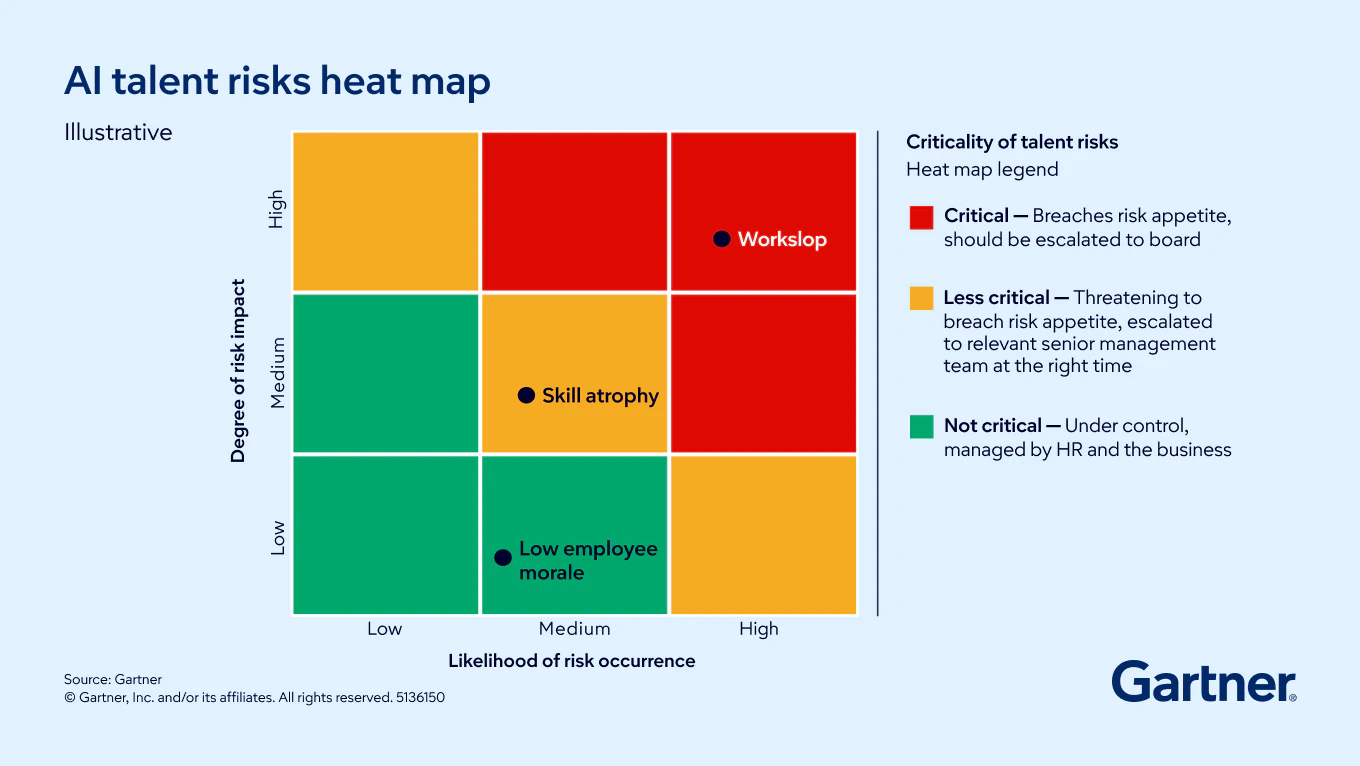
Organizations often underestimate AI talent risks
AI investment has accelerated in 2026, bringing the role of the CHRO in AI adoption into sharper focus. According to Gartner, 76% of CEOs expect AI to have the greatest impact on their industries within the next three years, prompting organizations to move quickly to capture value from their AI investments.
But technology deployment alone will not determine whether those investments will succeed. “Deploying AI to an unprepared workforce squanders investment and stalls adoption,” says Shayla Combs, Principal Analyst at Gartner. As AI transforms how work gets done, talent risk management becomes a critical driver of business outcomes.
AI creates workforce risks that technology alone cannot solve
“This is a career-defining moment for CHROs. Those who act decisively can transform their organization’s AI trajectory,” says Brent Cassell, Vice President Analyst at Gartner. As organizations scale AI initiatives, it’s the CHRO’s responsibility to identify, measure and mitigate the new talent risks AI introduces. AI changes how work gets done, introducing new workforce risks that can affect productivity, talent development, culture and business performance.
Align talent risk priorities with AI ambitions
Not every AI talent risk carries the same weight. The most effective CHROs focus on the workforce challenges most closely tied to their organization’s AI ambitions. Gartner identifies three broad ways AI can reshape work — augment work, reengineer work and invent new ways of working — each of which creates distinct workforce risks.
Augment work: Low employee morale, proliferation of workslop, bias amplification
Reengineer work: Skill atrophy, restrained entry-level hiring, disrupted succession pipelines
Invent new work: Excessive layoffs, poor reputation for AI, cultural atrophy
Organizations using AI to augment work often encounter risks related to employee experience, work quality and trust. Those redesigning workflows may face talent development challenges and disrupted talent pipelines, while organizations creating entirely new AI-enabled ways of working may need to address risks related to culture, reputation and workforce planning.
“Rather than trying to address every possible risk at once, CHROs should focus leadership attention on the workforce challenges most likely to impede AI strategy,” suggests Combs. Prioritizing those risks strengthens the organization’s ability to realize value from AI investments.
Measure the workforce signals that matter
Organizations that actively monitor talent risks are better positioned to address challenges before they slow AI adoption and value realization.
Depending on organizational priorities, the most important indicators may include employee engagement, turnover in AI-impacted roles, workforce skill levels or the quality of AI-assisted work. Monitoring these signals helps HR leaders identify emerging risks early and support executive leadership in making more informed decisions about AI adoption, workforce investments and long-term organizational performance.
AI success depends on more than deploying technology. Organizations that identify the talent risks most closely tied to their AI strategy and monitor workforce readiness over time are better positioned to accelerate adoption and realize value from their AI investments. CHROs play a critical role in ensuring the workforce is prepared for what AI makes possible.
AI talent risks FAQs
What are AI talent risks?
AI talent risks are workforce challenges that can affect the success of AI initiatives. Gartner identifies nine key risks, including skill atrophy, workslop, low employee morale, disrupted succession pipelines and cultural atrophy. These risks vary depending on whether an organization is using AI to augment work, reengineer workflows or create entirely new ways of working.
How can CHROs manage AI talent risks?
CHROs can focus on the workforce challenges most closely tied to their organization’s AI strategy, align talent priorities with AI objectives and monitor workforce signals that may indicate emerging risks. This helps leadership teams respond before workforce challenges begin affecting business outcomes.
Why do AI talent risks matter?
According to Gartner insights, organizations that deploy AI without adequately identifying and addressing the resulting talent risks will undermine organizational readiness, stall innovation and erode competitive advantage. This poor preparation for workforce impacts risks slower adoption and reduced value from AI investments. Conversely, CHROs who act decisively to mitigate AI talent risks will transform their organizations’ AI trajectory and support long-term business outcomes.
Attend a Conference
Join Gartner analysts and your peers to accelerate growth
Gather alongside your peers in Orlando to gain insights on emerging trends, receive one-on-one guidance from a Gartner expert and create a strategy to tackle your priorities head-on.
26 – 28 Oct 2026
Gartner HR Symposium/Xpo™
Orlando, FL

Drive stronger performance on your mission-critical priorities.