AI toolmates are the new allies reshaping workplace productivity — are you ready to lead the shift?
- Gartner client? Log in for personalized search results.
AI in the workforce: More than a tool, not quite a co-worker
Today’s AI tools interact directly, have unique identities and are visible in workflows. According to the Gartner 2024 Productivity Survey, 71% of workers see interactive AI as teammates, and 50% ask AI questions they wouldn’t ask people.
But while this anthropomorphism helps adoption, AI is not a human replacement. So branding AI as “digital labor” can create fear and erode trust. Instead, leaders should position AI toolmates as workflow partners — not competitors. This approach supports employees who see AI as helpful and not a threat to become daily AI users who are 4.5 times more likely to report significant productivity gains.
AI toolmates: Amplifying human skills, not threatening jobs
CIOs and workforce leaders who deploy AI toolmates, not to replace but to amplify humans, will increase adoption and productivity.
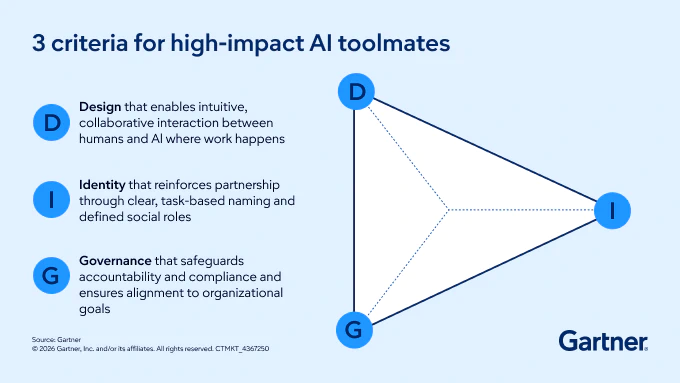
Successful AI toolmates are built around three pillars: design, identity and governance.
Design: Shaping the human experience
Great AI toolmates go beyond user interfaces — they foster relationships. Multimodal interfaces (text, voice, image) and adaptive feedback make AI engaging and context-aware. When AI proactively supports work (e.g., real-time writing review), employees get more value and satisfaction. Use cases that connect people to information, like onboarding or remote support, should be prioritized.
Identity: Defining the human-AI relationship
Identity framing is crucial to clarify roles and reduce anxiety. Assign AI toolmates clear, task-based names — think “workflow assistant,” not “digital colleague.” Personalization and clear boundaries help users understand what AI can — and can’t — do. This reduces confusion, driving adoption without stoking replacement fears.
Governance: Ensuring safety and accountability
With AI’s growing role comes new risks — overdependence, skill atrophy and misplaced trust. Effective governance means tracking toolmate identity, access and performance. Exclude AI from labor budgets and workforce metrics. Monitor for sycophancy (AI agreeing just to please), and ensure humans retain agency. Regular training and audits are essential.
Build AI toolmate personas to fit the workflow
To create AI toolmate personas that suit the task, it’s helpful to think in terms of familiar workplace archetypes. Persona archetypes include the Bureaucrat, for compliance-focused work; the Maverick, for innovative and fast results; or the Trusted Partner, for brainstorming and solving problems in line with organization values. Each persona will have different strengths and risks, but workforce leaders who treat AI toolmate selection as a hiring decision will find a more successful fit for workflow needs.
AI toolmates in the workforce FAQs
What makes an AI toolmate different from traditional AI tools?
AI toolmates blend utility with social interaction. They have a distinct identity, engage bidirectionally and operate visibly within workflows — going beyond automation to act as digital partners.
How can organizations avoid the “replacement” narrative with AI?
Assign AI toolmates clear, task-based roles and exclude them from headcount metrics. Communicate that AI is a partner, not a replacement, and focus on governance and user education.
What are the key risks of deploying AI toolmates?
Risks include overdependence, skill atrophy, sycophancy and confusion about AI’s capabilities. Strong governance, regular training and clear identity framing are essential to avoid these risks and foster productive toolmate use.
Attend a Conference
Experience CIO and IT Executive conferences
With exclusive insights from Gartner analysts on the latest trends, sessions curated for your role and unmatched peer networking, Gartner conferences help you accelerate your priorities.
19 – 22 Oct 2026
Gartner IT Symposium/Xpo™
Orlando, FL

Drive stronger performance on your mission-critical priorities.