AI is reshaping workforce economics, but the greatest risks to ROI come from costs that leaders aren’t tracking.
- Gartner client? Log in for personalized search results.
Workforce cost optimization is becoming more complex in the age of AI
CHROs are under increasing pressure to drive growth while reducing workforce costs; yet traditional cost-cutting approaches are proving insufficient in the face of AI-driven change. AI is widely seen as a lever for efficiency, productivity and cost reduction. As organizations accelerate investment — with 88% planning to increase AI spending — expectations for workforce savings are rising alongside it.
However, AI is not reducing workforce costs. It is reshaping where and how those costs appear. Many of these costs remain unplanned, making them difficult to anticipate and even harder to manage. These dynamics make workforce cost optimization more complex than traditional approaches and require CHROs to move beyond reactive cost reduction toward a more integrated, enterprisewide strategy.
Key take-aways on the workforce costs of AI
AI introduces new and often hidden cost dynamics across talent, structure and performance, including:
Premium compensation for scarce AI talent
Long-term costs from workforce reductions and rehiring
Increased benefit and workforce structure costs
Distortion of pay-for-performance models
AI talent costs are rising faster than expected.
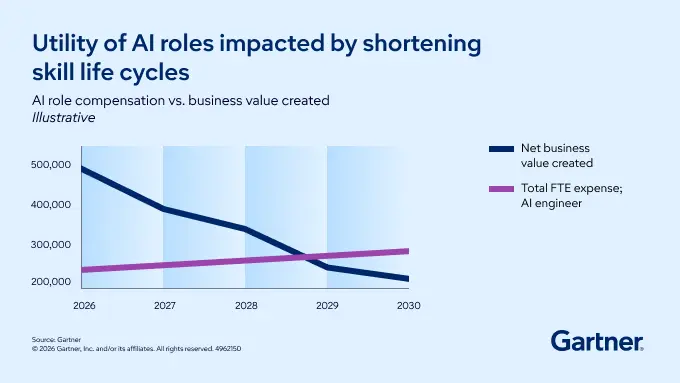
Competition for AI skills has driven a sharp increase in compensation, with some AI roles earning three to four times more than the average worker. At the same time, the value of these skills is becoming more short-lived. Technical skill life cycles have compressed from eight to 12 years to as little as two to five years, meaning organizations may pay premium compensation for capabilities that quickly depreciate.
This combination — high upfront cost and declining long-term utility — creates a structural risk to ROI. Organizations that overhire or overpay for AI talent may find themselves locked into fixed cost structures that outpace business value.
AI-driven workforce reductions create long-term cost pressure.
AI-driven productivity gains are prompting reductions in force (RIFs), particularly among early-career roles. While these actions may reduce costs in the short term, they often introduce long-term financial pressure. Gartner predicts that up to 30% of roles displaced by AI will be rehired by 2029 — often at a higher cost. Rehiring expenses, compensation premiums and recruitment costs can collectively exceed the original savings.
At the same time, reducing early-career roles weakens internal talent pipelines, increasing reliance on expensive external hiring for mid- and senior-level positions. Workforce composition shifts can also affect benefit structures, raising healthcare and retirement-related costs.
AI-driven productivity is distorting pay-for-performance models.
Most enterprise AI deployments focus on augmenting existing work: Increasing output speed and volume rather than fundamentally redefining roles. However, organizations have not fully aligned expectations or compensation models with these changes. Only 25% of employees report higher output expectations despite the availability of AI tools.
This mismatch creates risk in pay-for-performance systems. As employees produce more output with AI assistance, legacy metrics may:
Trigger higher-than-expected payouts
Reward incremental rather than strategic performance
Encourage unintended behaviors
Without redesign, performance models can increase workforce costs rather than optimize them.
The greatest risk to AI ROI — and workforce cost optimization — is unplanned cost.
While attention is placed on the cost of AI technology, the greater risk lies in the workforce transformation required to support it. Unplanned increases in compensation, rehiring, workforce structure changes and performance payouts can erode expected financial returns.
Organizations that treat AI purely as a cost-cutting tool risk increasing workforce costs, while those that treat it as a workforce cost optimization challenge can unlock more sustainable value.
What to do next to manage AI-driven workforce costs
AI is fundamentally changing workforce cost structure. For CHROs, this shift elevates workforce cost optimization from a functional responsibility to an enterprise leadership imperative. Delivering on the mission-critical priority of shaping work for the human-machine era requires CHROs to move beyond reactive cost reduction and instead lead an integrated approach aligning workforce strategy, AI adoption and financial outcomes.
The steps in that journey include:
Evaluate AI’s impact on work and workforce cost structures. Partner with business leaders to understand planned AI investments and their impact on work, roles and productivity expectations — and assess how these changes affect compensation, workforce mix and long-term labor costs.
Lead enterprisewide workforce planning that reflects AI-driven change. Help leaders plan for the intersection of work redesign, evolving employment models, location strategies and shifting supply and demand for AI and non-AI roles, including the cost implications of these changes.
Define, measure and manage an evolving workforce. Integrate change strategies across the workforce to ensure employees can adapt to the increasing role of AI, while establishing metrics to monitor emerging cost drivers such as AI talent premiums, rehiring trends and performance payouts.
Position HR as a critical partner in the organization’s AI strategy. Clearly define and demonstrate HR’s role in the enterprise AI-human work strategy by linking workforce decisions to financial outcomes and shaping C-suite expectations for AI ROI.
Evolve talent initiatives to meet enterprise needs. Build workforce programs that source, develop and manage future talent — while balancing the cost of acquiring scarce AI skills with the need for sustainable, long-term workforce investment.
Workforce costs of AI FAQs
Why are workforce costs increasing with AI adoption?
AI introduces new cost drivers even as it improves efficiency. These include higher compensation for scarce AI talent, increased reliance on external hiring, and adjustments to workforce structure and benefits. As a result, total workforce costs often shift rather than decline.
How do AI-driven layoffs affect long-term workforce costs?
AI-driven reductions in force can create short-term savings but often lead to higher long-term costs. Organizations may need to rehire displaced roles at higher compensation levels while also absorbing increased recruitment and benefit expenses.
What is the biggest risk to AI ROI from a workforce perspective?
The greatest risk is unplanned workforce cost. Organizations that fail to account for talent premiums, workforce restructuring impacts and changes to performance models may see lower-than-expected returns on AI investments.
Attend a Conference
Join Gartner analysts and your peers to accelerate growth
Gather alongside your peers in Orlando to gain insights on emerging trends, receive one-on-one guidance from a Gartner expert and create a strategy to tackle your priorities head-on.
26 – 28 Oct 2026
Gartner HR Symposium/Xpo™
Orlando, FL

Drive stronger performance on your mission-critical priorities.