As AI shifts from a back-office tool to something else, it changes how we design roles, develop talent and define performance.
- Gartner client? Log in for personalized search results.
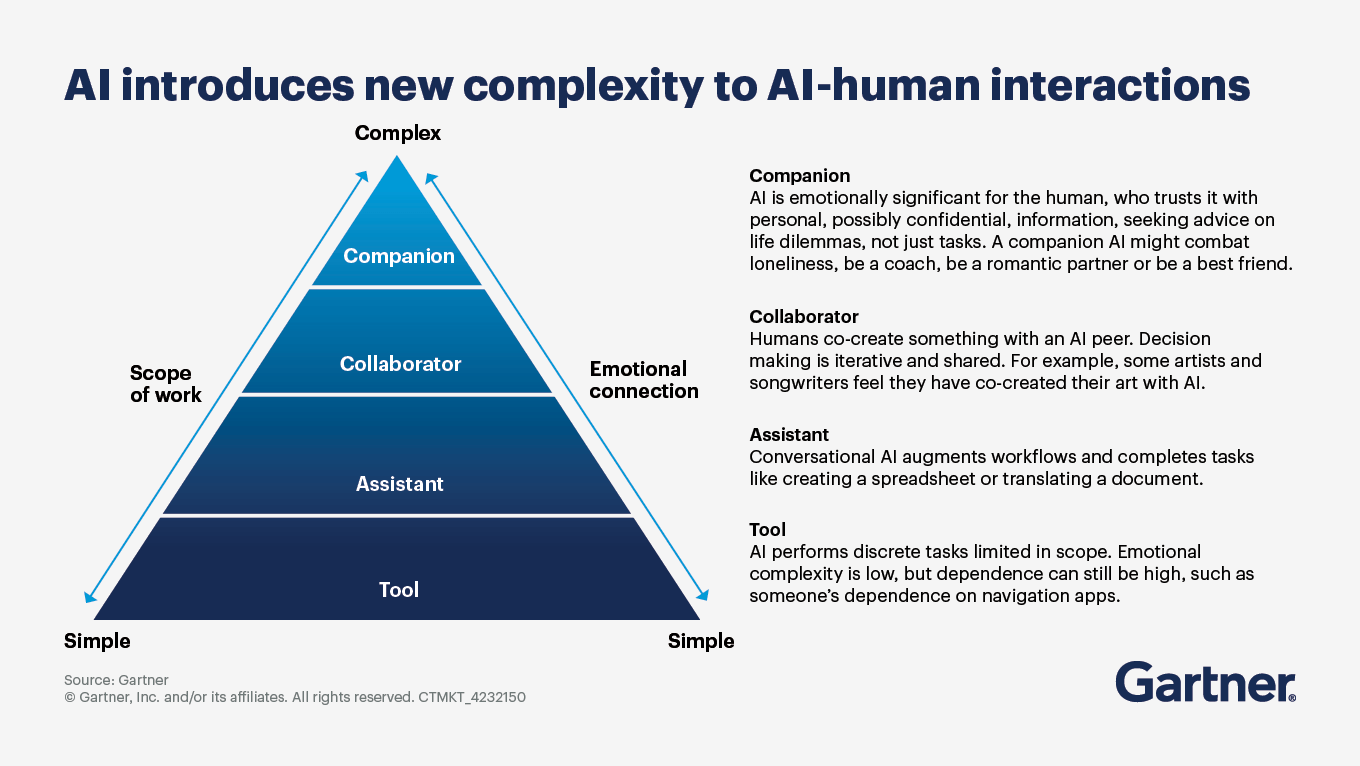
Traditional boundaries between human and machine work are dissolving
Most headlines about AI focus on automation or layoffs. But for most organizations, the real shift is both more nuanced and more profound. AI isn’t just running in the background — whether as an assistant, advisor or compliance partner — it’s an active participant in daily work. This blurs the line between “human” and “machine” work and, in the process, upends traditional approaches to hiring, upskilling, mentoring and organizational design.
As humans and AI stand shoulder to shoulder, leaders must rethink teams, risk and value
This shift introduces new dynamics into how teams function and grow. Organizations that thrive see their future workforce as made up of both people and machines — and update their leadership playbooks accordingly.
Recognize the early patterns shaping talent models
Leaders are seeing several distinct patterns emerge as AI becomes more than a tool — each with different implications for talent development, performance and resilience.
Experience starvation: Senior staff use AI to accomplish more alone; junior employees lose hands-on learning opportunities.
Experience compression: Less-experienced staff quickly reach higher performance levels with AI support — disrupting seniority models.
Experience redistribution: Some organizations shift people from legacy roles into net-new AI-centric functions. This pattern is seen mainly where business models are changing.
Why it matters: These shifts can accelerate capability building or, if left unmanaged, hollow out critical skills.
Redefine how you measure value for human-AI teams
As AI moves into core workflows, traditional metrics like headcount reduction or simple productivity gains miss the bigger picture. Leading organizations are redefining value by measuring:
Team capacity and adaptability
Speed of innovation
Quality of decision making
Employee engagement
Look beyond cost savings to answer the real question: How does human-AI collaboration create new capabilities? It’s about accelerated learning curves, redeployed talent in growth areas and resilience through machine precision plus human judgment. Financial efficiency still matters — but now it depends on how well you orchestrate people and algorithms together.
Manage behavioral byproducts before they erode performance
AI can accelerate work, but it also introduces cultural and capability risks if left unchecked. Among them:
Overreliance on AI can erode critical human skills like problem solving, critical thinking and judgment.
Skepticism can lead to underuse of valuable tools and an erosion of the value of human labor.
Chatbots and virtual agents may reduce human peer collaboration or create unrealistic expectations of people (like an expectation that they should be as patient as your chatbot). Without clear accountability for monitoring these shifts, organizations risk cultural drift, loss of expertise and weakened team dynamics.
Make cross-functional ownership non-negotiable
No single leader owns all aspects of human-AI teamwork. CIOs often inherit responsibility by default because they deploy the technology, but lasting results require collaboration across IT, HR, legal/compliance and user experience. Assigning explicit ownership ensures technical advances don’t outpace cultural readiness or governance safeguards.
Move from reactive fixes to proactive frameworks
To make human-AI collaboration sustainable, leaders need intentional practices that anticipate both technical and behavioral impacts. Leading organizations are:
Auditing how AI impacts talent development across the organization
Regularly surveying employees on AI use and its effect on learning, decision making and engagement
Designing intentional human-machine partnerships
Aligning measurement with business outcomes
Building governance frameworks that anticipate technical and behavioral impacts
How Gartner helps HR leaders succeed with AI
AI is fundamentally changing how work gets done. With more than 2,400 business and technology analysts, 6,000 written insights and 4,000 AI use cases and case studies, Gartner helps CHROs and their leadership teams build a human‑AI workforce that aligns technology, talent and operating models with enterprise strategy.
Human-AI collaboration FAQs
How does making AI part of core teams affect workforce planning?
Embedding AI as a teammate transforms job roles rather than eliminating them outright. Workforce planning must consider evolving skill sets — such as prompt engineering or oversight — and ensure pathways for both human learning and machine integration.
What risks should leaders watch for as humans collaborate with algorithms?
AI can erode critical skills if overused or lead to missed opportunities if underused. Unmanaged reliance on AI can lead to lost expertise or weakened team dynamics. Proactive monitoring helps organizations act before small shifts create big problems.
Attend a Conference
Join Gartner analysts and your peers to accelerate growth
Gather alongside your peers in Orlando to gain insights on emerging trends, receive one-on-one guidance from a Gartner expert and create a strategy to tackle your priorities head-on.
26 – 28 Oct 2026
Gartner HR Symposium/Xpo™
Orlando, FL

Drive stronger performance on your mission-critical priorities.