Success in the next wave of disruption will depend on how well organizations prepare for far-horizon technologies today.
- Gartner client? Log in for personalized search results.
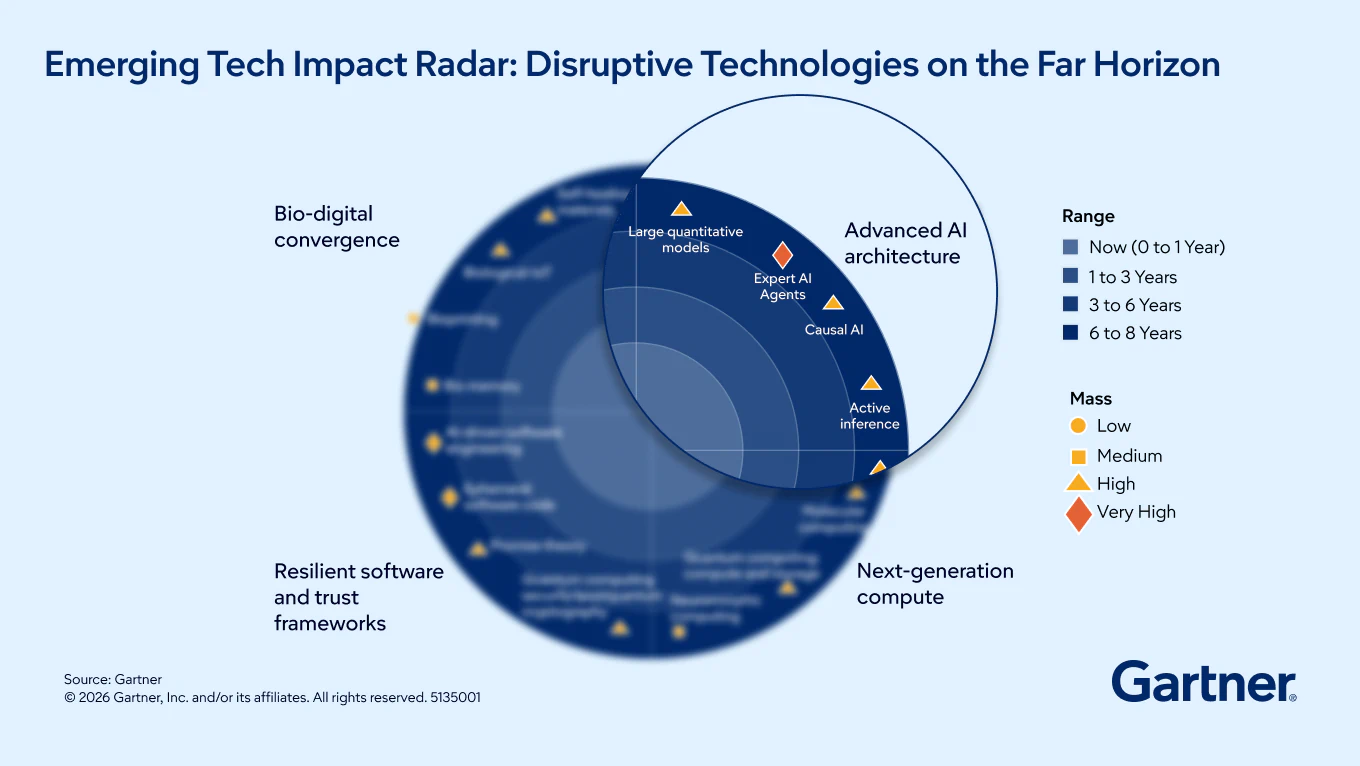
Get ready for a world beyond today’s technology limits
Disruptive technologies are reshaping organizations at a pace that is challenging leaders’ ability to anticipate what comes next. Gartner finds that the convergence of advanced AI, next-generation computing and biodigital integration will drive unprecedented change across industries in the years ahead. Yet, many technology leaders remain unprepared for the speed, scale and complexity of the disruption these far-horizon technologies may bring. Gartner Senior Director Analyst Danielle Casey cautions, “It is not a matter of if, but when, a far-horizon scenario will occur.” Success will require new skills, proactive migration strategies and a willingness to rethink traditional IT leadership.
These global-scale disruptive technologies will be long-term market disruptors
C-Level executives need to act on several emerging technologies that are set to reach early majority adoption within six to eight years. These technologies are already being explored and deployed by first movers, making it essential for organizations to plan ahead and prioritize innovation across the four far horizons.
Advanced AI architectures enable a new era of expertise and autonomy
AI autonomy will advance steadily over the next several years before accelerating with the emergence of causal AI and active inference. Active inference enables AI systems to continuously learn and adapt through real-time interactions, while causal AI moves beyond correlation to model cause-and-effect relationships for more accurate predictions and decisions. Together, these innovations will enable more effective autonomous action in increasingly complex and high-stakes environments.
The future of AI lies in expert agents capable of deep, domain-specific workflow automation. Industries that rely on specialized knowledge, including healthcare, financial services, manufacturing and utilities, are likely to see the earliest disruption. These systems will be driven by advances in model innovation, such as large quantitative models (LQMs), which are purpose-built to analyze complex scientific and mathematical data. While expert agents and LQMs remain largely emerging technologies, today’s prepackaged agents and domain-specialized models signal a market shift toward AI expertise.
Next-generation computing architectures solve what traditional systems could not
To unlock new levels of speed, efficiency and capability, next-generation compute demands fundamentally new paradigms. For example, quantum computing is designed to solve highly complex problems that are impractical for classical computers, while neuromorphic computing delivers greater performance and energy efficiency by combining memory and processing for real-time intelligence in autonomous systems and robotics.
Emerging paradigms such as molecular and spatial computing further expand what is possible. Molecular computing leverages biological mechanisms to enable highly parallel, energy-efficient processing for applications such as disease prediction and drug discovery, while spatial computing creates real-time digital representations of the physical world to support digital twins and train physical AI systems. Together, these innovations are laying the foundation for a new generation of computing that bridges the physical and digital worlds.
Biodigital innovation creates new frontiers for business
Embedding biosensors and biological components into IoT networks will revolutionize sectors such as healthcare, agriculture and environmental management. Bioprinting and self-healing materials will drive innovation in manufacturing and sustainability, though commercialization and regulatory hurdles remain. Innovation in biotech will create entirely new competitive opportunities and risks to both digital and physical products and supporting services.
Resilient software and trust frameworks are foundational to future AI systems
As organizations become more dependent on autonomous systems, resilient software and trust frameworks will be critical to ensuring security, reliability and adaptability. Innovations such as AI-driven software engineering, ephemeral software code, promise theory and postquantum cryptography are reshaping how software is built and governed.
AI-driven software engineering and ephemeral code will enable software to be continuously created, optimized and updated by AI, boosting productivity while reducing technical debt. At the same time, promise theory and postquantum cryptography will help establish trust among autonomous agents and protect data from emerging threats, creating a foundation for secure, resilient AI systems.
Disruptive technologies FAQs
What disruptive technologies should tech leaders prioritize now?
Tech leaders should focus on four categories of high-impact emerging technologies that are expected to shape innovation and revenue opportunities over the next six to eight years: advanced AI architectures, next-generation computing, resilient software and trust frameworks, and biodigital convergence. Key technologies include expert AI agents, causal AI, LQMs, quantum and neuromorphic computing, postquantum cryptography, biological-IoT, bioprinting and self-healing materials. While many remain early-stage investments, they have the potential to become major market disruptors and sources of first-mover advantage.
How can leaders prepare for disruptive technologies?
Leaders should prepare by identifying which future horizon aligns with their organization’s strategic goals and then developing a roadmap for investing in the technologies most critical to that future. This includes allocating budget and R&D resources, prioritizing AI architectures that enable greater specialization and autonomy, exploring new computing approaches that solve complex problems, and building trust, resilience and security into AI systems. Organizations that begin planning and experimenting now will be better positioned to capitalize on future innovation and market shifts.
Attend a Conference
Experience Information Technology conferences
With exclusive insights from Gartner analysts on the latest trends, sessions curated for your role and unmatched peer networking, Gartner conferences help you accelerate your priorities.
21 – 23 Sep 2026
Gartner CIO & IT Executive Conference
São Paulo, Brasil

Drive stronger performance on your mission-critical priorities.