Classical computing can’t handle the needs of GenAI and simulations. New trends in computing technologies offer a solution.
- Gartner client? Log in for personalized search results.
Embrace New Computing Technologies to Enable Innovation
By Soyeb Barot | October 14, 2024
This page features a previous edition of Gartner’s Top Strategic Technology Trends. For the most up-to-date insights, explore the Gartner Top 10 Strategic Technology Trends for 2026.


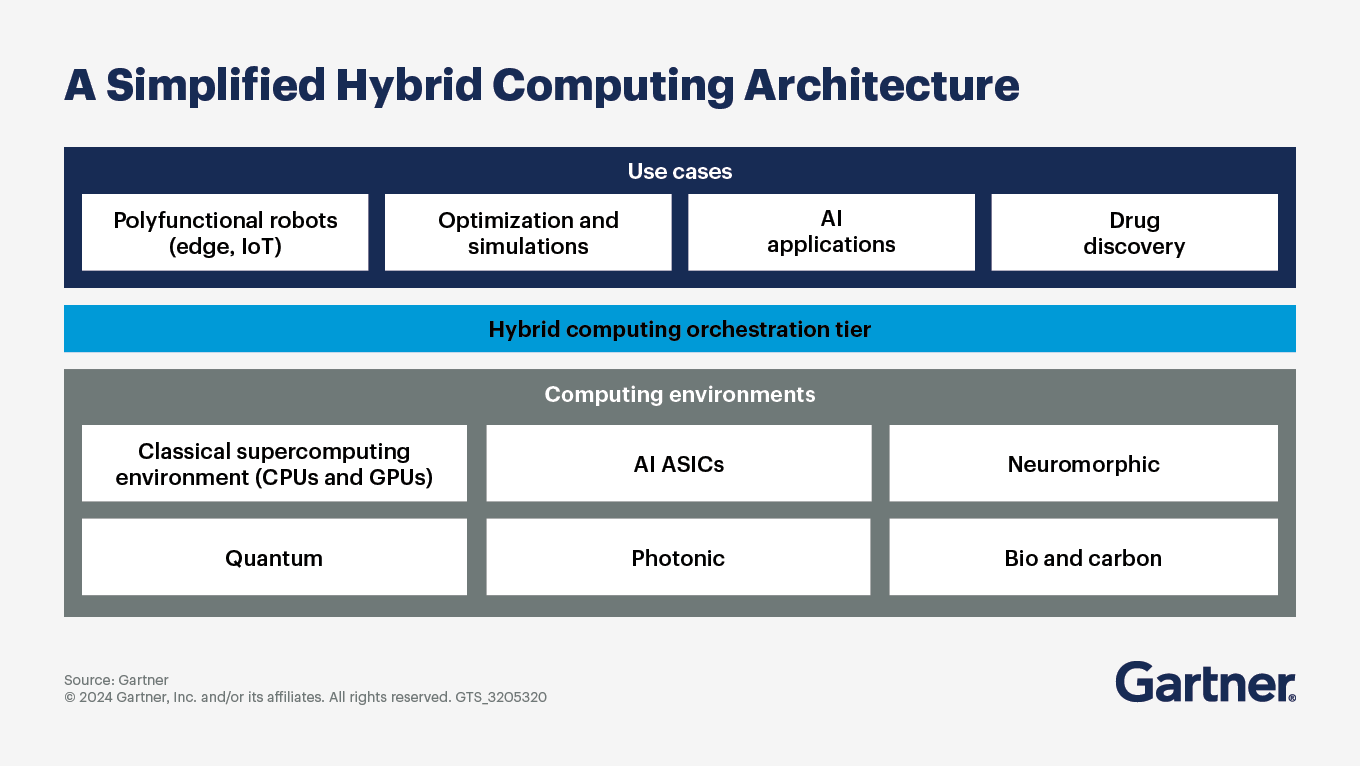
Orchestrate multiple computing technologies to enable tech innovation
The classical computing model that has enabled innovation over the last eight decades has reached a natural limit. Continued progress requires new computing technologies like quantum, neuromorphic and photonic. These are energy efficient, yet have limitations related to general availability and high costs — at least for now.
That’s where hybrid computing comes in. Capturing the benefits of new computing technologies while addressing their limitations will require IT teams to orchestrate workloads across their computational environment to harness the strengths of different computing types while mitigating costs and environmental impact.
Computing technologies prove stronger together
An orchestration layer that splits end-to-end workflows across available computing and integrates data through a universal data fabric facilitates extreme efficiency and technological capabilities, enabling a range of applications and use cases, from scientific simulations to data analytics to machine learning to AI.
Optimize your computing environment
The primary benefits of orchestrating across multiple computing technologies lie in the ability to handle problems that are difficult to manage today, such as:
High complexity. New computing technologies will be able to deal with high-dimensional optimization problems and will be scalable for large problems, potentially using less memory and energy.
Interoperability. Future-focused trends in computing will emphasize the need to use multiple computing mechanisms via an orchestration tier. In doing so, they will support and extend human-to-agent (HAI), agent-to-agent and agent-to-human interactions.
New use cases. Innovations in industries as far afield as manufacturing and logistics, financial services, life sciences, materials and drug discovery will be possible because of the data and network integration between classical, quantum computing, neuromorphic and photonic computing environments.
Embrace the cultural enablers of modern computing technologies
Trends in computing bring forth dramatic change from the classical computing approach. Embracing that future is not about entirely replacing classical computing models but rather creating an environment where they can coexist with new models.
To prepare, cultivate the following enablers:
High problem-solving acumen. Anticipate cost and complexity challenges, including those related to security and trust.
High tolerance for change. Traditional organizational structures are designed to deliver consistent value using proven approaches and are inherently resistant to change. In contrast, building and creating value from different computing technologies operating in the same environment requires new organizational structures that can withstand frequent changes and higher failure rates.
Composable technology architectures. Organizations with multiple rigid architectural approaches must rearchitect systems and applications to better integrate and interface across compute mechanisms. Composable systems offer the best way to optimize the computing environment.
A robust orchestration layer. This layer and associated services enable access to software, storage and networks for each portion of the application workflow. Select platforms that can support the development and deployment of applications across a hybrid compute environment.
Strong data and system security governance. Emerging trends in computing technologies will introduce significant security risks, as each system operates autonomously and generates data that it passes to other systems. The governance and security of data pipelines and systems will require an overhaul.
Discipline in a federated world. Manage AI agents, edge and devices with strict discipline, considering the rising cost of computing while accommodating for scale and targeting innovative use cases.
Gartner also recommends creating opportunity maps for your industry and computing environment, and adopting a lab-to-factory approach to actively explore and orchestrate between innovative computing approaches.
Learn more about how Gartner works with technical teams to navigate new computing technologies, execute efficiently and drive business results.
Are you a CIO or IT leader at a midsize enterprise?
See how your peers are navigating AI adoption, vendor decisions and evolving business demands — with tools tailored to your role:
Explore our resources for midsize enterprises
Check out a curated list of Gartner’s most popular research being utilized by your peers
Computing technologies FAQs
What is the latest trend in computing technologies?
Many observers talk about quantum as the most important trend driving the future of computing. It isn’t, though. Quantum is relevant as one of multiple computing mechanisms that organizations will run simultaneously. As a result, the latest trend in computing is not related to one computing technology or approach but rather to how organizations can make those approaches work together to get the best from each one. This will involve creating an orchestrated computing environment built to leverage the respective strengths and capabilities of each mechanism.
What is the next era of computing?
The next era of computing will combine conventional computing technologies with quantum, neuromorphic and other computing mechanisms to help organizations explore and solve problems. Their power will come not from using one or the other but from combining specialized compute, storage and network mechanisms to help technologies, such as AI, to perform beyond current limits.
Attend a Conference
Experience Information Technology conferences
With exclusive insights from Gartner experts on the latest trends, sessions curated for your role and unmatched peer networking, Gartner conferences help you accelerate your priorities.
23 – 24 Feb 2026
Gartner CIO Leadership Forum
Phoenix, AZ

Drive stronger performance on your mission-critical priorities.