By orchestrating collaborative AI agents, multiagent systems (MAS) help enterprises accelerate innovation, reduce risk and future-proof their operations.
- Gartner client? Log in for personalized search results.
Multiagent Systems: A New Era in AI-Driven Enterprise Automation
By Tom Coshow and Kiumarse Zamanian | December 18, 2025


Multiagent systems break through the limits of monolithic AI
Traditional AI often relies on a single, general-purpose AI that struggles with complex workflows. Multiagent systems (MAS) change the game by orchestrating specialized agents, each focused on a specific task, to automate more complex problems.AS
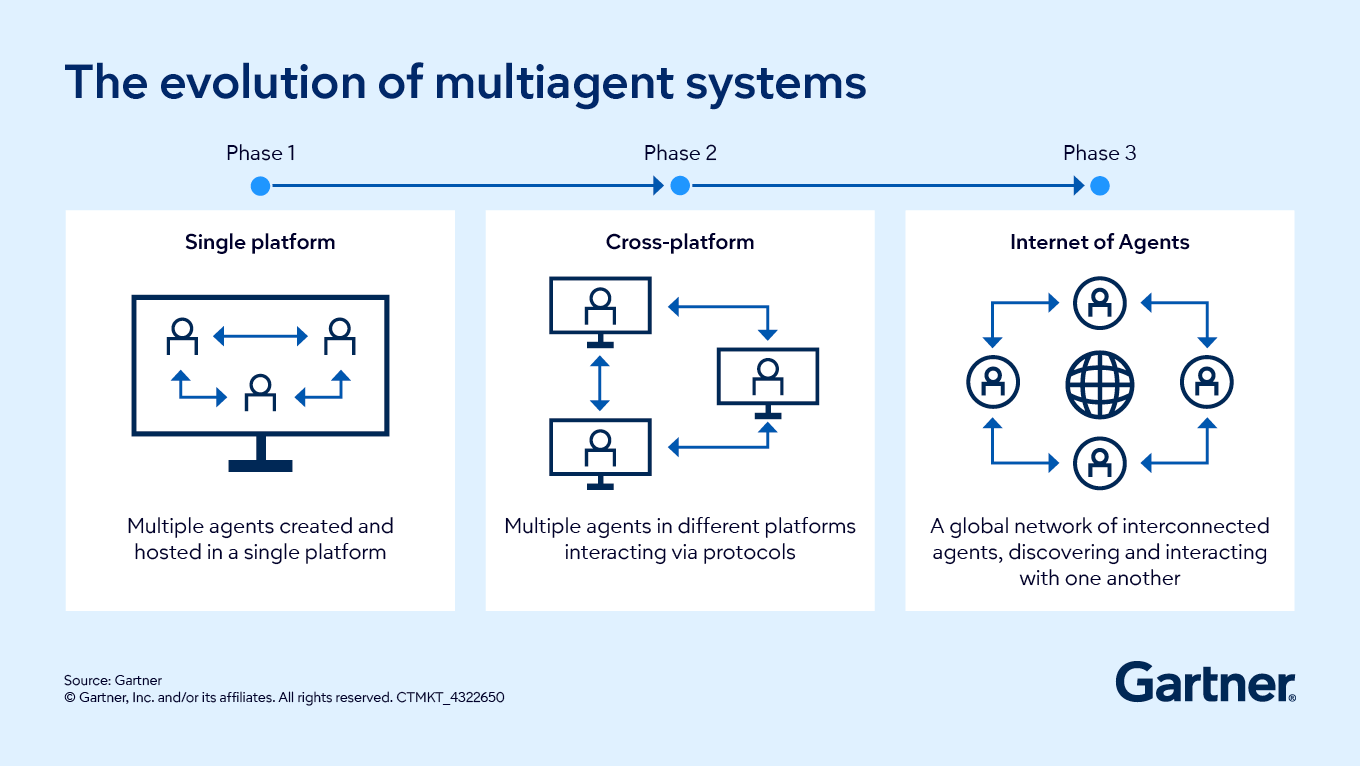
MAS let organizations rethink and redesign complex processes, products and experiences by breaking workflows into manageable steps. Each step is handled by the best-suited agent, expediting innovative automation and improving efficiency. Proven agents can be reused across workflows, boosting reliability and scalability while reducing errors that plague monolithic AI. MAS also allow interoperable agents to discover, negotiate and collaborate — even across organizational boundaries — paving the way for the emerging Internet of Agents.
What CIOs must know to prioritize MAS for strategic advantage
Gartner predicts that by 2027, 70% of MAS will use narrowly specialized agents, improving accuracy and increasing coordination complexity. CIOs and IT leaders should view MAS as a strategic lever for performance, risk reduction and competitive differentiation. To get started, organizations should design workflows from the ground up, prioritize governance and launch small pilots with observability tools. Adopting modular, agentic platforms will future-proof MAS investments, especially as interoperability standards mature and multivendor agent integration becomes the norm.
MAS augment human work, they don’t replace it
Despite hype around digital workforces, current AI agents — including those in MAS — are not replacements for people. Multiagent systems automate and augment parts of work, potentially reducing headcount, but lack the full agency and adaptability of humans needed to solve complex problems. The real value is in enabling more effective collaboration between humans and AI, allowing each to focus on what they do best.
MAS use cases and industry momentum are accelerating
MAS are transforming industries with applications like supply chain optimization, healthcare emergency response, cybersecurity, business process automation, and consumer services. Gartner reports a 1,445% surge in MAS inquiries from Q1 2024 to Q2 2025, reflecting skyrocketing interest. As MAS frameworks and interoperability standards mature, adoption is set to accelerate across sectors worldwide.
MAS introduce challenges and risks that require careful management
MAS bring new complexities, including larger security attack surfaces, increased integration and monitoring needs, cost management challenges, and reliability concerns due to compounding errors. To mitigate these risks, organizations should adopt frameworks for governance, observability and compliance from the start, use orchestrated workflows and validate agent actions and outputs at every step.
MAS adoption is fueled by innovation but hindered by immature standards
Accelerators for MAS adoption include improved agent frameworks, platforms and protocols, as well as growing client demand and vendor investment. However, immature standards for agent communication, reliability concerns and unpredictable costs remain inhibitors. IT leaders should identify high-value MAS use cases, upskill teams, design modular agents and adopt industry standards for interoperability as they mature.
Competitive advantage for vendors in the multiagent AI era
Vendors that embrace multiagent systems are positioned to lead the next wave of enterprise AI innovation in the AI vendor race. As organizations move beyond single-purpose AI, vendors must deliver solutions that are scalable, interoperable and tailored to complex business needs.
Standards-based interoperability unlocks new market opportunities
Product leaders who invest in open, standardized communication protocols enable their AI agents to collaborate seamlessly across platforms and ecosystems. This not only accelerates time to market but also expands ecosystem reach, allowing vendors to tap into new revenue streams and avoid vendor lock-in. By supporting interoperability, vendors can future-proof their offerings and foster network effects that drive adoption.
Operational management and reliability build customer trust
Vendors gain a competitive edge by delivering robust operational management, observability and governance for multiagent systems. Reliable, secure and compliant MAS inspire user confidence and facilitate enterprise-scale deployments for automating complex processes. Vendors that prioritize transparent audit trails, real-time monitoring and risk mitigation set themselves apart in regulated industries where trustworthiness is paramount.
Strategic recommendations for vendors building enterprise-scale MAS
To succeed in the evolving enterprise AI landscape, vendors must adopt specialized engineering practices and align their product strategy with the unique demands of multiagent systems.
Invest in modular architecture and data-centric design
Vendors should architect their MAS using modular, event-driven frameworks and semantic layers that enable fast, secure, scalable access to mixed-dimensional data. This approach streamlines agent collaboration, simplifies integration and ensures flexibility for future enhancements. Modular design also supports interoperability with third-party agents, positioning vendors for long-term success.
Prioritize governance, compliance and continuous evaluation
Establishing robust governance frameworks, continuous testing pipelines and transparent monitoring are essential for building trustworthy MAS. Vendors should embed security, accountability and risk management into every layer of their MAS. By adopting industry standards, contributing to open protocols and validating agent behavior under diverse scenarios, vendors can deliver reliable, enterprise-class solutions that meet evolving business and regulatory requirements.
Multiagent systems (MAS) FAQs
How do multiagent systems transform enterprise processes?
Multiagent systems transform processes by dividing work among task-specialized AI agents, which boosts efficiency, innovation and scalability. By breaking workflows into modular steps and allowing agents to collaborate or act independently, organizations can automate complex tasks and processes, reuse proven agents and adapt quickly to changing business needs — unlocking new sources of competitive advantage.
What are the main opportunities and risks of multiagent systems for CIOs?
Multiagent systems offer CIOs opportunities to expedite innovation, accelerate automation and improve efficiency through collaborative, specialized AI agents. However, they also introduce risks like increased security challenges, integration complexity, unpredictable costs and compounded error rates as agent interactions multiply. Strong governance and robust interoperability are essential for success.
Why is governance critical for deploying multiagent systems at scale?
Governance is critical for multiagent systems because as the number of agents and interactions grows, so do security risks, operational costs and the potential for unpredictable failures. Effective governance — including oversight, compliance and observability — ensures reliable, secure and cost-effective MAS deployments across the enterprise.
Attend a Conference
Experience Information Technology conferences
With exclusive insights from Gartner experts on the latest trends, sessions curated for your role and unmatched peer networking, Gartner conferences help you accelerate your priorities.
28 – 29 Apr 2026
Gartner Data & Analytics Summit
São Paulo, Brasil

Drive stronger performance on your mission-critical priorities.