Strategic alignment gives CFOs a valuable opportunity to accelerate AI-driven growth with confidence.
- Gartner client? Log in for personalized search results.
CEOs and CFOs Are Aligned on Growth — Now CFOs Must Harness AI Ambition
By Jessica Kranish | May 26, 2026
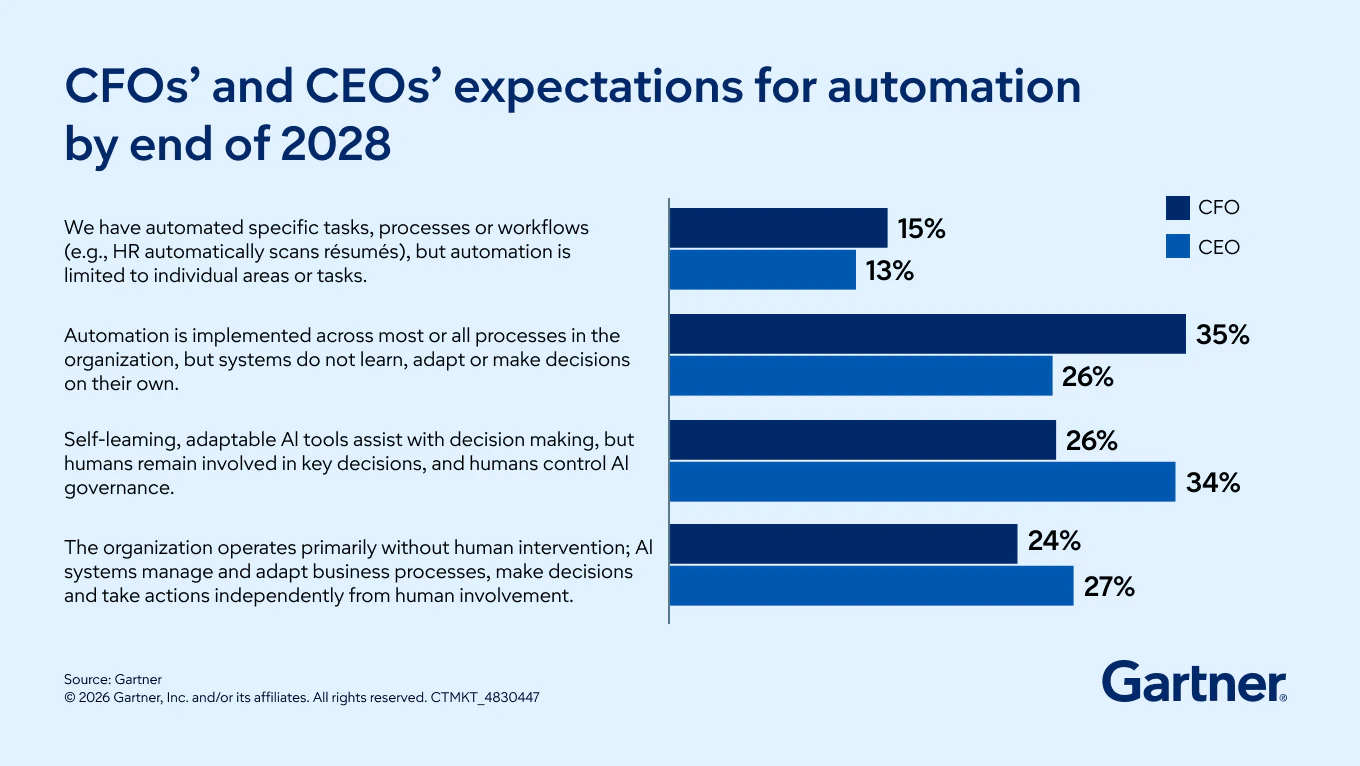
Strategic priorities are aligned — and CFOs have a window to act
Gartner shows both CEO and CFO groups rank growth as their top strategic priority for the next two years, and their top 3 priorities match exactly. This level of alignment creates a window for CFOs to advance initiatives that might otherwise face resistance.
That window matters because CEOs are looking for partners to lead bold transformation. Nearly half of CEOs say they rely most on their CFO when working on new initiatives or issues. With growth, AI and transformation converging at the top of the agenda, CFOs are uniquely positioned to shape how AI ambition translates into enterprise value.
CEOs and CFOs agree on AI’s importance but differ in their strategic perspective
While both roles recognize AI’s significance, differences in expectations and usage reveal a strategy gap CFOs must now close.
CEOs see AI as a growth engine; CFOs see risk and responsibility
AI tops the list of technologies expected to disrupt industries by 2026 for both CEOs (77%) and CFOs (72%). However, their ambitions diverge when AI is framed as a growth driver. More than half of CEOs identify AI as a top enabler of growth, compared with roughly a third of CFOs.
This gap reflects role realities. When it comes to AI, CEOs are focused on transformation and competitive advantage, while CFOs gravitate toward evaluating the risks involved. Yet without broader CFO engagement in AI-driven growth, enterprises risk underinvesting in the very initiatives CEOs expect to scale.
CEOs anticipate new profit models; CFOs seek clearer business cases
Expectations also diverge around AI’s impact on business models. Nearly twice as many CEOs (24%) as CFOs (13%) anticipate significant changes to their organizations’ profit models due to the implementation of AI. CEOs also expect more future revenue from AI agents or machines acting as customers.
By contrast, CFOs are more likely to say they are uncertain which revenue streams are most exposed to disruption or what new revenue AI will create. This caution is understandable — but waiting for perfect clarity risks falling behind CEO and board expectations.
CEOs and CFOs emphasize different priorities for AI
While CEOs and CFOs both recognize AI’s importance, they emphasize different priorities when it comes to how it is applied across the enterprise.
CEOs tend to focus on AI’s role in driving growth, competitiveness and broader enterprise outcomes. CFOs, by contrast, often prioritize value realization, financial discipline and measurable returns.
These differences reflect not a gap in execution, but a difference in perspective — shaping how AI initiatives are evaluated, funded and scaled.
How CFOs can turn alignment into AI-powered growth
To capitalize on CEO alignment and board momentum, CFOs should take a more active role in shaping AI ambition:
- Clarify AI ambition with the CEO. Use tools such as the Gartner AI Opportunity Radar to identify where AI can drive growth and value — not only cost reduction.
- Harness strategic priorities. Win support for big bets, as long as they can demonstrate how AI plays into their plans.
- Develop enterprise AI strategy. Make sure it explicitly states how AI will change employees’ time.
- Engage early on business model impact. Use the shared focus on growth to test, learn and scale — rather than waiting for complete certainty.
CEO and CFO AI ambition FAQs
What is the CEO/CFO AI ambition gap?
The CEO/CFO AI ambition gap refers to the difference in how CEOs and CFOs view the speed and scope of AI’s impact. Gartner business and technology insights show CEOs expect larger, faster changes from AI — especially in profit models and revenue streams — while CFOs tend to be more cautious and incremental, balancing ambition with risk management.
Why does the CEO/CFO AI disconnect matter for AI success?
This disconnect slows enterprise AI adoption and risks missing growth opportunities. CEOs want CFOs to lead on AI, but if CFOs hesitate, they can’t deliver the returns CEOs and boards expect. Alignment is critical for turning AI ambition into results, while maintaining financial discipline.
How can CFOs align with CEO AI ambitions quickly?
CFOs should use tools such as the Gartner AI Opportunity Radar to clarify AI goals, automate finance tasks to free up time for strategic work, and have direct conversations with CEOs to set clear targets for AI-driven outcomes — all while ensuring risk and return are managed.
Attend a Conference
Join Gartner experts and your peers to accelerate growth
Gather alongside your peers in National Harbor to gain insight on emerging trends, receive one-on-one guidance from a Gartner analyst and create a strategy to tackle your priorities head-on.
2 – 4 Jun 2027
Gartner Finance Symposium/Xpo™
National Harbor, MD

Drive stronger performance on your mission-critical priorities.