AI ambitions are accelerating faster than the budgets, governance models and workforce plans needed to support them.
- Gartner client? Log in for personalized search results.
CIOs must align AI goals with operational reality
CIOs face a growing challenge as enterprise AI ambitions increasingly outpace IT realities. While organizations continue to prioritize AI investments, many CIOs are operating within budget, governance and workforce structures that were not designed for the pace and scale of AI adoption.
The 2027 Gartner CIO and Technology Executive Survey highlights gaps in budgeting, governance, cost management and workforce planning that CIOs must address as AI adoption scales. “Failing to close the gap between enterprise AI ambitions and IT realities exposes CIOs to severe financial, organizational and political risks,” says Gartner Vice President Analyst Daniel Sanchez Reina.
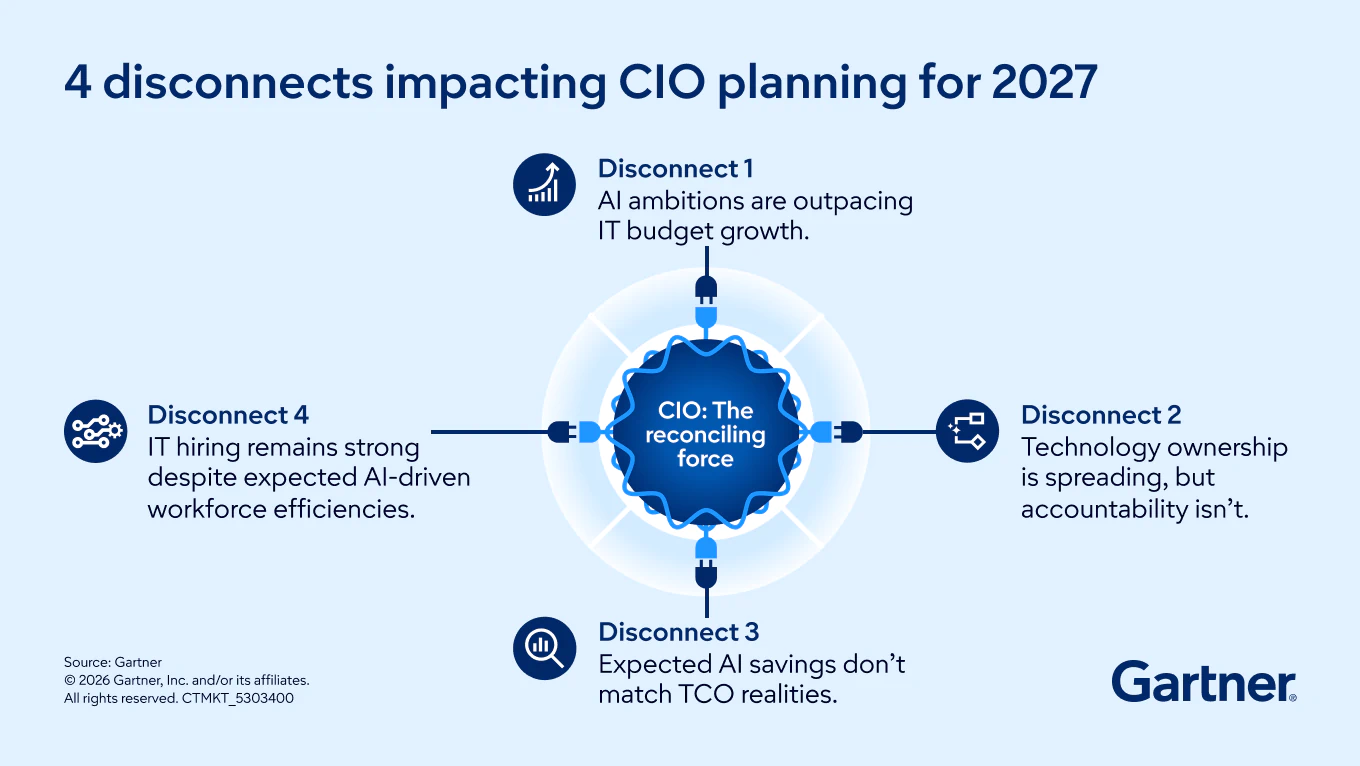
Four disconnects shaping CIO planning for 2027
Delivering on enterprise AI priorities over the upcoming year will require more than technology investment. Gartner identified four critical disconnects between enterprise AI ambitions and IT realities that CIOs must address to reduce risk to their organization.
AI investment ambitions are increasing faster than budget growth
IT budgets are projected to grow by an average of just 3.7% in 2027. After accounting for inflation, many organizations will see only marginal gains in available funding.
At the same time, AI investment continues to surge. Gartner found that funding for agentic AI is expected to increase by an average of 31.8%, making it the fastest-growing technology investment area. Adoption is also accelerating: 37% of respondents already deployed AI agents and another 34% are planning deployments within the next 12 months, effectively doubling active deployment rates of agentic AI.
This creates a significant funding mismatch. Without stronger cost controls, successful AI initiatives can actually increase demand beyond what existing budget models can support.
To contain costs, Gartner recommends CIOs:
- Create curated AI marketplaces to manage approved tools and services.
- Ruthlessly eliminate “zombie AI” projects that continue consuming resources without delivering value.
- Require every AI investment to demonstrate business value within 90 days or face termination.
Technology ownership is shifting beyond IT, but accountability is not
Agentic AI is accelerating the growth of business-led technology development. Currently, an average of 15.3% of technology solutions are developed outside centralized IT, and 80% of technology executives expect AI to expand the number of business-developed solutions by 2030 — nearly 40% expect a significant increase.
However, governance has not kept pace. Gartner found 73% of enterprises have no plans to develop rules for ownership of technology costs and solutions, despite increasing decentralization.
The result is a growing accountability gap. Business units may deploy AI technologies while CIOs remain responsible for governance, risk management and budget outcomes.
To address this challenge, CIOs should:
- Align technology ownership with cost allocation.
- Establish accountability guardrails before AI adoption outpaces governance.
- Use fusion teams to create shared responsibility for business value, operational support and risk management.
AI economics require a broader view than technology costs
Many executives expect AI to reduce costs, but CIOs are experiencing a different reality. Gartner found 58% of CIOs face growing pressure to deliver AI-driven cost savings, while 51% expect AI to increase total cost of ownership (TCO) over the technology life cycle.
Confidence remains limited. Only 36% of respondents believe they will meet expected cost-reduction targets. Meanwhile, just 13% reported significant value from AI tools so far.
These findings indicate organizations need a more comprehensive approach to AI economics. Managing token consumption and infrastructure costs alone is not enough.
Gartner recommends CIOs:
- Partner with CFOs to define enterprisewide AI economics containing token consumption, platform costs, governance overhead, workforce impacts and business value realization.
- Include funding models, ownership, accountability and value realization metrics.
- Implement automated financial controls and cost thresholds.
- Measure AI performance based on overall business outcomes, including revenue growth or improved customer experiences.
Workforce growth and efficiency expectations remain in conflict
Most CIOs expect technology staffing levels to remain stable or increase. Gartner found 40% plan to grow IT headcount, while 37% expect staffing to remain unchanged. But this contrasts with the enterprises’ expectations of workforce cost-efficiencies from AI adoption.
The greatest hiring demand is projected in:
- Data and analytics (56%)
- Cybersecurity (54%)
At the same time, 44% of CIOs cite insufficient technical talent as a major concern regarding AI adoption and scaling.
Rather than hiring broadly, Gartner advises CIOs to redesign work before expanding teams:
- Classify roles into strategic, core, foundational and misaligned categories to determine where workforce investment is most valuable.
- Assess where automation can augment existing employees before creating new positions.
- Elevate business acumen, critical thinking and judgment capabilities among data, analytics and software engineering professionals. As AI automates routine tasks, these human-centered skills become increasingly important for defining business intent, evaluating AI outputs and ensuring that technology delivers meaningful outcomes.
Recommended resources for Gartner clients*:
*Note that some documents may not be available to all Gartner clients.
CIO planning for 2027 FAQs
How can CIOs plan for AI budget challenges in 2027?
Gartner recommends CIOs implement cost containment measures, such as curated AI marketplaces, eliminating zombie AI projects and requiring 90-day proof points for AI investments.
Why is governance important in CIO planning for 2027?
AI is accelerating business-led technology development, yet 73% of enterprises have no plans to establish ownership rules for technology costs and solutions. Gartner emphasizes accountability guardrails, cost-allocation models and shared governance structures to prevent AI adoption from outpacing organizational oversight.
What workforce priorities are highlighted in CIO planning for 2027?
Gartner recommends redesigning work before expanding headcount. IT leaders should train new employees in the skills and job requirements of the AI era, focusing on business acumen, critical thinking and sound judgment, while using automation to improve productivity across existing teams.
Attend a Conference
Experience Information Technology conferences
With exclusive insights from Gartner experts on the latest trends, sessions curated for your role and unmatched peer networking, Gartner conferences help you accelerate your priorities.
21 – 23 Sep 2026
Gartner CIO & IT Executive Conference
São Paulo, Brasil

Drive stronger performance on your mission-critical priorities.