AI-driven attacks are faster and smarter, requiring resilient, proactive cybersecurity.
- Gartner client? Log in for personalized search results.
Cybersecurity for CIOs: Build Resilience and Mitigate Risk in the AI Age
By Ed Gabrys and Mike Ramsey | May 15, 2026
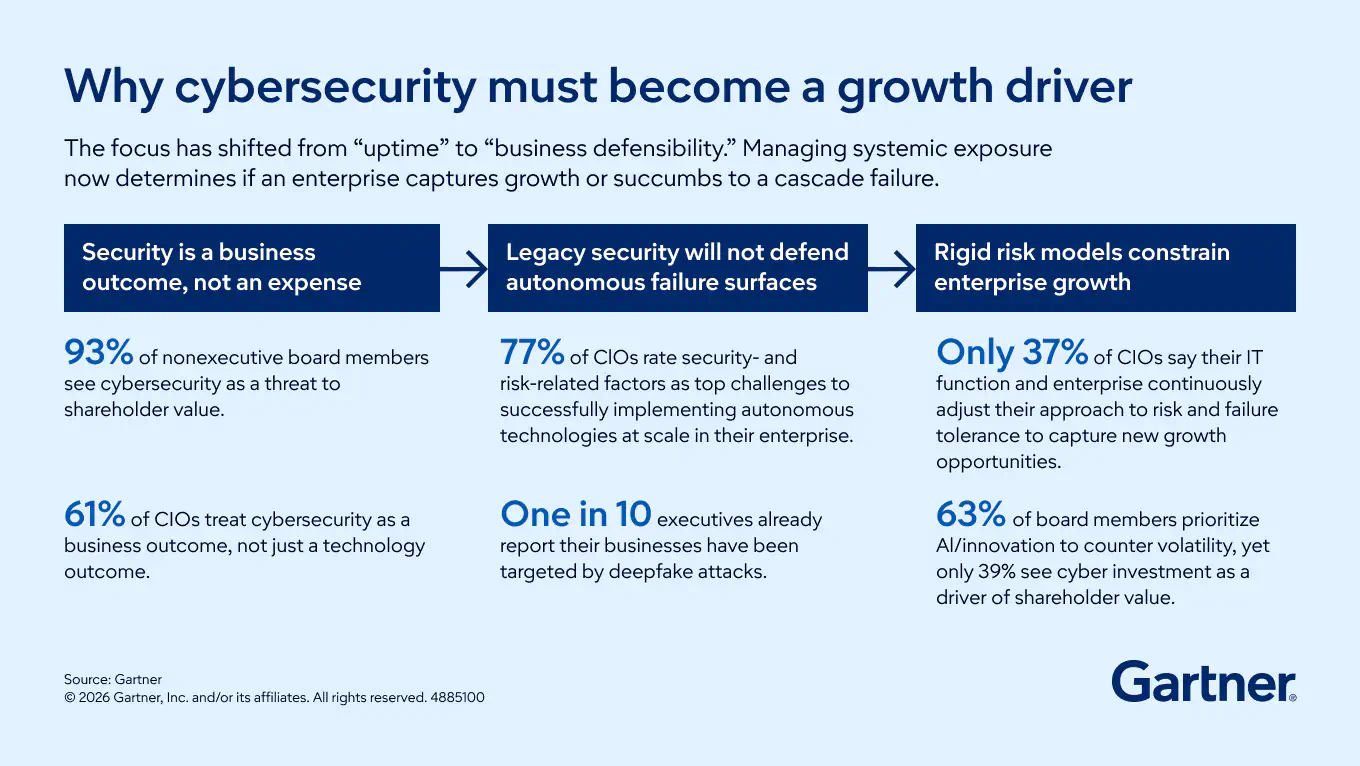
Strong CIO leadership transforms cybersecurity into a growth advantage
Cybersecurity is a strategic business capability that underpins enterprise value, operational resilience and sustainable growth. As such, CIOs must ensure cybersecurity investments align with business outcomes and board priorities, moving beyond legacy controls and compliance checklists to embed security, transparency and agility into every digital initiative.
You might also like this webinar: Drive Cybersecurity Investment in the AI Era With Outcome-Driven Metrics and Benchmarks
Cybersecurity and board priorities: From prevention to resilience
Ninety-three percent of boards see cybersecurity as a threat to value, and 61% of CIOs treat cybersecurity as a business outcome. Perfect prevention is not possible in a world of advanced, AI-driven threats and complex ecosystems. Resilience — minimizing impact and recovering quickly from incidents — is the new benchmark for effective cybersecurity leadership. Boards expect CIOs to demonstrate not just robust defenses but also business continuity, adaptability and the ability to protect value during disruption.
3 main actions for CIOs to embed cybersecurity as a business outcome
1. Break down silos and shift culture. Move beyond technical silos by building cross-functional teams and making security a shared, strategic outcome. Leadership and communication are as important as technology.
2. Translate risk into business terms. Act as a “sense maker” for the board, translating technical risk into business trade-offs to build trust and confidence.
3. Integrate security into every initiative. Security, resilience and transparency must be part of every workflow and digital project to ensure that cyber investments fuel innovation and growth.
What “good” cybersecurity looks like in large enterprises
Cybersecurity is managed as a business outcome, not just a technical function.
Outcome-driven metrics, not just technical KPIs, are reported to the board.
Security is embedded in every workflow and initiative.
Dynamic, data-driven risk appetite is defined with business leaders.
Security spend is continuously reviewed against business value.
Adoption of protection-level agreements (PLAs) aligns IT and business.
Regular workshops are used to assess risk appetite and investment options.
Preemptive, adaptive “immune systems” counter AI-era threats.
How to get started
Build cross-functional teams to make security a shared outcome.
Integrate security reviews and threat modeling into all AI and digital projects.
Define risk tolerance in partnership with business leaders.
Inventory all AI-native and shadow AI deployments.
Upskill teams to secure autonomous workflows and digital agents.
What to do next to build resilience, mitigate risk and maintain cybersecurity in the AI age
As AI, cloud and emerging quantum threats expand the attack surface, vendor risk, technical debt and data protection demand enterprisewide vigilance. Every cyber investment must tie to business outcomes, requiring CIOs to master security economics, preempt risk and manage the compounding impact of poor security on innovation. This is key to achieving the mission-critical priority of building resilience, mitigating risk and maintaining cybersecurity in the AI age.
The steps in that journey include:
Revisiting and modernizing the CIO relationship with cybersecurity, elevating cyber as a core leadership responsibility and reprioritizing how security is governed, funded and integrated into enterprise decision making
Building a new cybersecurity foundation that treats cyber as a business decision with measurable and benchmarkable protection levels, enabling CIOs to control spend, reduce inefficiency and align security investments to business outcomes
- Resetting the cybersecurity North Star to focus on stakeholder defensibility, ensuring customers, shareholders, regulators and partners agree the organization has the right level of protection while preparing for AI‑driven threats and future risk scenarios
Looking for a government perspective? Explore how public sector cybersecurity leaders are managing AI-related risks while enabling innovation and operational resilience.
Cybersecurity for CIOs FAQs
What are the biggest barriers for CIOs in treating cybersecurity as a business outcome?
CIOs often feel trapped by siloed accountability and legacy controls. The solution is to break down silos, build cross-functional teams and communicate security’s value in business terms.
How much security is “enough” for our specific risk appetite and revenue goals?
There’s no single answer — successful organizations define risk tolerance with business leaders, use outcome-driven metrics and regularly review security spend versus business value.
What cybersecurity metrics matter most to boards?
Boards want to see outcome-driven metrics that show how cybersecurity protects revenue, cost and shareholder value. These include average time to detect and recover, third-party risk engagement and AI risk readiness.
Attend a Conference
Experience CIO and IT Executive conferences
With exclusive insights from Gartner analysts on the latest trends, sessions curated for your role and unmatched peer networking, Gartner conferences help you accelerate your priorities.
19 – 22 Oct 2026
Gartner IT Symposium/Xpo™
Orlando, FL

Drive stronger performance on your mission-critical priorities.