Gartner’s predictions keep IT leaders informed and ahead of rapidly unfolding generative AI technology developments.
- Gartner client? Log in for personalized search results.


Generative AI technologies will evolve quickly over the next four years.
AI, generative AI and the technologies that underpin them will continue to drive rapid market transformation for the foreseeable future, thanks, in large part, to enormous investments from large technology companies and research labs. In fact, GenAI seems to be immune to the overall slowdown in venture capital investment, while well-funded startups continue to emerge and mature.
The speed at which GenAI technologies are emerging poses significant challenges for IT leaders tasked with staying abreast of industry developments.
Three key predictions for the future of GenAI technologies
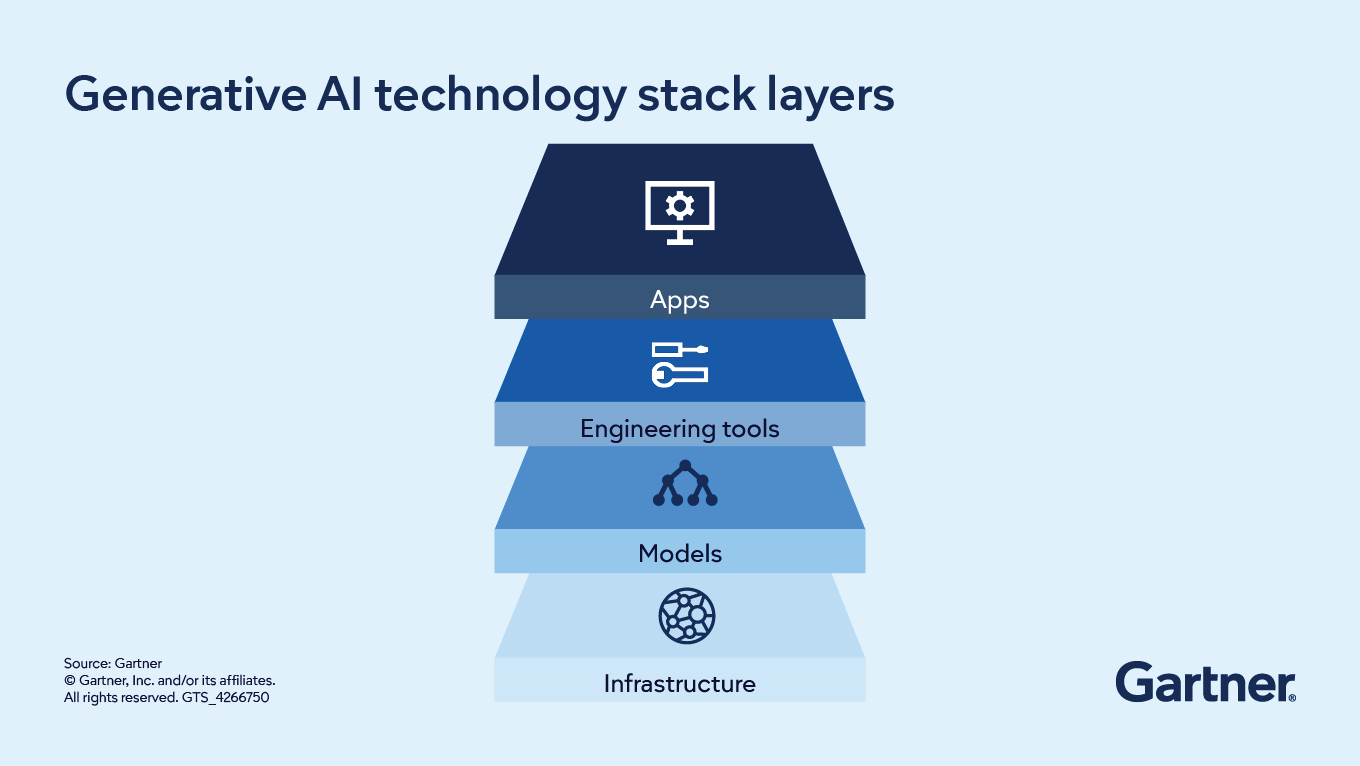
Looking at all four layers of the generative AI technology stack — infrastructure, models, AI engineering tools and applications — Gartner offers the following predictions.
GenAI prediction No. 1: Demand will increase for domain-specific GenAI models
Although general-purpose models perform well across a broad set of applications, demand for GenAI is rising in many sectors. Combined with increased availability of high-performing and commercially usable open-source large language models, there is an appetite for domain-specific models. By 2027, more than 50% of the GenAI models that enterprises use will be specific to either an industry or business function — up from approximately 1% in 2023.
Domain models can be smaller, less computationally intensive, and lower the hallucination risks associated with general-purpose models.
Plan for the need to deploy and manage multiple domain-specific GenAI models to support a variety of use cases. But before you build your own, look for off-the-shelf, domain-specific models you can train or tune to accommodate your enterprise needs.
GenAI prediction No. 2: AI agents will proliferate — and collaborate
Agentic AI, characterized by its ability to act autonomously, learn from interactions and make decisions in complex environments, will lead the next wave of digital transformation with AI and dominate GenAI investments over the next few years. By 2028, 33% of enterprise software applications will incorporate agentic AI capabilities — up from less than 1% in 2024 — and agentic AI will make at least 15% of day-to-day work decisions autonomously.
As AI agents’ ability to perform specialized tasks increases, they will need to collaborate effectively to solve complex, cross-functional projects. Multiagent generative systems (MAGS) use a “divide and conquer” approach, assigning tasks to specialized agents within and across platforms for more effective management of intricate workflows.
Future-proof your agentic AI investments and prepare for multiagent systems by staying informed on the agentic standards that align with your specific and long-term goals.
Use proven protocols when building your internal multiagent platforms — and create modular agent systems with clear boundaries to improve routing clarity and flexibility.
GenAI prediction No. 3: Multimodal GenAI will transform most enterprise applications
Multimodal GenAI boosts GenAI usability by allowing models to interact with and generate outputs across various modalities such as images, videos, audio, text, tabular data and code. The results include greater accuracy, enhanced automation capabilities, deeper contextualization around decision-making and better user experiences.
Tailored to specific industries, multimodal GenAI models will become increasingly prevalent. By 2030, 80% of enterprise software will be multimodal — up from less than 5% in 2024.
Multimodal GenAI models can be challenging to train, build, integrate and govern. Lay a strong foundation by prioritizing the modalities that are most important for your domain and use cases. Proactively invest in data quality, curated multimodal datasets and the technical expertise needed to manage them. Then create a governance strategy that covers GenAI and multimodal compliance requirements by use case and industry.
Are you a CIO or IT leader at a midsize enterprise?
See how your peers are navigating AI adoption, vendor decisions and evolving business demands — with tools tailored to your role:
Explore our resources for midsize enterprises
Check out a curated list of Gartner’s most popular research being utilized by your peers
Drive stronger performance on your mission-critical priorities.