The future demands smarter, faster decisions. AI-powered finance technology is your edge.
- Gartner client? Log in for personalized search results.
Finance Technology: The Tools-First Model for CFO Decision Support
By Brian Stickles | April 22, 2026
Finance technology transforms how CFOs deliver decision support
Gartner predicts that by 2030, frontrunner finance teams will drive a shift from traditional, in-person business partnering to a tools-first model, enabled by finance technology. These teams will deliver decision support through AI-powered, finance-built tools, meeting the growing need for faster and higher-quality support. This shift is essential for CFOs seeking scalable, effective decision-making solutions.
You might also like this Gartner webinar: Trends in the Finance Technology Market for 2026
The future of finance decision making is moving from business partnering to AI-powered tools
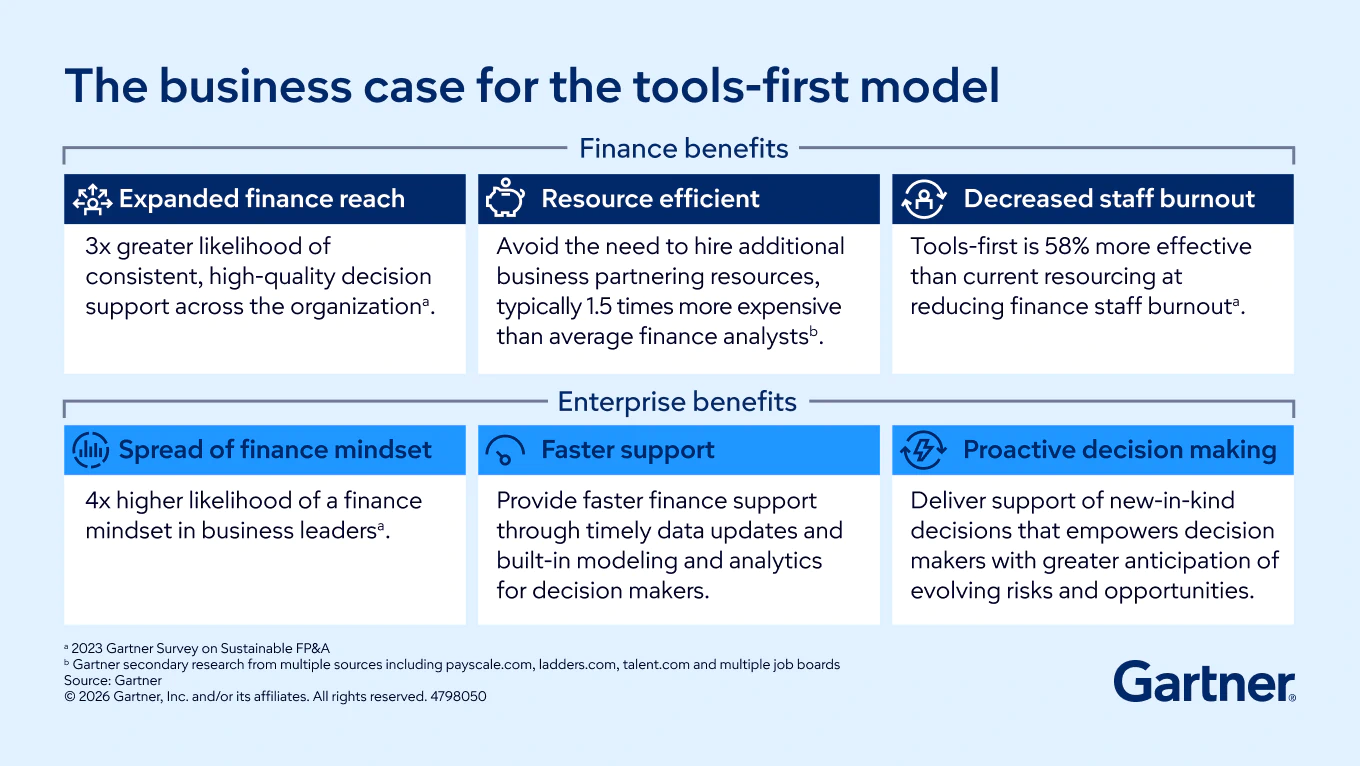
The tools-first model enables decision makers to access finance’s insights themselves. This self-sufficiency enables finance to scale its insights to more decision makers without burning out its staff. Gartner insights show that finance teams that adopt a tools-first model are 3x to 4x more effective in delivering consistent, high-quality guidance, and 58% more effective at reducing finance staff burnout.
3 main actions to adopt a tools-first finance technology model
Shift staffing models toward digital product development. Transition from hiring more business partners to building digital product teams with roles like AI product managers and knowledge engineers.
Adopt a product-oriented mindset. Prioritize usability, continuous feedback and iterative improvement to ensure tools deliver value and drive adoption. Focus on user experience, intuitive interfaces and ongoing training for business users.
Choose accessible finance technology for tool development. Select finance technology, such as agentic coding tools and low/no-code solutions, that staff can easily use to accelerate tool-building capabilities for decision support.
What “good” looks like in large enterprises
Decision support is delivered primarily through AI-powered, finance-built tools.
Business leaders can independently model scenarios and receive recommendations through finance-built tools.
Natural language interfaces make sophisticated analysis accessible to business decision makers.
Real-time feedback helps finance teams continuously improve tools.
Digital product teams manage tool development, adoption and improvement.
Context engineering ensures tools reflect unique organizational needs.
Reliance on IT for tool development is minimized to avoid bottlenecks.
How to get started with finance technology for CFO decision support
Work with IT to create a digital sandbox for finance tool-building exploration.
Retrain finance business partners to focus on teaching and need-sensing.
Begin storing organizational context (e.g., meeting transcripts, emails) for future AI use.
Pilot a tool where decision support demand is high and analysis is repeatable.
Select agentic coding or low/no-code platforms aligned with team skills.
Measure tool performance and user adoption continuously.
Gather user feedback to drive iterative improvements.
Expand tool deployment as adoption and effectiveness grow.
What to do next to lead the shift to AI-first finance
AI has ushered in the biggest transformation to finance since the digital spreadsheet, requiring CFOs to act as catalysts for fundamental change by leading the shift from legacy systems and mindsets to an agile, AI‑powered finance function. That vision marks the starting point of a broader journey CFOs must navigate to fully deliver on the mission‑critical priority of leading the shift to AI-first finance.
The steps in that journey include:
Redesigning finance teams, roles and ways of working to maximize AI’s benefits. This includes shifting responsibilities, updating talent profiles and evolving workflows so the function captures transformational — not just fractional — productivity gains.
Reviewing validated finance AI use cases and applying best practices for identifying, prioritizing and piloting new opportunities. CFOs should also assess emerging vendors that can support evolving finance needs as use case complexity grows.
Assessing digital and technical capabilities required for successful finance AI implementation. That means deploying emerging best-practice solutions to build both the systems and the people capabilities needed to accelerate adoption and scale value.
Creating a finance AI roadmap that builds value-added capabilities while delivering measurable ROI. CFOs should ensure the roadmap explicitly ties automation, efficiency and potential headcount displacement to clear financial outcomes.
Learning how to approach build‑versus‑buy decisions for finance AI solutions. Understanding where vendor capabilities lead or lag CFO expectations helps determine which capabilities are best sourced externally and which should be developed in‑house.
For more on how Gartner helps drive success on this and other mission-critical priorities for CFOs, speak to us today.
FAQs about finance technology for CFO decision support
What is the tools-first model in finance technology for CFO decision support?
The tools-first model uses AI-powered, finance-built tools to deliver decision support, enabling CFOs and business leaders to access insights, model scenarios and make decisions without relying on in-person finance partners.
How does finance technology for CFO decision support improve efficiency?
Finance technology for business decision support scales decision support 3x to 4x more effectively than traditional methods, reduces burnout by 58% and allows finance teams to focus on higher-value work.
What are the first steps for adopting finance technology for CFO decision support?
Start by enabling tool-building exploration, retraining staff for digital roles, storing organizational context and piloting tools where demand is highest and analysis is repeatable.
Attend a Conference
Join Gartner analysts and your peers to accelerate growth
Gather alongside your peers in National Harbor to gain insight on emerging trends, receive one-on-one guidance from a Gartner analyst and create a strategy to tackle your priorities head-on.
2 – 4 Jun 2027
Gartner Finance Symposium/Xpo™
National Harbor, MD

Drive stronger performance on your mission-critical priorities.