Discover new AI-driven sales metrics to improve seller performance when traditional approaches miss.
- Gartner client? Log in for personalized search results.
AI-driven sales metrics expose critical performance gaps
Traditional sales productivity metrics are failing chief sales officers (CSOs). In 2025, 31% of CSOs missed new customer acquisition targets and 26% fell short on customer growth. Economic and political uncertainty has made deals stall and churn risk spike. Yet, most sales analytics functions aren’t delivering the actionable insights leaders expect — 47% of CSOs say analytics have less influence on performance than executive leadership wants.
The problem? Relying on lagging indicators like win rates and deal size hides the real drivers of seller performance. But with new AI-powered approaches, CSOs are now able to quantify the value of every customer interaction, revealing what improves performance. With average interaction value (AIV), sales leaders unlock sharper coaching, smarter go-to-market decisions and clear ROI on AI investments.
AI-driven sales metrics redefine productivity measurement
AI-driven metrics give CSOs a new lens on productivity. Three KPIs matter most — account reach, account engagement and AIV. Here’s how they work together:
Account reach spotlights market coverage
Account reach measures how many accounts your sellers actively engage — through emails, calls or meetings — in a given period. This KPI tells you if your team is maximizing territory potential or leaving opportunities untouched. Use it to see which sellers stretch for new accounts and where coverage gaps exist.
Account engagement reveals seller activity patterns
Account engagement tracks the average number of interactions per active account. It answers: Are your sellers hitting the optimal cadence? What’s the right mix of human and AI-supported touches? Top performers often blend high-frequency, high-value interactions. Segment this metric by sales role or customer type to pinpoint what works.
Average interaction value quantifies revenue impact
AIV is the average revenue earned per customer interaction. It’s the missing link between activity and outcomes. There are two ways to measure it:
Simple: Total revenue divided by total interactions.
Advanced (AI-driven): For each interaction, multiply deal value by the change in probability to close, and then average across the period.
AIV lets you see which campaigns, messages and sellers drive the most value — and where AI is boosting results.
Comparative analysis drives targeted coaching
When you analyze these KPIs together, you get a multidimensional view of seller performance. Comparative analysis highlights strengths, exposes weaknesses and helps managers deliver personalized coaching. The result? More accurate identification of top performers, better development for struggling sellers and smarter investments in enablement.
How to implement AI-driven sales productivity metrics
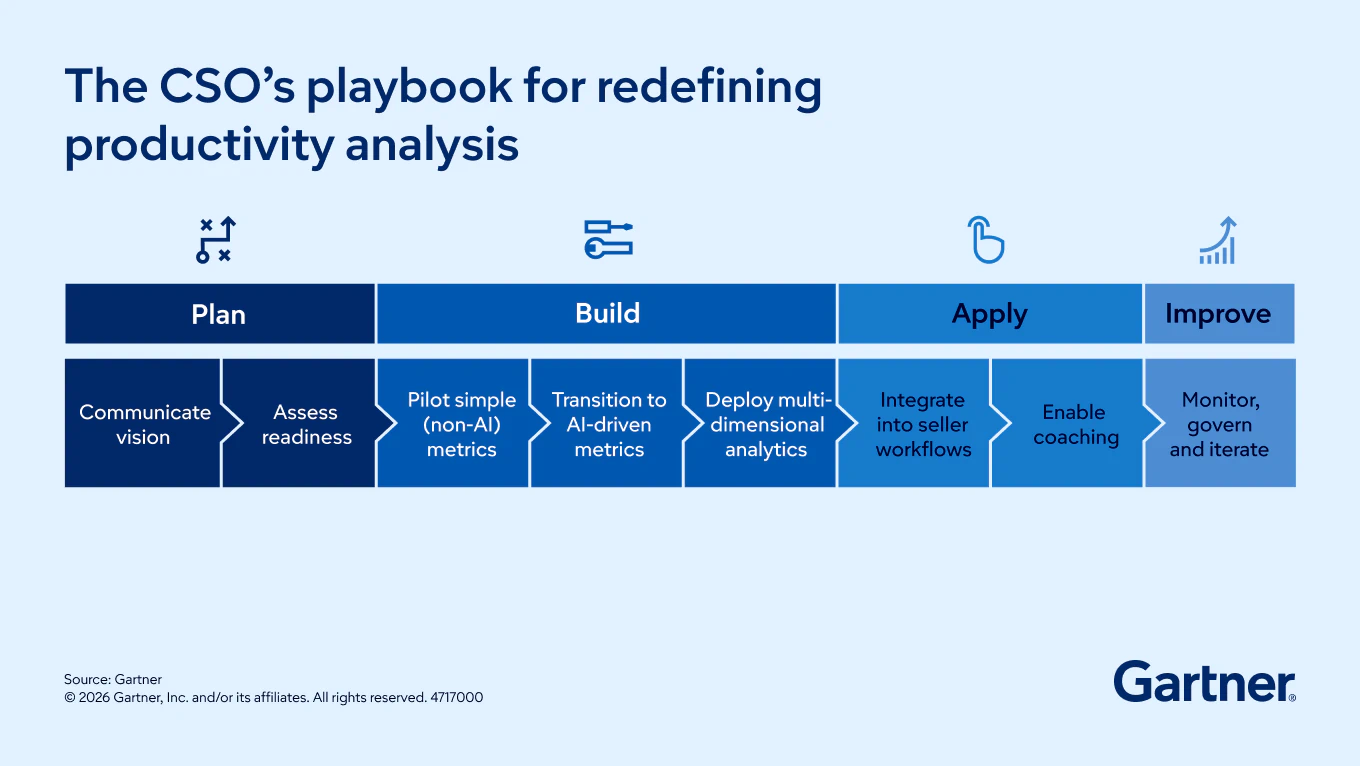
Follow this eight-step playbook to put interaction-based KPIs into action.
Communicate vision: Explain why interaction value matters to execs and frontline teams.
Assess readiness: Audit your sales tech stack and data quality.
Pilot simple metrics: Test account reach, engagement and basic AIV with a sample group.
Transition to AI-driven metrics: Upgrade platforms to capture granular, AI-powered interaction data.
Deploy analytics: Roll out dashboards and reporting for comparative analysis.
Integrate into workflows: Embed predictive analytics and real-time feedback in seller tools.
Enable coaching: Train managers to use new metrics for personalized coaching.
Monitor, govern and iterate: Establish ongoing reviews, data quality checks and metric refinement.
What to do next
Pinpointing sales productivity and performance levers is one critical step in the CSO’s mandate to reimagine sales productivity in the AI era.
The other steps in this imperative include:
Aligning AI strategy to productivity gaps by fundamentally reimagining workflows around productivity objectives, challenging assumptions, and aligning sellers and technology where each has a competitive advantage.
Building a tech-enabled operating rhythm by embedding calculation, monitoring and validation of productivity into AI-driven systems and the supporting operations layer, using technology to streamline workflows, reduce decision fatigue and sustain high‑value performance gains.
Executing AI-driven workflow transformations by evolving operations for activation, acceptance and adoption of AI workflows — preparing data, translating business requirements into AI workflows, establishing governance, validating system efficacy, simplifying seller roles and piloting before scaling.
Isolating key metrics and related workflows by decoupling processes from traditional headcount assumptions, identifying which activities drive results, aligning impact metrics to workflows and establishing new baselines with productivity measures independent of FTE.
AI-driven sales metrics FAQs
Why do traditional sales productivity metrics fall short?
Traditional metrics focus on lagging indicators like win rates and deal size, missing the nuances of seller performance. Gartner analysts recommend shifting to interaction-based KPIs — account reach, engagement and AIV — for a more actionable, real-time view of what drives success.
How does analyzing average interaction value (AIV) improve sales productivity?
AIV quantifies the revenue impact of every customer interaction, not just closed deals. Gartner insights show that using AIV helps CSOs identify which activities, messages and sellers drive the most value. This enables targeted coaching, sharper go-to-market decisions and clearer ROI on AI investments.
What are the biggest challenges in implementing AI-driven sales metrics?
Gartner has identified two main hurdles: data quality and system maturity. Advanced AIV calculations require detailed pipeline data and accurate probability-to-close metrics. Success depends on robust sales data infrastructure and transparent, interpretable AI models to ensure adoption and trust among sales teams.
Attend a Conference
Join Gartner analysts and your peers to accelerate growth
Gather alongside your peers in Las Vegas to gain insight on emerging trends, receive one-on-one guidance from a Gartner analyst and create a strategy to tackle your priorities head-on.
18 – 19 May 2027
Gartner CSO & Sales Leader Conference
Las Vegas, NV

Drive stronger performance on your mission-critical priorities.