AI will shift routine finance work to machines and focus human effort on judgment and accountability.
- Gartner client? Log in for personalized search results.
AI Finance Transformation: How 7 Core Finance Activities Will Change by 2030
By Shankar K | July 14, 2026
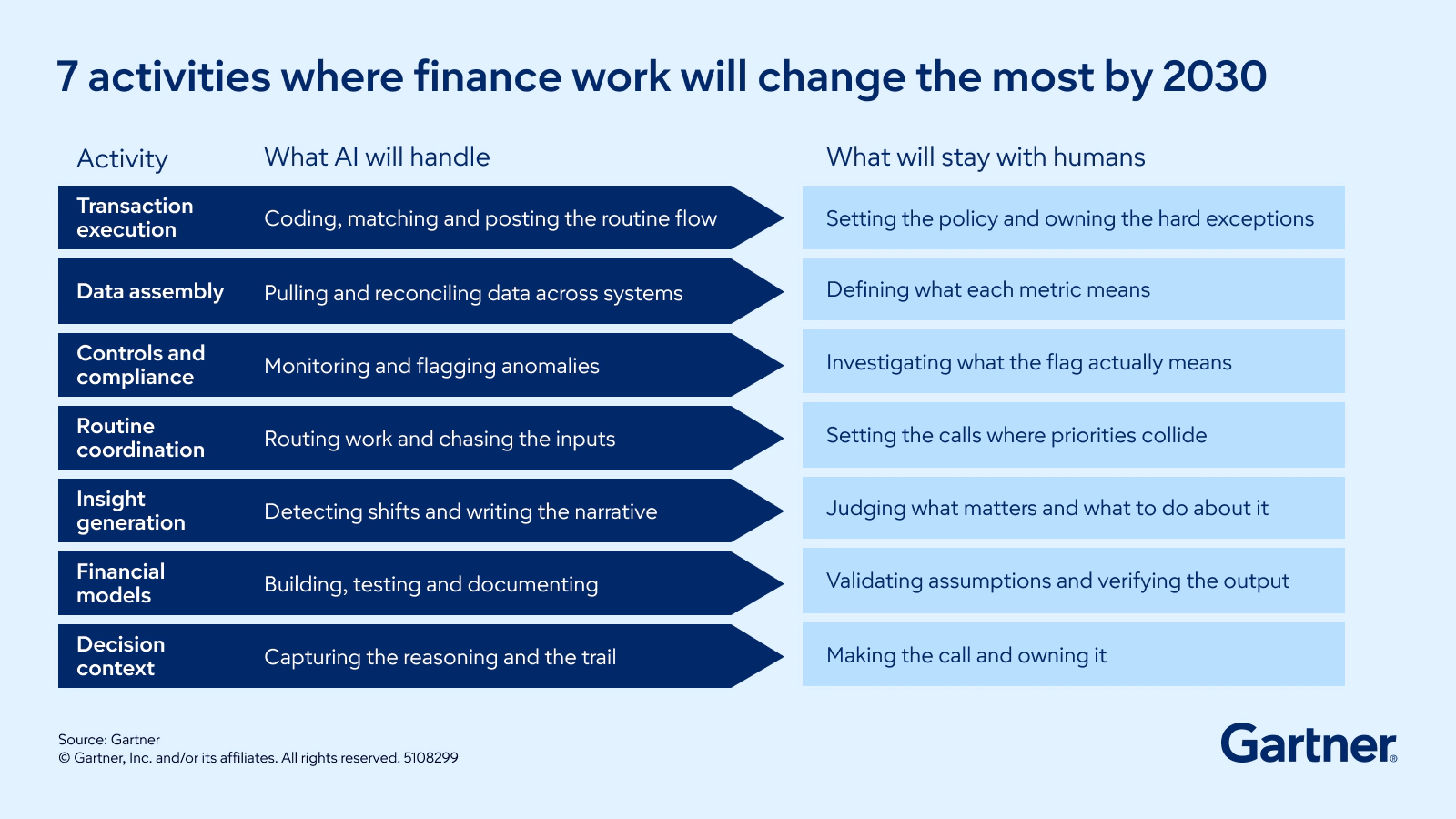
AI will redefine finance roles and reshape operating models
By 2030, Gartner predicts that finance will be organized around new divisions of labor between humans and machines. The defining question for CFOs will be which parts of finance work can be executed by machines, which require human judgment and which decisions require accountable human ownership. AI will take a larger share of the work where logic can be expressed as rules, policies or repeatable patterns. Human effort will focus on areas where judgment affects outcomes, such as setting policies, defining metrics, resolving exceptions and owning decisions with audit or reputational consequences.
Proactive CFOs can turn AI adoption into an operating model advantage by separating machine-run activities from human-owned decisions, then redesigning roles, controls, data governance and accountability around that split. After that, shift people out of manual assembly and review work and into boundary setting, exception handling and outcome ownership.
AI will automate routine tasks and change finance accountability
AI capabilities are advancing faster than most finance operating models can absorb. CFOs see that AI will change day-to-day finance work, but often lack clarity on which activities will move to AI, which will remain with people and how roles, controls and accountability should change as a result.
Finance functions that delay this redesign, risk carrying today’s high cost structure into an AI-enabled environment — slowing decisions, leaving control gaps and eroding stakeholder confidence. Acting now creates operating leverage, scaling transaction volume and business support without headcount growth.
Transaction execution, data wrangling and controls will shift to AI.
Gartner expects that humans will no longer be the manual integration layer for core transactions by 2030. AI agents will handle corrections, recoding, approvals and matching payments. Accounts payable, travel and expense, and cash applications will become fully automated, with machines executing processes and generating audit trails. Data work that feeds every report and model will move off human desks. Agents will query governed semantic layers and answer questions directly, with data tooling tracing lineage and flagging quality issues automatically.
Controls and compliance will shift to continuous, explainable monitoring. AI systems will watch every transaction, learn what normal looks like and produce an auditable evidence trail. Regulators and audit committees already see this as stronger than periodic sampling.
Human roles will focus on judgment, exceptions and accountability.
Human work will concentrate on areas where judgment changes outcomes; setting approval policies, handling exceptions, ensuring master data quality and owning fraud risk. In data wrangling, humans will define metrics, govern access and resolve context-driven exceptions. For controls and compliance, humans will define boundaries, investigate high-impact anomalies and manage remediation.
As AI takes over routine tasks, humans will set priorities, manage escalations and negotiate trade-offs that require enterprise context. In insights generation, people will frame and interpret findings, challenge assumptions and maintain stakeholder credibility. For model building, humans will define the business question, validate assumptions and remain accountable for recommendations.
Decision traceability and insights delivery will become machine-driven.
By 2030, Gartner predicts that the record of how a decision is reached will become a designed capability. AI will capture decision context automatically, link decisions to evidence and summarize discussions into structured logs. Humans will define which decisions require traceability, retain accountability for approvals and govern privacy and psychological safety.
Insights delivery will shift from decks and meetings to embedded, proactive, conversational tools. Systems will detect margin shifts in real time, write narratives and answer follow-up questions in plain language — all embedded directly into decision workflows.
What to do next to lead the shift to AI-first finance
AI is driving the most significant change in finance since the digital spreadsheet. CFOs must lead the shift from legacy systems and mindsets to an agile, AI‑powered finance function. Start the journey to an AI-first finance function with these steps.
Redesign finance teams, roles and ways of working to maximize AI’s benefits. Shift responsibilities, update talent profiles and evolve workflows to capture transformational productivity gains.
Review validated finance AI use cases and apply best practices for identifying, prioritizing and piloting new opportunities. Assess emerging vendors as use case complexity grows.
Assess digital and technical capabilities required for successful finance AI implementation. Deploy best-practice solutions to build both system and people capabilities.
Create a finance AI roadmap that delivers measurable ROI. Tie automation, efficiency and potential headcount displacement to clear financial outcomes.
Learn how to approach build‑versus‑buy decisions for finance AI solutions. Understand where vendor capabilities lead or lag CFO expectations to determine which capabilities are best sourced externally and which should be developed in‑house.
For more on how Gartner helps drive success on this and other mission-critical priorities for CFOs, speak to us today.
AI finance transformation FAQs
What will AI finance transformation mean for finance teams by 2030?
Gartner predicts that finance will be organized around new divisions of labor between humans and machines by 2030. AI will take a larger share of work that can be expressed as rules, policies or repeatable patterns, while human effort will focus on areas where judgment affects outcomes, such as setting policies, defining metrics, resolving exceptions and owning decisions with audit or reputational consequences.
Which finance activities are most likely to shift to AI?
Gartner expects transaction execution, data wrangling, controls and compliance monitoring, decision traceability and insight delivery to become increasingly machine-driven. AI agents will handle activities such as corrections, recoding, approvals, matching payments and answering questions through governed semantic layers, while AI systems continuously monitor transactions and generate auditable evidence trails.
What responsibilities will remain with people in an AI-powered finance function?
Human work will concentrate on areas where judgment changes the outcome. Finance professionals will continue to set approval policies, handle exceptions that rules cannot resolve, ensure master data quality, investigate high-impact anomalies, manage remediation, define business questions, validate assumptions and retain accountability for model-generated recommendations.
Attend a Conference
Join Gartner analysts and your peers to accelerate growth
Gather alongside your peers in National Harbor to gain insight on emerging trends, receive one-on-one guidance from a Gartner analyst and create a strategy to tackle your priorities head-on.
2 – 4 Jun 2027
Gartner Finance Symposium/Xpo™
National Harbor, MD

Drive stronger performance on your mission-critical priorities.