AI-generated work creates labor-like costs, governance needs and management responsibilities.
- Gartner client? Log in for personalized search results.
AI costs are becoming harder to predict
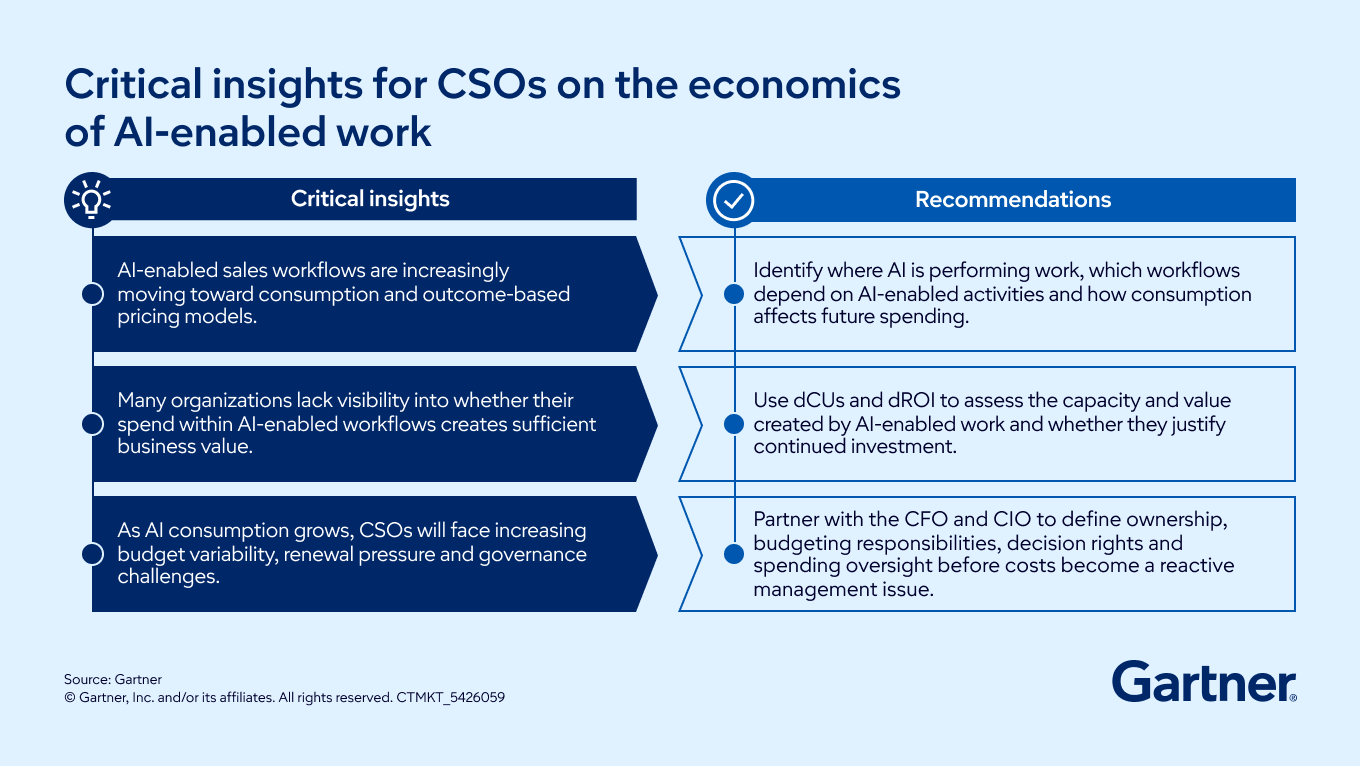
For years, AI capabilities were bundled into software subscriptions, enterprise agreements and technology investments that created relatively predictable costs. As AI adoption expands, that predictability is starting to disappear. Sales organizations increasingly rely on AI for prospecting, account planning, forecasting, coaching and seller assistance.
“AI-enabled sales workflows that previously appeared ‘free’ or included within software subscriptions are increasingly moving toward metered pricing models based on consumption, workflow execution, credits or business outcomes,” says Alyssa Cruz, Senior Director Analyst at Gartner.
Costs are now driven by the amount of work AI performs rather than the number of users who have access to it.
You might also like this webinar: Redesign Roles to Elevate AI-Augmented Seller Productivity
AI is becoming digital labor
Most organizations still manage AI as software, but Gartner argues that AI-generated work increasingly behaves like labor. It performs measurable work, creates capacity and generates costs that scale with usage.
Work performed matters more than software access
As AI performs more sales activities, from prospecting to forecasting and coaching, organizations will increasingly invest in digital sales capacity rather than software access alone.
This shift changes how leaders think about AI investments. Traditional software delivers functionality while digital labor delivers capacity. Sales leaders need visibility into the work being performed, the capacity being created and the value delivered in return.
| Traditional Software Model | Digital Labor Model |
Primary Purchase | Software access and licenses | Work performed and capacity created |
Cost Structure | Fixed and predictable | Variable and consumption-based |
Value Measured By | Users and seats | Work completed and business outcomes |
Management Approach | Technology asset management | Workforce resource management |
Governance Focus | Deployment and access | Usage, value creation and economics |
Budget Planning | License forecasting | Capacity and consumption forecasting |
Digital labor creates new economics
AI-generated work creates capacity. The challenge for sales leaders is determining whether that capacity justifies its cost.
Gartner recommends evaluating this work through concepts such as:
Digital capacity units (dCUs) to estimate the capacity AI creates relative to human effort
Digital return on investment (dROI) to assess whether AI-generated capacity produces sufficient business value to justify continued investment
The goal is not to track usage for its own sake. It’s to understand whether AI is creating meaningful sales capacity and whether the resulting value outweighs the associated costs.
Sales leaders need governance before costs scale
As AI consumption increases, spending, ownership and accountability become more complex. Sales, finance and IT may all influence AI spending without a single group maintaining end-to-end accountability.
CSOs should work with CFOs and CIOs to establish governance before costs become a reactive issue. They should also create visibility into the following:
AI-enabled workflows that generate costs
Consumption patterns across teams and activities
Decision rights for AI spending and investment
Thresholds that trigger spending reviews or intervention
Organizations that govern digital labor early will be better prepared to forecast spending, negotiate renewals and scale AI-enabled work responsibly.
Sales AI FAQs
Why is AI becoming digital labor?
AI increasingly performs measurable work and creates measurable capacity. As pricing models shift toward consumption and outcomes, AI-generated work begins to behave more like labor than traditional software.
How should CSOs measure AI-generated work?
Gartner recommends evaluating AI-generated work using concepts such as dCUs and dROI to understand capacity creation, costs and business value.
Why do sales leaders need AI governance?
As AI consumption grows, organizations face greater spending variability, renewal pressure and budget accountability challenges. Governance helps align AI investment with business outcomes and operational priorities.
Attend a Conference
Join Gartner analysts and your peers to accelerate growth
Gather alongside your peers in Las Vegas to gain insight on emerging trends, receive one-on-one guidance from a Gartner analyst and create a strategy to tackle your priorities head-on.
18 – 19 May 2027
Gartner CSO & Sales Leader Conference
Las Vegas, NV

Drive stronger performance on your mission-critical priorities.