Explore how AI agents will redefine HR workflows, roles and technology strategies—and what HR leaders must prepare for
- Gartner client? Log in for personalized search results.
Agentic AI in HR: Strategic Foundations for CHROs
Why Agentic AI Is Critical for CHROs
By 2030, 50% of HR tasks will be completed through AI agents, fundamentally reshaping HR workflows, roles, and technology strategies. These agents go beyond automation—they perceive, decide, and act with minimal supervision, enabling HR to shift from transactional execution to strategic impact.
Download the Gartner Agentic AI in HR insight to learn:
What defines true AI agents—and why autonomy matters
How agentic AI will transform HR technology and operating models
Key considerations for responsible adoption
About Agentic AI in HR
Agentic AI represents a shift from reactive tools to autonomous or semi-autonomous entities that perceive, decide, and act to achieve objectives. In HR, these agents can streamline processes such as candidate sourcing, interview scheduling, and payroll execution, reducing manual intervention and improving efficiency.
For CHROs, this is more than a technology upgrade—it’s a leadership imperative. Early engagement helps organizations capture efficiency gains, improve decision quality, and prepare for new governance and workforce models.
Agentic AI in HR FAQs
What is Agentic AI in HR?
Agentic AI in HR is an approach that builds HR solutions using one or more AI agents — autonomous or semiautonomous software entities that perceive, make decisions, take actions and pursue goals in digital or physical environments.
AI agents are not digital workers. They are pieces of software that use a range of AI techniques, including GenAI and machine learning, to perform tasks.
Why is Agentic AI a priority for CHROs now?
Adoption momentum is accelerating: 82% of HR leaders plan to implement agentic AI by 2026, mainly driven by efficiency goals and cost optimization.
Gartner forecasts that by 2030, 50% of HR activities will be automated or agent-driven, reshaping HR’s operating model. Early engagement allows CHROs to influence governance, workforce planning, and vendor strategy before the technology becomes mainstream.
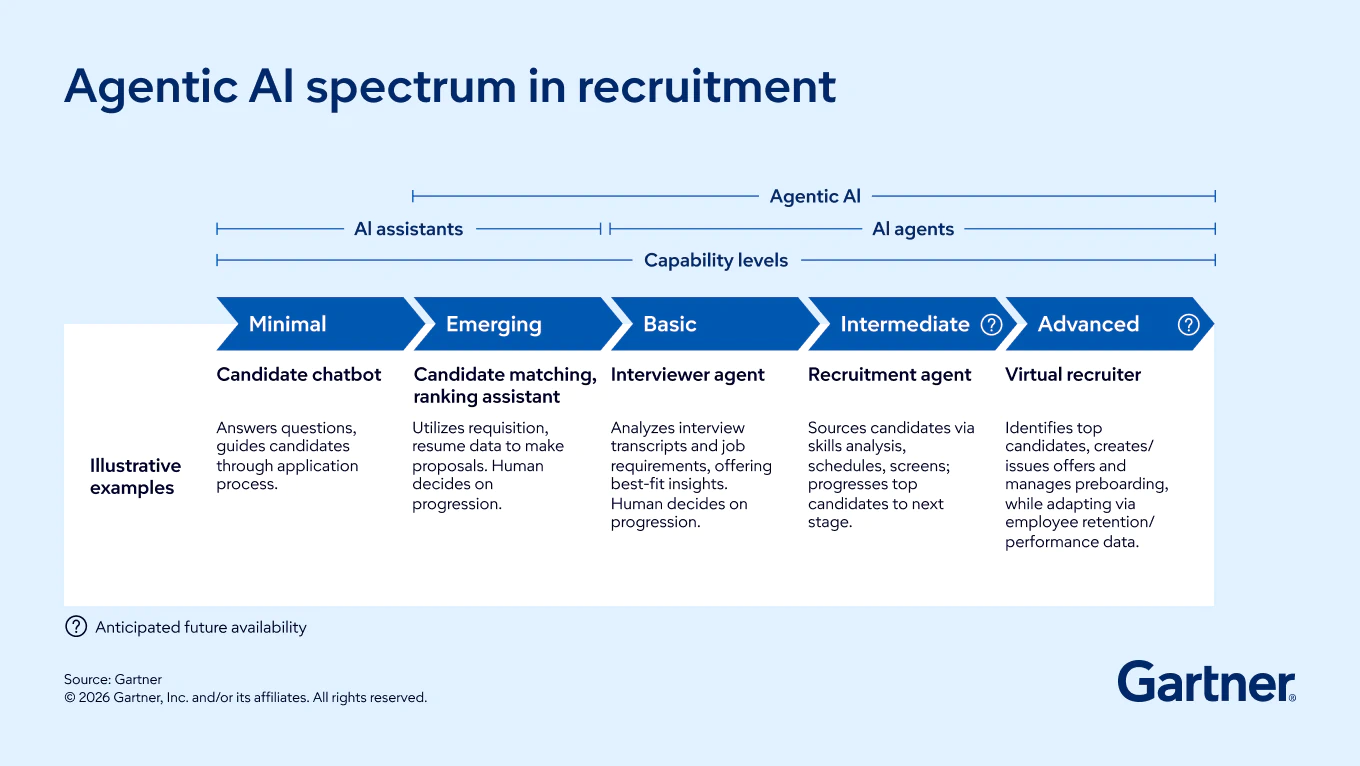
How do AI agents differ from AI assistants, and why does this distinction matter?
AI assistants respond to prompts and enhance tasks within predefined boundaries. AI agents, by contrast, plan, act, and adapt with minimal supervision—executing complex workflows either semi- or fully- autonomously.
For example, an assistant might suggest candidate rankings, while an agent can source candidates, execute outreach, and schedule interviews.
Understanding this distinction helps CHROs avoid “agentic AI washing,” where vendors rebrand assistants as agents without delivering true execution autonomy.
What are examples of Agentic AI use cases in HR?
Agentic AI is already influencing HR workflows, with use cases emerging across different levels of autonomy:
Performance Management: Agents can draft performance reviews by pulling data from multiple sources, suggest ratings, and prepare talking points—saving managers hours of manual work.
Sentiment Analysis: Agents synthesize data from pulse surveys, chat platforms, and feedback channels to provide real-time insights into workforce sentiment, along with recommended action plans.
Recruiting: Advanced agents can proactively source candidates, manage outreach, and schedule interviews.
These examples illustrate how agentic AI moves beyond reactive automation to deliver adaptive, context-aware support for HR leaders. For a full roadmap and additional use cases, download Gartner’s research.