Learn how to align structure, talent, and strategy for sustainable business success
- Gartner client? Log in for personalized search results.
Organization Design for CHROs: Leading Change in the AI Era
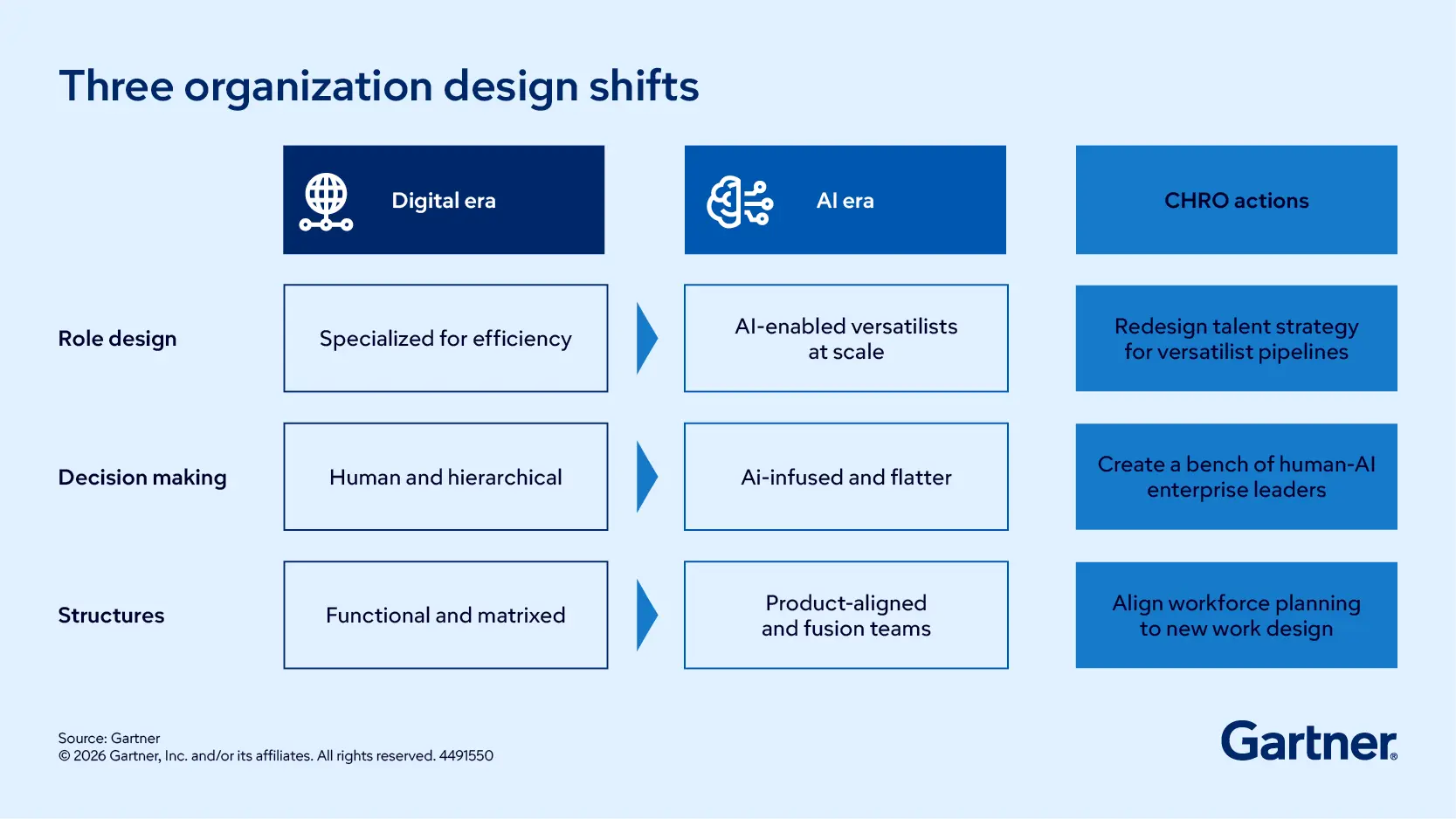
AI Drives New Org Design: Key Shifts CHROs Must Lead
AI is fundamentally changing organization design. Gartner research shows that by 2028, top-performing organizations will shift over half their workforce to versatilist roles, reduce decision-making layers from six to four, and move toward product-aligned structures. Download the Gartner guide for actionable insights tailored for CHROs, including how to:
Redesign talent strategies to build pipelines of versatilist leaders
Streamline decision-making for broader, AI-infused domains
Transition to product-aligned structures for greater agility
Implement enterprise-wide talent management for future-ready workforce planning
Why Continuous Organization Design Is Essential for CHROs Navigating AI, Disruption, and Enterprise Transformation
Organization design is a critical enterprise capability in an era defined by constant disruption and the rise of AI. Gartner research highlights that episodic redesign is no longer sufficient. CHROs and executive teams must embed organization design as a continuous discipline, aligning HR and C-suite leaders to drive and sustain enterprise-wide transformation. This approach ensures that organization design supports disciplined growth, operational efficiency, and the agility required to respond to new technologies and market shifts.
Intentional organization design means making deliberate decisions about how work is structured, how value flows through the organization, and how talent and culture are developed to support strategic goals. It requires leaders to balance short-term needs with long-term vision, integrate people and technology, and foster a culture that is adaptable to change. By prioritizing organization design, leaders can enable their organizations to thrive amid disruption and achieve sustainable success.
Gartner’s frameworks, playbooks, and tools, including the Organization Design Accelerator, guide CHROs from strategic alignment through execution and ongoing review, ensuring organization design supports disciplined growth, operational efficiency, and AI-driven agility.
Organization Design FAQs
What is Organization Design?
Organization design is the end-to-end, strategic practice of aligning an organization’s processes, structure, talent, governance, performance metrics and rewards, and technology, with its strategy and desired culture. It applies a full-system lens, ensuring choices across all organizational elements are integrated, sequenced, and mutually reinforcing, to enable sustained performance.
Why is organization design important for business success?
Effective organization design is essential for disciplined growth, operational efficiency, and the ability to adapt to disruption. Gartner research shows that most CEOs believe their operating models are unfit for AI, and fewer than half of CHROs are confident in meeting their organization design goals. Embedding organization design as a core capability helps leaders create future-ready organizations that can respond to changing market conditions, leverage AI, and sustain strategic outcomes.
How can CHROs and executive teams lead organization design transformation?
CHROs play a distinctive role in shaping and influencing business strategy through organization design. CHROs can guide the process from strategy development to implementation and ongoing review. This approach ensures alignment across the C-suite, enables enterprise-wide transformation, and supports continuous improvement to keep the organization.