How to sense skills shifts and act before gaps slow growth.
- Gartner client? Log in for personalized search results.


Skills strategy is at a crossroads
Growth depends on new capabilities, but most organizations lack the skills to deliver. According to the latest Gartner insights, only 7% of HR leaders say their workforce is ready for the future. Meanwhile, looming budget cuts and productivity pressures make traditional development strategies harder and more important to execute, as organizations can ill-afford premiums for recruiting new talent or pulling employees away from core work for training.
4 imperatives for building an agile skills strategy
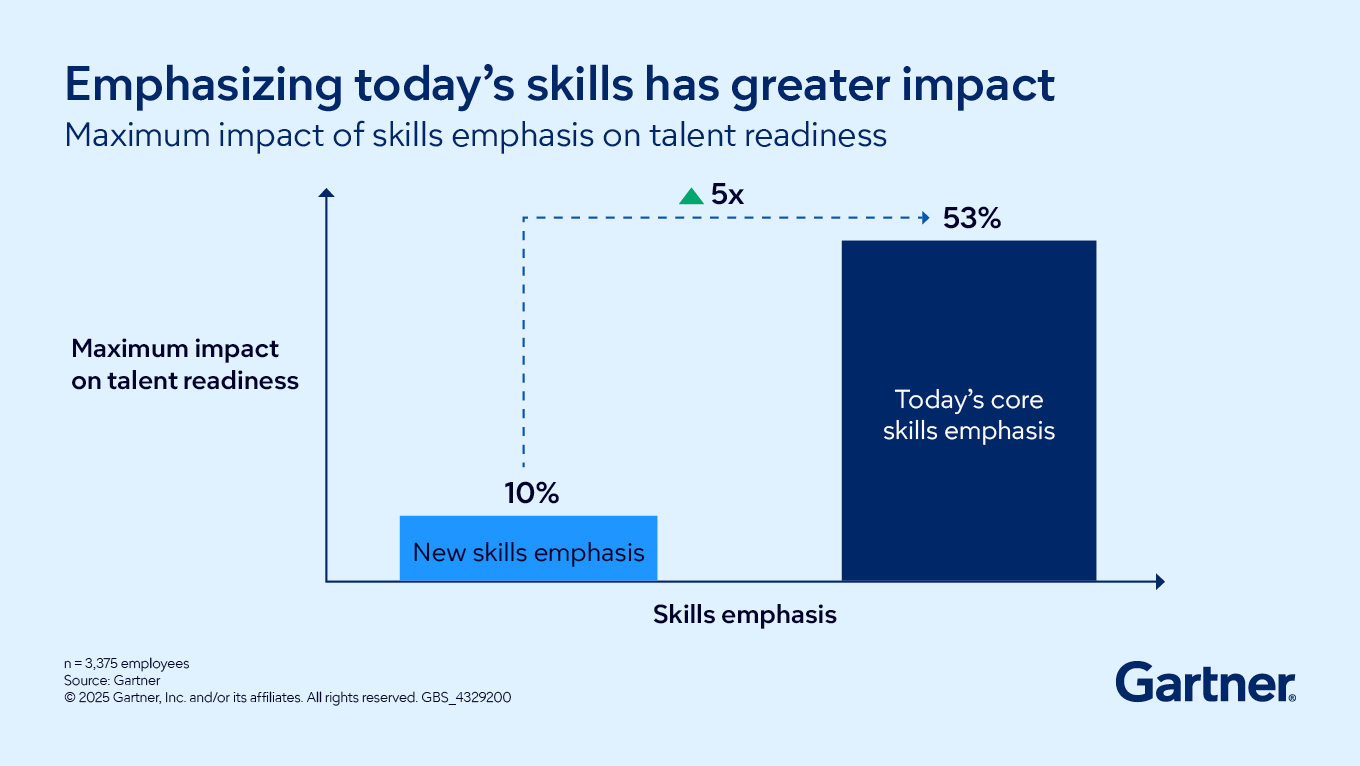
The good news: There’s a smarter way forward. Shift your focus from chasing every new skill to strengthening today’s core skills — the foundation employees need to perform now and adapt quickly later. Gartner insights show this approach has five times the impact on talent readiness compared to prioritizing new skills alone. Do this with four imperatives: Build skills intelligence, focus resources where they matter most, deliver learning at speed and continuously adjust as priorities shift.
Build skills intelligence to identify what matters
Progressive organizations are narrowing their focus for skills data collection, or “skills intelligence.” Moving beyond exhaustive skills inventories, they’re honing in on collecting quality data about skills needed for the organization’s core workflows and accepting directional information about less critical skills areas. Collecting, organizing and analyzing skills data is a significant effort, and fully comprehensive skills data is both costly and often unnecessary. A narrow focus on understanding the skills that underpin core workflows allows organizations to invest that effort sustainably and target information needed for critical talent strategy decisions.
To establish sustainable skills intelligence:
First, align on a clear vision for core skills.
Prioritize roles based on their stability or dynamism.
Build partnerships to create a robust data infrastructure.
Align learning resources to critical priorities
Even with a narrowed focus on core skills, HR teams often face more learning priorities than resources can support. Make trade-offs transparent and fund what moves the needle:
Continuously communicate alignment between organizational priorities and learning budgets. Alignment with business priorities often fades as urgent requests arise. Regularly reinforce the connection between core organizational priorities and learning spending to determine appropriate trade-offs and keep resources focused on initiatives with the greatest impact:
Support self-directed learning to help employees address fast-moving, hyperpersonalized needs on their own. You’ll never meet everyone’s exact learning needs, so it’s important that organizations build employees’ capability to find the learning resources they need, when they need them.
Deliver learning at the speed of business
Traditional learning delivery models cannot keep pace with today’s skills demands. To adapt learning delivery for speed, scale and agility, adjust your approach to:
Managing learning delivery partners. Design tiers of engagement to clearly define and narrow the scope of partners who need to be engaged on changes to learning delivery strategy and execution.
Connecting employees with expertise. Maximize the impact of subject matter experts with collective learning opportunities, like skill-based peer learning networks, digital twin repositories of organizational knowledge, and AI-enabled coaching.
Implementing learning technology rollouts. Time technology rollouts to coincide with peak motivation. Demonstrate how new technology helps employees and leaders reach their performance goals, thus improving adoption levels.
Promoting learning to employees. Communicate the skills employees need to drive growth in their role, rather than specific resources or programs to drive motivation, and help employees effectively direct their development.
Adjust strategy continuously
Business priorities will continue to shift, technologies will evolve and skills requirements will change. It’s critical to build responsive feedback loops that track organizational learning in real time and support pivots. Here’s how:
Map learning activities to business outcomes. Map how learning activities connect to business results to spot early signs that the strategy needs to change.
Use a select set of leading and lagging indicators to inform design decisions. Choose the right metrics to track progress. Focus on a few key indicators to guide learning design and demonstrate real business impact.
Tier data collection to track the most critical skills. Focus on measuring only the most important skills that drive business performance.
Learning and development FAQs
What is a skills-sensing network and why does it matter?
Skills-sensing networks enhance learning and development by integrating insights from various HR partners, such as talent acquisition and diversity groups. These networks offer real-time skills intelligence, helping organizations identify and address skills needs promptly, making better talent decisions.
What are skills accelerators?
Skills accelerators are tools that facilitate quicker application of new skills on the job, replacing traditional training methods. They adapt learning delivery to business needs, build on existing skills and use influential employees to provide personalized learning support, ensuring timely upskilling and reskilling.
Attend a Conference
Join Gartner experts and your peers to accelerate growth
Gather alongside your peers in Orlando to gain insights on emerging trends, receive one-on-one guidance from a Gartner expert and create a strategy to tackle your priorities head-on.
26 – 28 Oct 2026
Gartner HR Symposium/Xpo™
Orlando, FL

Drive stronger performance on your mission-critical priorities.