CMOs must close critical skills gaps to turn AI adoption into sustained value.
- Gartner client? Log in for personalized search results.
Marketing is adopting AI faster than results
Marketing is leading enterprise adoption of AI, but many organizations are still struggling to translate early experimentation into consistent business impact. Ninety-eight percent of CMOs report piloting or using AI for activities such as content creation, workflow automation and optimization, and a whopping 15% of marketing budgets now go to AI. Yet one in three senior marketing leaders are not seeing the returns they expected and remain unsure what actions to take next.
The primary constraint is not technology maturity but skills. Sixty-six percent of marketers say learning new technologies takes significant time away from day-to-day work, slowing adoption just as pressure mounts from CEOs and boards to scale AI value. Without focused capability building, marketing risks investing in tools its teams are not prepared to use effectively.
A framework for scaling AI skills in marketing
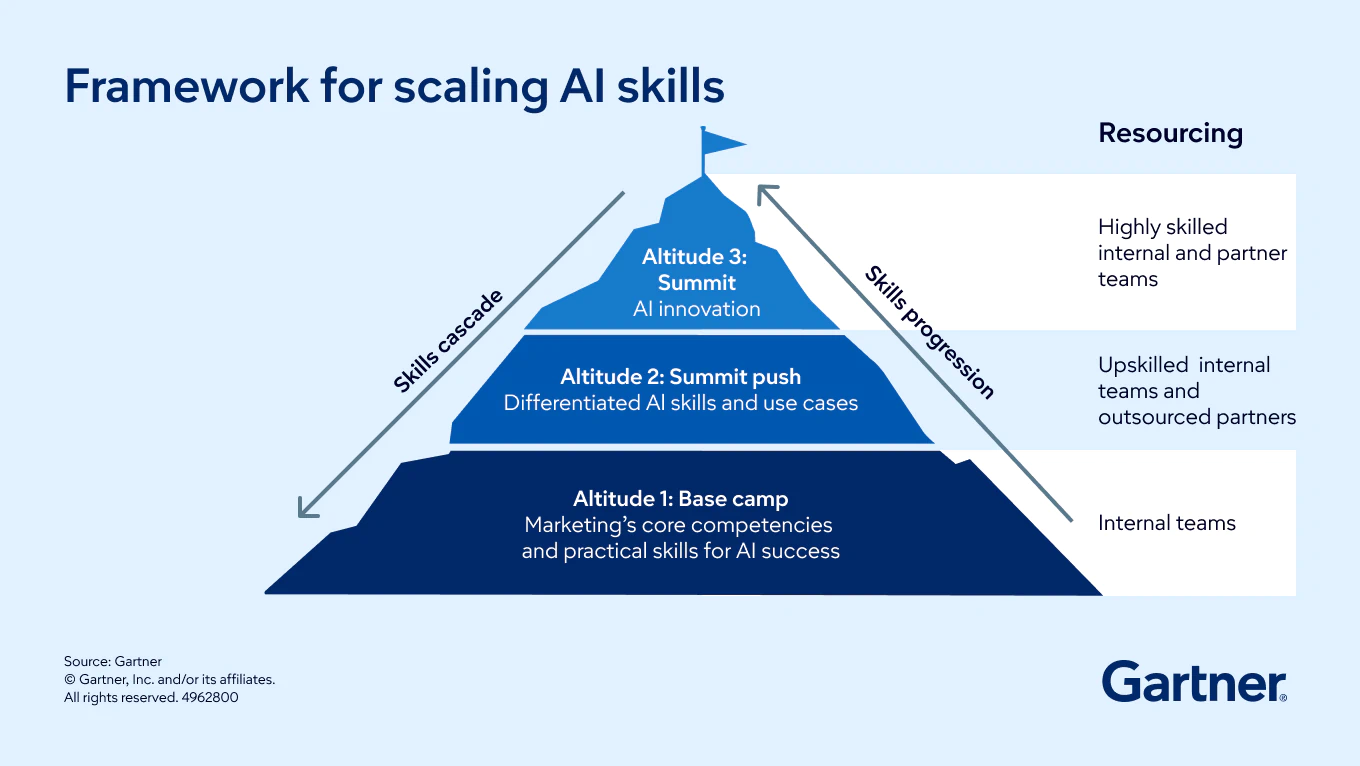
To close skills gaps quickly without overloading internal teams, CMOs should scale AI skills across three progressive altitudes that balance speed, risk and investment with marketing’s AI maturity.
Altitude 1. Base camp: Build foundational AI capabilities internally
Developing foundational AI skills is the most urgent priority for marketing leaders. Organizations in the top quartile of learning outcomes are nearly twice as likely to outperform their peers on revenue, margin and return on assets, underscoring the link between capability building and performance.
At this altitude, CMOs should ensure marketers can use AI effectively, efficiently and ethically. These core skills also enable teams to oversee and collaborate productively with external partners as AI initiatives become more complex. Four practical AI skills are essential:
AI use-case identification. Recognizing high-value opportunities where AI can improve marketing outcomes.
AI technology fluency. Staying current on emerging capabilities and understanding where tools are fit for purpose.
AI-prompting skills. Crafting precise inputs that improve output quality and relevance.
AI output discernment. Evaluating accuracy, bias and alignment with brand and regulatory standards.
As these skills improve, teams often see reduced burnout. Marketers who report high AI usage are significantly less likely to feel overwhelmed and report more time for creative, thought‑intensive work.
Altitude 2. Summit push: Blend internal and external resources
External partners play a critical role once foundational skills are in place. Global agencies, consultancies and martech providers have invested heavily in AI tools and training, often placing them well ahead of individual marketing organizations. Partnering effectively allows CMOs to accelerate learning, access mature tooling and expose teams to cross‑industry best practices.
However, collaboration does not happen automatically. Seventy‑two percent of marketers say it takes too much effort to get work done through agencies. CMOs must therefore actively remove collaboration barriers and instill new ways of working across internal and external teams.
Effective techniques include:
Partner‑led AI training that combines classroom learning with hands‑on application.
Thought‑leadership sessions where agencies share examples from other clients and industries.
- Hackathons and design sprints that allow mixed teams to experiment together in low‑risk environments.
This summit‑push phase strengthens internal capability while preparing marketing to pursue more differentiated AI use cases.
Altitude 3. Summit: Pilot innovative AI use cases with partners
Many advanced AI use cases remain risky, episodic or unproven. Agencies and martech vendors are often better positioned to absorb this risk because they amortize AI investments across multiple clients and scale experimentation faster than in‑house teams.
At this altitude, CMOs should pair highly skilled internal marketers with external partners to pilot innovative use cases such as:
AI agent sandboxes and staging environments for safe testing before deployment.
Synthetic datasets that mimic real-world customer behavior without exposing sensitive data.
Test scripts that validate AI-generated content, analytics and automation outputs.
Use cases classified as “calculated risks” are best piloted in this hybrid model, while “likely wins” should ultimately be scaled and owned internally. CMOs must also vet partners carefully, particularly as AI work becomes customer‑facing, to ensure strong governance around ethics, privacy and brand safety.
What to do next to build an AI-powered marketing organization
Setting your vision is just one critical step in the CMO’s mandate to build an AI-powered marketing organization. According to Gartner, the other steps in this imperative include:
Building new marketing governance frameworks that support the changes AI will bring to people, processes and brand.
Identifying and prioritizing marketing’s agentic use cases to deliver the most value.
Reprioritizing marketing’s investments in people, partners and technology based on how AI is changing costs and value.
Updating roles and structure to support AI integration in a hybrid-human AI team.
For more on how Gartner helps drive success on this and other mission-critical priorities for CMOs, speak to us today.
FAQs on AI skills in marketing
Why are CMOs struggling to realize value from AI?
Adoption is outpacing skills. While many marketing teams are piloting AI, gaps in practical skills, data readiness and workflows limit their ability to scale impact beyond experimentation.
Which AI skills should marketing teams prioritize first?
CMOs should focus on four practical skills: AI use‑case identification, GenAI technology fluency, prompting skills and output discernment to ensure accuracy, ethics and brand alignment.
When should CMOs rely on external partners for AI work?
External partners are best suited for complex or innovative AI use cases that carry higher risk, while internal teams should own and scale use cases that are proven and repeatable.
Attend a Conference
Accelerate growth with Gartner conferences
Gain exclusive insights on the latest trends, receive one-on-one guidance from a Gartner analyst, network with a community of your peers and leave ready to tackle your mission-critical priorities.

Drive stronger performance on your mission-critical priorities.