Enhance creativity, productivity and customer engagement by harnessing the power of artificial intelligence.
- Gartner client? Log in for personalized search results.
AI in Marketing: The Future of Smart Marketing


Realize the promise of generative AI in marketing for enhanced content delivery
Generative AI is transforming marketing, enabling brands to augment, accelerate, and create new content while reshaping how marketing operates.
Download the guide to applying AI in Marketing to:
- Explore the drivers of, and barriers to, generative AI in marketing
- Unlock actionable ways to apply generative AI for enhanced content marketing and CX
- Capitalize on generative AI's potential and navigate its limitations
Reap the content, client and ops benefits of AI in marketing
As enterprises look toward a future where smarter marketing leads to deeper, more valuable connections between customers and brands, successful CMOs leverage AI in the following ways.
Enhance Content and CX
Future-Proof the Team
Foster Customer Centricity
Drive creativity and personalized experiences through generative AI
The ability to create original content, synthetic data, models of physical objects, and code to improve response time to customer engagement is providing breakthrough innovation opportunities for marketing.
Generative AI (GenAI) learns from existing artifacts to generate new, realistic artifacts that reflect the characteristics of the training data without repeating them. It produces new content artifacts such as video, narrative, speech, training data and product designs. It can generate within the same modality (e.g., picture to picture) or across modalities (e.g., picture to narrative) and produce entirely unique artifacts or improve existing ones.
GenAI promises a new level of creativity and enhanced experiences using two primary methods:
Augmented GenAI optimizes existing creative workflows collaboratively with human operators that shape the AI’s generation behavior through reinforcement, such as by saying “more like this” generated element or “less like this.”
Automated GenAI produces unique artifacts in bulk with little human involvement beyond shaping the parameters for production. For example, humans set the brand guidelines for automated copy development.
GenAI in marketing is quickly gaining traction, with varying levels of practical impact.
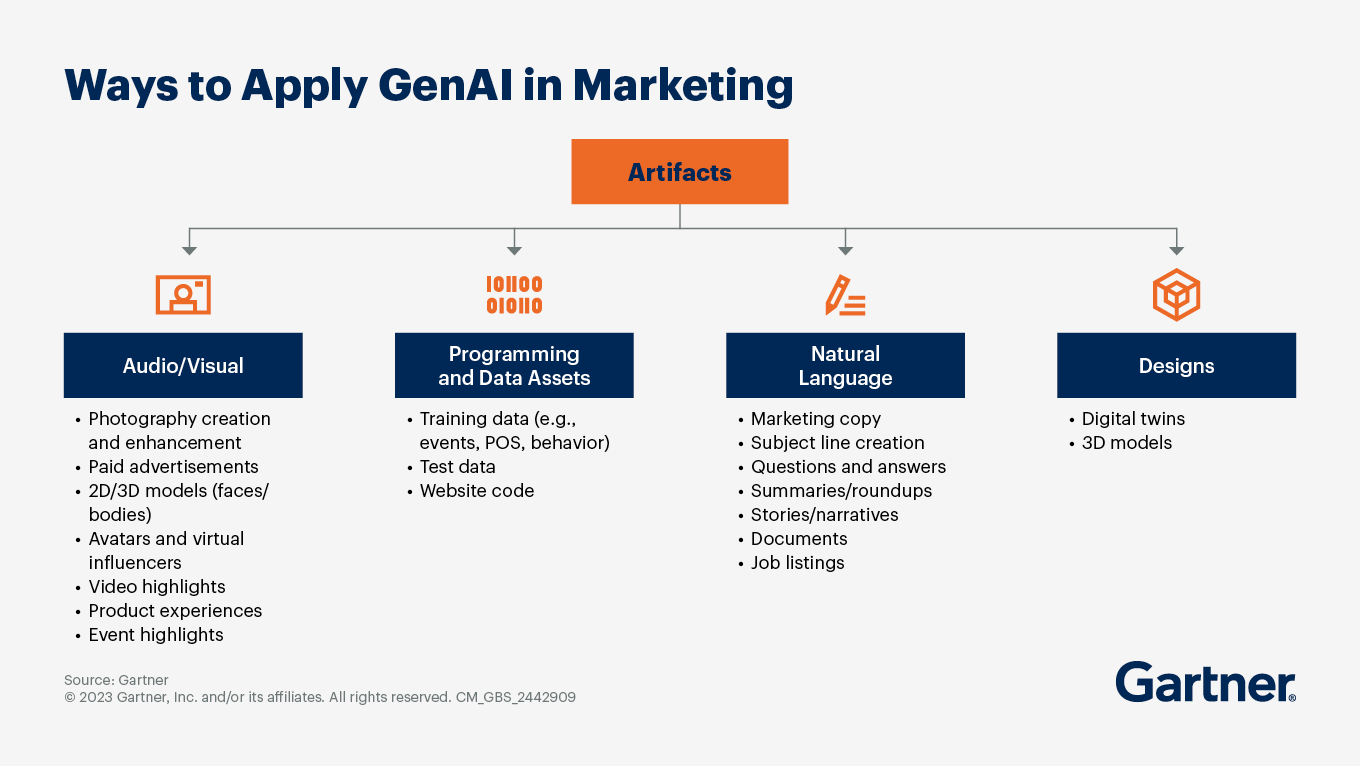
Specific marketing AI applications include the following:
Text generators can create marketing copy, news stories and job descriptions. Short-form content like subject line creation can support A/B testing.
Images can be generated for logos; human images can be generated for modeling; and images can be altered for different poses, aging and many other aspects.
AI-generated video can showcase event highlights, immersive product experiences and multilingual versions.
Ads can be optimized by assembling content artifacts into combinations to support personalization.
Computer vision (CV) can improve image quality, develop digital twins and create deep fakes.
Avatars and virtual influencers can engage customers on social media and provide customer support.


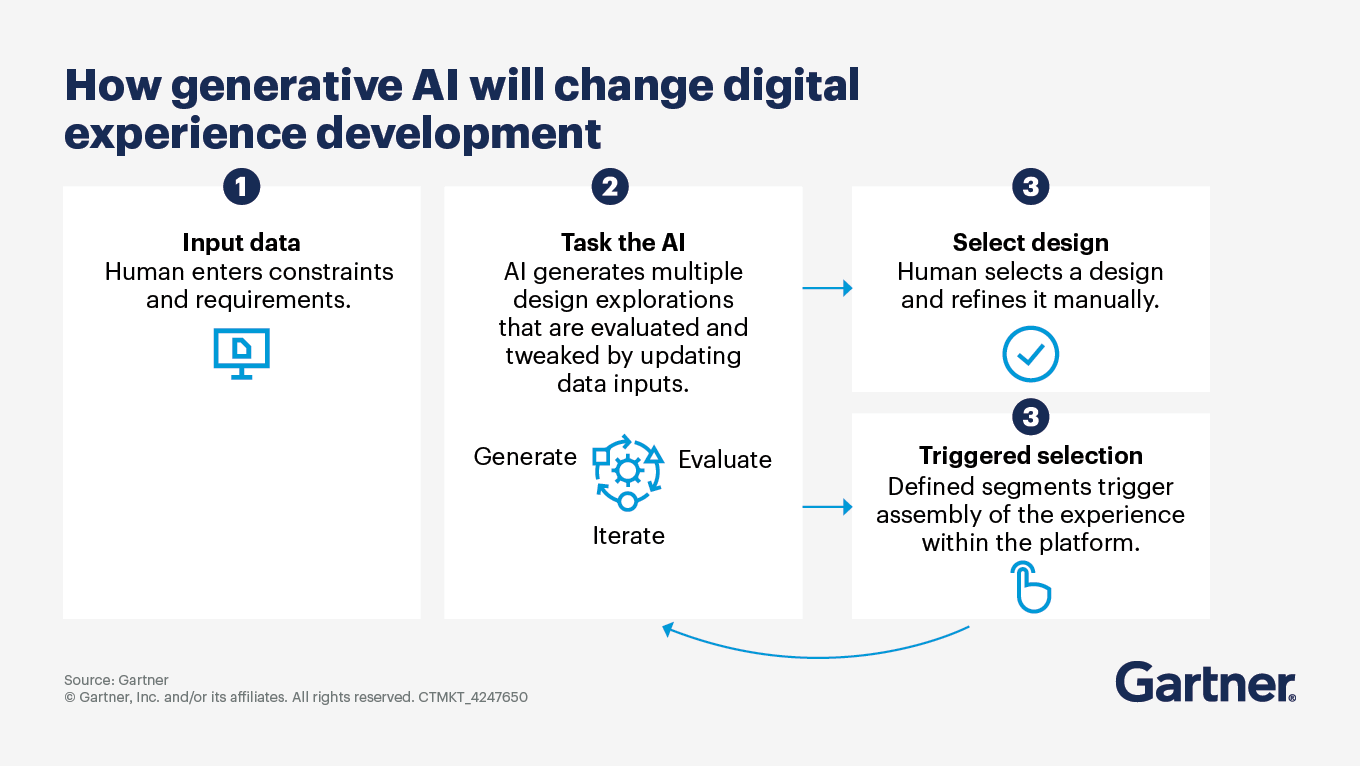
Most applications of AI still require people to set the parameters to guide learning and provide governance. Marketing leaders must consider the implications for their teams, particularly in the areas of data and asset management, skills development and capacity planning.
Along with GenAI’s promise come inherent risks. Issues around ethics, intellectual property and bias are only a few of the potential pitfalls. To avoid these and other unintended consequences, keep in mind the following:
AI will not evolve to regulate itself — so humans will need to regulate it.
The best time to identify relevant risks to your organization is before you implement AI.
Responsible use of AI is a cross-functional effort that requires a foundation of transparency, trust and security to ensure your organization can exploit AI’s benefits while mitigating risk.
Blending key skills and relationships will drive AI success
Today’s marketing teams cite a gap in marketing roles and skills as the biggest challenge to successful AI execution.
Though GenAI has boosted marketing productivity and creativity, benefits remain inconsistent. CMOs struggle to move beyond GenAI pilots to unlock the full potential of the technology.
To successfully implement AI at scale, marketing teams must build core competencies and AI skills, utilize key tools and work with external teams to implement innovative use cases and experimentation.
Develop the foundational capabilities of internal marketing teams. CMOs should focus on building skills in three key areas: practical AI skills for marketing (e.g., AI use-case identification, GenAI tech fluency), critical marketing core competencies (e.g., digital and data literacy; brand positioning and differentiation; business and financial acumen) and addressing cultural resistance to AI.
Blend internal and external resources to differentiate. CMOs who foster AI-driven collaboration with agencies and external partners unlock significant value. These teams can provide access to specialized expertise, martech partners, and consultancies.
Pilot innovative use cases with partners and highly skilled internal staff. CMOs can advance innovative, cutting-edge GenAI use cases by pairing external partners with highly skilled internal team members. These outside agencies and martech partners are often more equipped to handle the risk of investing heavily in experimental use cases. Additionally, despite vendor “no-code” claims, internal teams may still lack the key skill sets to successfully implement AI use cases.


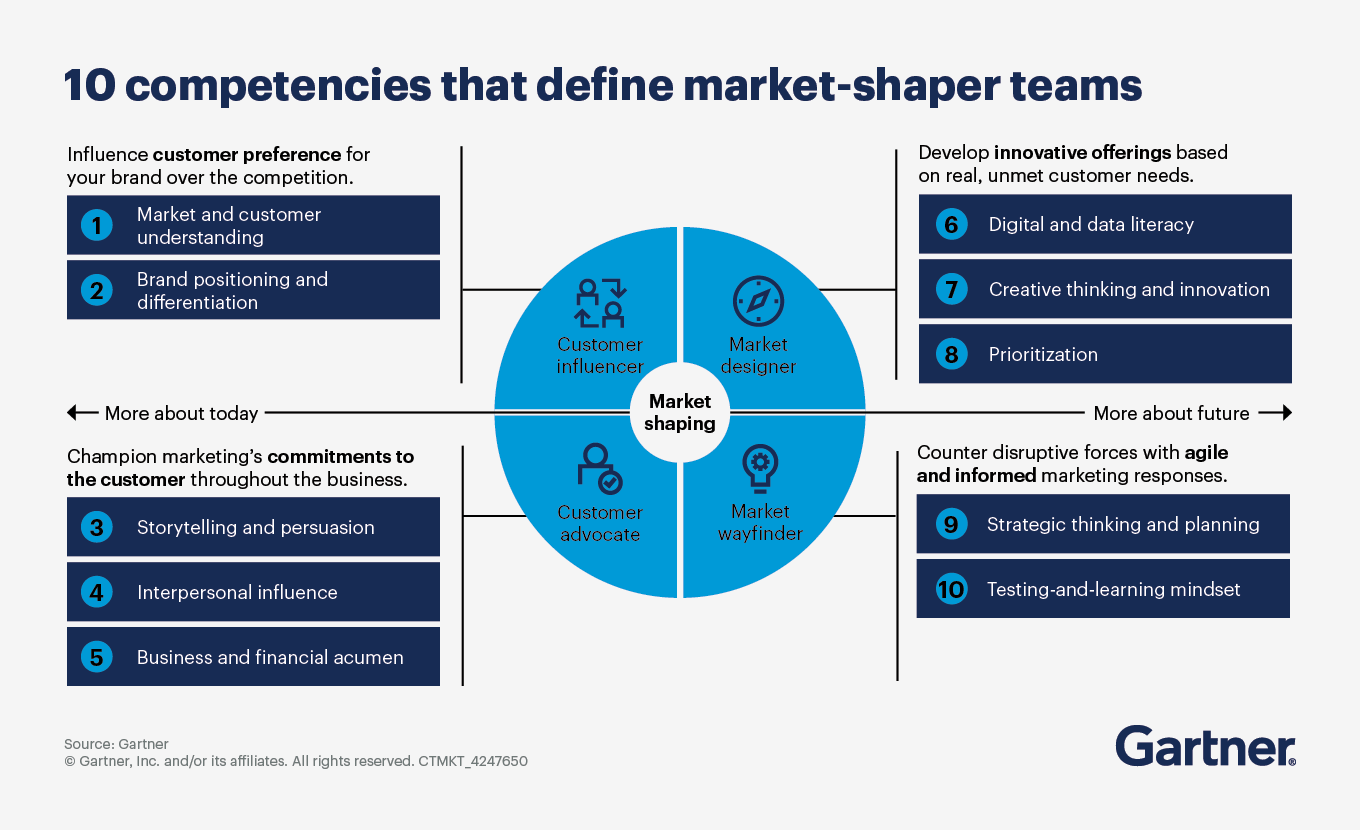
CMOs who are able to blend these three key areas will provide their marketing teams with the skills, tools and relationships to successfully implement AI at scale and create ROI for the business.
Build an effective insights team to deliver true value
CMOs who leverage deep customer and market insight, bold position and innovation are 2.6 times more likely to surpass revenue and profit targets. However, it is challenging to effectively embed these strengths across fragmented teams and unclear processes.
Insights teams can be a useful tool for CMOs, but structuring them to deliver real value can prove challenging. These teams often exist in silos, which means their valuable intelligence remains underused — or even duplicated by another team — and they fail to deliver strategic differentiation.
Build an insights infusion team. Today’s CMOs oversee a broad range of responsibilities, which leaves them with limited time to focus on enhancing customer experience. Instead, CMOs should delegate insight integration to a dedicated team. This approach frees up the CMO to focus on vision setting and market shaping for planning growth strategy.
- Identify stakeholders served by the team. First, decide which stakeholders the insights infusion team serves and what is provided to its internal clients. The final list will depend heavily on the size of the organization and the skill sets within the team. However, start by reviewing the current stakeholder list, interview stakeholders to identify current and future needs, and broaden the list to include potential needs from enterprisewide initiatives.


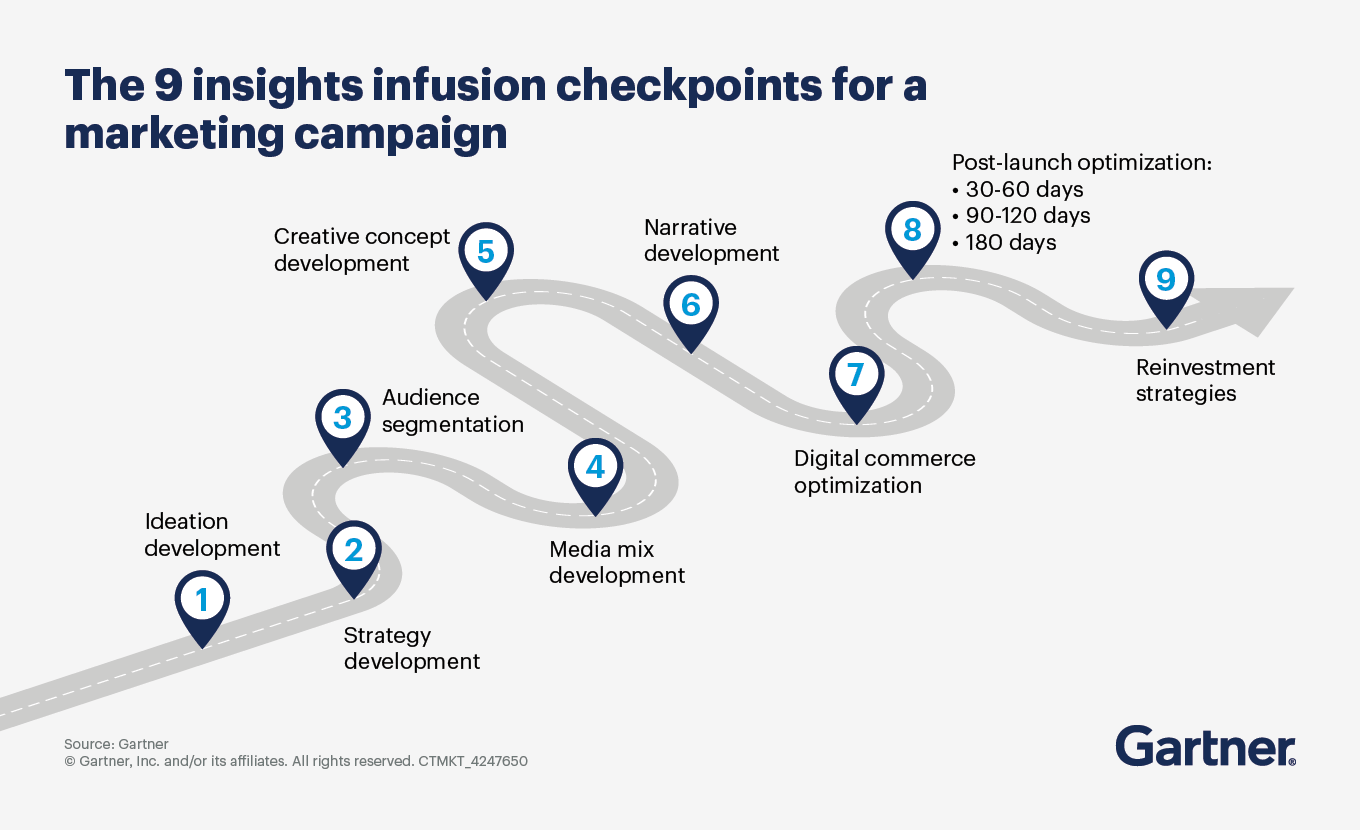
Structure the team within the marketing organization. For the most impact, structure the insights infusion team as an in-house agency and consultancy. Depending on the setup, these insights teams are often siloed and rendered ineffective. By restructuring the insights infusion team and focusing on accelerating growth through impactful insights applications from diverse data sources, CMOs create a team that can effectively boost marketing productivity.
Create key insights infusion checkpoints. For the team to be truly effective, it’s vital that the organization successfully implement the insights. Without this implementation, the organization risks market misalignment, off-target strategies and missed opportunities. Executing on strategies without taking the insights into account means marketing is not being as effective as possible. Integrate insights infusion checkpoints that regularly assess if there are new insights, data or intelligence that could differentiate the strategy or execution.
Attend a Conference
Accelerate growth with Gartner conferences
Gain exclusive insights on the latest trends, receive one-on-one guidance from a Gartner expert, network with a community of your peers and leave ready to tackle your mission-critical priorities.

AI in Marketing Related Resources
Gartner clients: Log in for a complete suite of actionable insights and tools on AI in Marketing.



AI in Marketing FAQs
How will the use of AI in marketing evolve?
The use of AI in marketing operations will evolve the marketing function in the following ways:
Applying AI to content and customer journeys will be fundamental to segmentation and personalization.
AI-augmented marketing operations will become more resilient, agile and data-focused.
Generative design AI will accelerate product time to market.
What are the problems with generative AI and marketing?
In addition to challenges presented by the growing volume, scale and uncertainty around the accuracy of AI-generated content, regulators and advocacy groups are becoming more vocal about concerns associated with manipulative and biased uses of AI in Marketing. Several brands have come under scrutiny over their use of advanced technology to influence consumers in creepy and inequitable ways.
What should be top of mind when choosing AI marketing tools?
When choosing an AI marketing tool, begin by understanding the types of tools needed and the potential for overlap with solutions already in your martech stack. Support your investigation with clear user stories and the prospective AI solution’s ability to integrate with existing technology investments and achieve stakeholder adoption. Finally, analyze how AI solution providers vary against key competencies.
Drive stronger performance on your mission-critical priorities.