Unlock the full potential of AI by shifting focus from time savings to measurable business outcomes.
- Gartner client? Log in for personalized search results.
Most CMOs miss out on real business gains
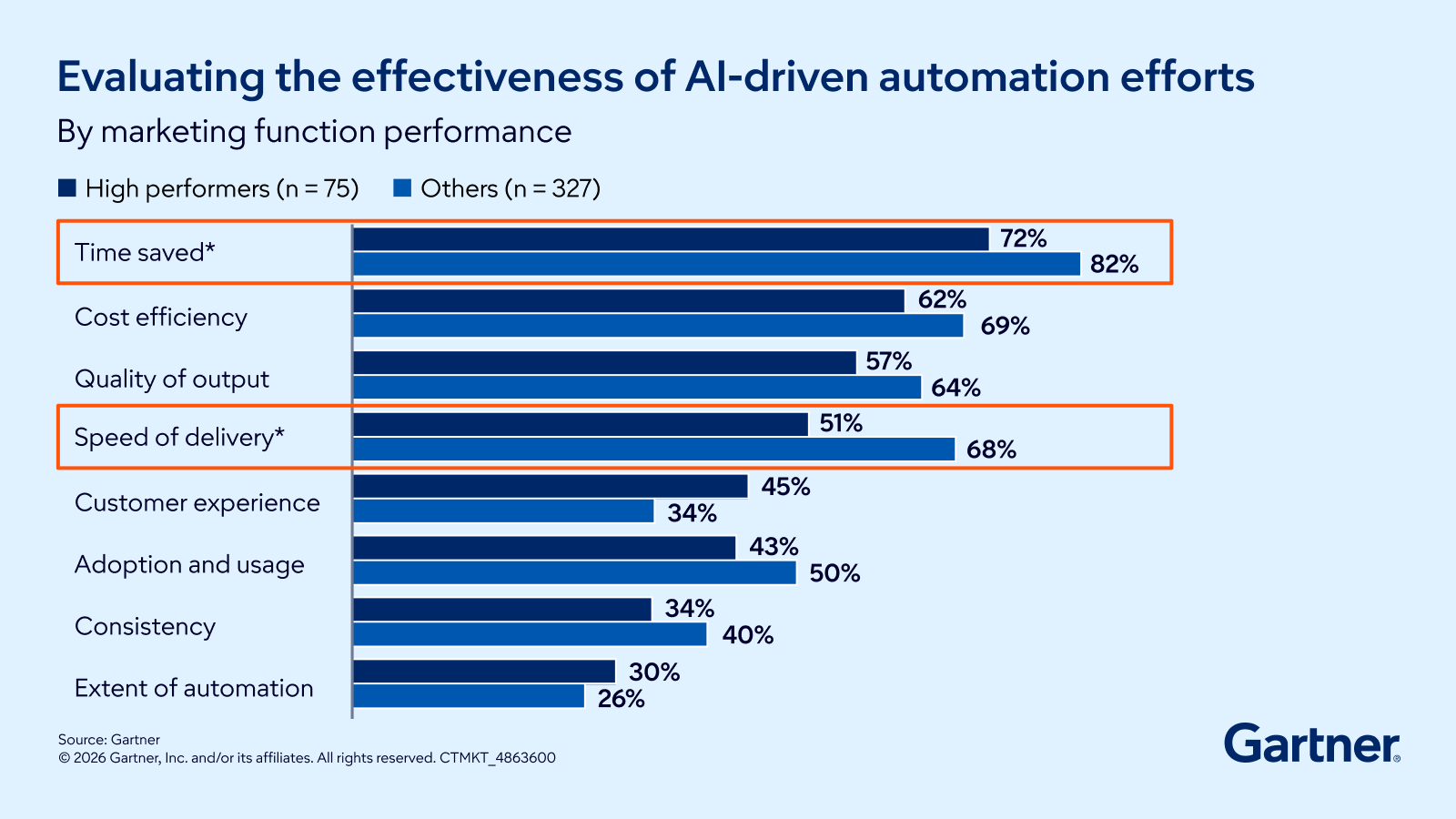
Only one in three CMOs are seeing the returns they expect from AI investments. Most focus on efficiency — measuring time saved and speed — but high-performing CMOs take a different approach. They prioritize business outcomes, not just productivity.
Gartner business and technology insights show that organizations automating more of their marketing work are twice as likely to see ROI from AI. Yet, short-term productivity gains rarely translate into meaningful business results unless you intentionally measure and optimize for impact. By 2028, only 10% of CMOs who focus on time savings over business outcomes will secure the budget needed to meet strategic goals. That’s a wake-up call for every marketing leader.
You might like this webinar: Leading Through Change: CMOs, AI Fatigue, and the Path to Growth
High performers focus on business impact
High-performing CMOs measure AI by its effect on customers and the business, not just efficiency. Here’s what sets them apart:
High performers track downstream business metrics.
Instead of stopping at time saved, high performers focus on downstream business outcomes (e.g., by measuring conversion rates, customer satisfaction and campaign impact). This enables them to use these metrics to build a business case for AI — and to win budget and support. This approach ensures that AI investments are tied directly to outcomes that drive growth, not just operational efficiency. When you focus on downstream metrics, you reveal the true value of AI to the business and avoid missed opportunities that come from overemphasizing short-term gains.
AI output validation is a must-have.
High performers are 1.4 times more likely to direct teams to redo or validate tasks automated by AI. They treat time saved as an opportunity for quality control, not just extra capacity. Rigorous validation helps safeguard against risks like inaccurate data or content misalignment, which can undermine campaign effectiveness and brand reputation. By prioritizing validation, CMOs build trust in AI outputs and maintain high standards as automation scales.
Marketing operations teams become critical.
As AI automates more work, the role of marketing operations grows. High performers identify this function as a critical function for future success. Sixty-two percent of CMOs say AI automation has prompted a reevaluation of key roles. Marketing operations teams are uniquely positioned to govern AI use cases, ensuring processes are optimized and compliant. Their oversight is vital for maintaining quality and adapting workflows as AI transforms marketing.
Talent strategy shifts from reduction to reallocation.
AI isn’t a shortcut to layoffs. Instead, CMOs should plan to upskill staff and redeploy talent toward optimizing AI outputs. According to Gartner, job redesign will require more effort than simple workforce cuts. Investing in talent reallocation prepares your team to manage new workflows and maximize AI’s impact, rather than simply reducing headcount. This strategic shift helps future-proof your marketing organization as automation accelerates.
Ready to get more from your AI investments? Here’s your action plan:
Shift your measurement strategy: Track KPIs tied to business outcomes, like customer experience and output quality. Establish a baseline with and without AI to prove its value.
Define “good” AI output: Set clear standards for accuracy, brand fit and strategic alignment. Build trust with a formal review process.
Upskill your team: Train staff to evaluate and optimize AI outputs. Create resources and checklists to guide their work.
Prepare for role changes: Use business outcome metrics to support staff reallocation and role redesign. Map AI’s impact on workflows to plan for future needs.
What to do next?
Identifying and prioritizing marketing’s agentic AI use cases is one critical step in the CMO’s mandate to build an AI-powered marketing organization. The other steps in this imperative include:
Build new marketing governance frameworks that support the changes AI will bring to people, processes and brand.
Update roles and structure to support AI integration and building a hybrid human/AI team.
Reprioritize marketing’s investments in people, partners and technology based on how AI is changing costs and value.
Discover what an AI-powered marketing function looks like and how to upgrade your own team.
For more on how Gartner helps drive success on this and other mission-critical priorities for CMOs, speak to us today.
AI in marketing FAQs
How should CMOs measure AI effectiveness in marketing?
CMOs should focus on business outcomes, not just time saved. Track metrics like improved customer satisfaction, increased conversion rates and campaign performance. According to Gartner, high-performing CMOs use these measures to demonstrate AI’s value and build a case for further investment.
What does AI automation mean for marketing roles?
AI automation is not a shortcut to workforce reduction. Gartner predicts that that job and role redesign will require much more organizational effort than layoffs or hiring. CMOs should plan to redeploy staff toward optimizing AI outputs and managing new workflows, making marketing operations teams even more critical.
What makes “good” AI output in marketing?
“Good” AI output aligns with your brand, meets accuracy standards and supports marketing strategy. CMOs should formalize review processes and provide guidance so teams can evaluate and improve AI-generated work, ensuring it drives real business impact.
Attend a Conference
Accelerate growth with Gartner conferences
Gain exclusive insights on the latest trends, receive one-on-one guidance from a Gartner analyst, network with a community of your peers and leave ready to tackle your mission-critical priorities.

Drive stronger performance on your mission-critical priorities.