How CMOs can advance brand’s impact on transformative growth
- Gartner client? Log in for personalized search results.
Brand strategy is shifting in the age of AI
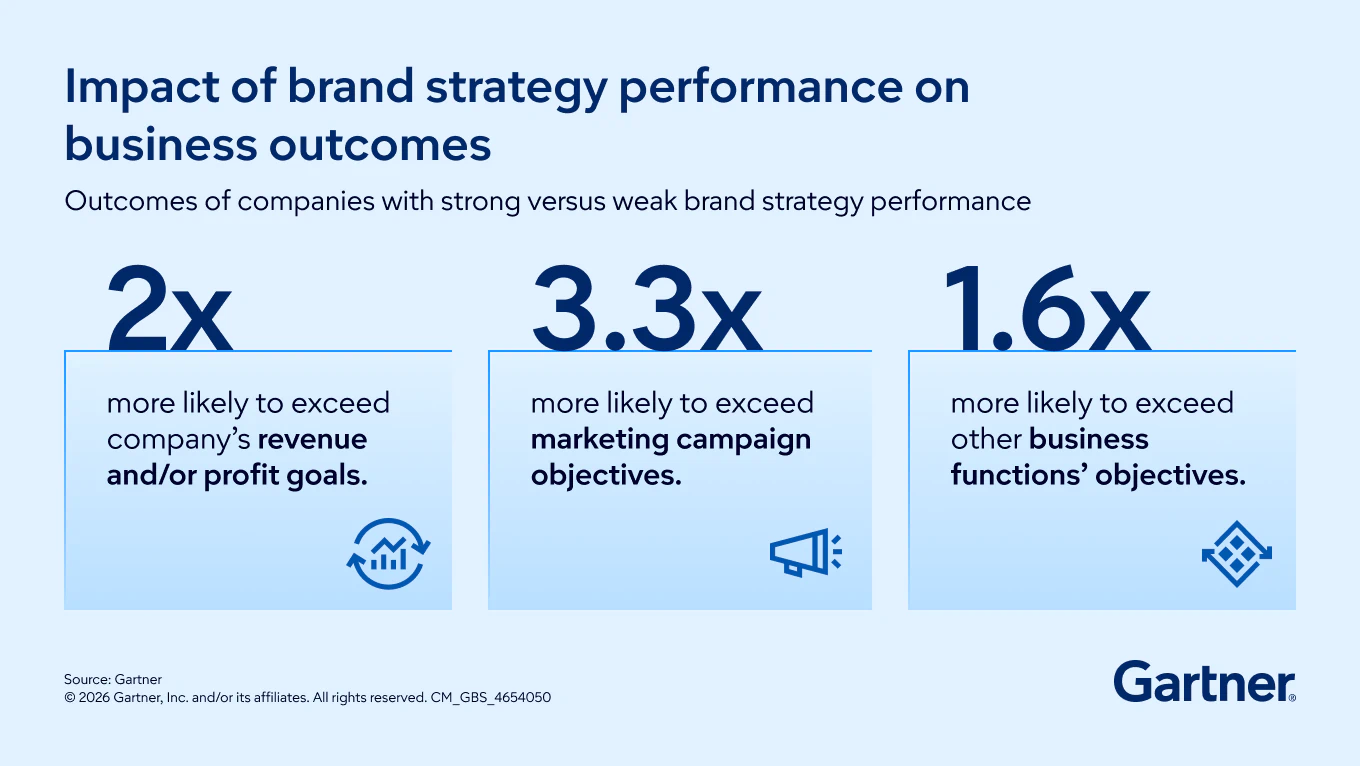
Companies with a strong brand strategy are twice as likely to exceed growth goals — and its importance is only increasing as AI fuels disinformation and raises the need for distinctive, trustworthy positioning. According to the 2026 Gartner Brand and Business Strategy Survey, most organizations have already refreshed their brands in the past two years to keep pace with AI’s impact. Yet despite this urgency, most business leaders still do not factor brand into their growth strategy.
Gartner’s position: CMOs need a modern approach to brand strategy that directly links the brand to growth goals and puts marketing leadership at the center of that work.
You might also like this webinar: Strategies That Distinguish “Genius” Digital Marketing Brands.
Brand is a growth lever, not just a marketing asset
A high-performing brand strategy is one that is fully aligned with the business strategy, consistently executed across functions and, above all, seen by executive leadership as important to growth.
Brand strategy is weakened by limited measurement
According to Gartner, organizations with a strong brand strategy are 2x more likely to meet growth goals, 3.3x more likely to exceed marketing campaign targets and 1.6x more likely to exceed other functional objectives. The challenge? Most leaders only see brand as a marketing asset. And most companies don’t allocate enough resources to measuring brand performance data, trapping CMOs in a vicious cycle often called a “doom loop.” Without the budget for brand measurement, they can’t show the returns needed to make the case for a larger budget. Brand strategy is stronger when the CMO leads.
Gartner predicts that by 2028, over 80% of companies will make significant changes to their company’s identity to keep pace with the impact of AI. To support these changes, brand strategy needs to operate under strong leadership. While function leaders often expect CMOs to lead this charge, most aren’t actually responsible for core brand elements like positioning, messaging and differentiation. Instead, those responsibilities are typically shared cross-functionally.
CMO leadership is a critical first step for brand strategy
For brand strategy to support growth, it has to directly influence what you build and how you bring it to market — and today’s AI landscape requires CMOs to be at the center of this work (i.e., insights, product direction and customer experience). When marketing fully leads, companies see stronger brand strategy successes. And when CMOs take the lead in setting product and pricing strategy, leaders are more likely to report exceeding enterprise growth goals.
The good news: Functional leaders agree that CMOs should lead brand differentiation efforts. More than 50% of CxOs want their CMO to clarify the relationship between brand and business strategy, and 43% of them want CMOs to relay a clear and simple message about brand health and business performance.
What “good” brand strategy looks like
Link to growth goals: CMOs must elevate brand concerns beyond marketing and into the decisions that shape value, that is, commercial and product calls.
- Center marketing as the head of all aspects of brand strategy: CMOs must demonstrate that they can effectively lead brand positioning.
Your immediate brand strategy to-do list
Create a compelling narrative for senior leadership about the importance of measuring brand performance.
Tie brand performance into CxOs’ top priorities to firmly position brand strategy as a foundation for organizational growth.
Build a focused and differentiated brand positioning statement to connect with customers and drive commercial success.
Craft a unique brand personality to help set strategic direction.
What to do next
Aligning brand strategy to the organization’s growth plans is one critical step in the CMOs’ mandate to elevate the brand’s role in transformative growth.
The other steps in this imperative include:
Activating the brand consistently across all channels and teams to ensure unified brand execution at every touchpoint
Connecting brand investments to business outcomes by determining how brand strategy, programs and investments support enterprise objectives
Proving the value of brand investments by identifying ways to measure and communicate brand impact to the C‑suite
Repositioning brand internally by reframing brand investments in ways that resonate with nonmarketing stakeholders
For more on how Gartner helps drive success on this and other mission-critical priorities for CMOs, speak with us today.
Brand strategy FAQs
What is brand strategy in today’s business environment?
Brand strategy defines how an organization positions itself to create distinctive, trustworthy value in the market. When aligned with business strategy, the brand becomes a lever for enterprise growth rather than a stand-alone marketing asset.
Why is the brand considered an underused growth lever?
Organizations with a strong brand strategy are more likely to meet and exceed growth goals. However, most leaders still do not factor brand into their growth plans or invest sufficiently in brand measurement, limiting CMOs’ ability to demonstrate the brand’s business impact and secure executive commitment.
How is AI changing the role of brand strategy?
AI is accelerating the need for distinctive, credible brand positioning as disinformation increases. Gartner predicts that most companies will significantly update their identity to keep pace with AI’s impact. As a result, brand strategy must evolve to guide product direction, insights and customer experience.
Why must CMOs lead brand strategy to drive growth?
While brand responsibilities are often shared across functions, brand strategy is more effective when CMOs lead positioning, differentiation and alignment to business goals. When CMOs take the lead in areas such as product and pricing strategy, organizations are more likely to exceed enterprise growth targets.
Attend a Conference
Join Gartner experts and your peers to accelerate growth
Gather alongside your peers in Denver to gain insight on emerging trends, receive one-on-one guidance from a Gartner expert and create a strategy to tackle your priorities head-on.
7 – 9 Jun 2027
Gartner Marketing Symposium/Xpo™
Denver, CO

Drive stronger performance on your mission-critical priorities.