CMOs: Discover the top marketing trends for 2026 to move faster, spend smarter, and outpace competitors
- Gartner client? Log in for personalized search results.
Generative AI is radically reshaping the future of marketing
AI is unlocking new possibilities for marketing. Gartner’s 2026 predictions show how AI agents and GenAI‑powered personal tech will redefine channels, accelerate execution, and elevate the role of data, content, and organizational design. Learn how to:
- Build AI‑ready data, content & context governance
- Maintain brand trust across AI‑driven search & social
- Shift to composable orgs with transparent AI policies
Transform How Marketing Operates and Delivers Value
AI is reshaping discovery and decision-making. CMOs who modernize data, content, and operating models now will unlock agility, strengthen trust, and position their brands for sustained growth.
Analyst insights on how AI will reshape the future of marketing in 2026 and beyond
AI is transforming every element of marketing — from customer journeys to organizational structures, from influencer credibility to device‑driven brand interactions.
Five marketing predictions from Gartner analysts guide CMOs in preparing for the disruptions created by agentic AI, the surge in authenticity-driven content ecosystems, and the rapid evolution of ambient intelligence and consumer trust shaping the future marketing landscape.
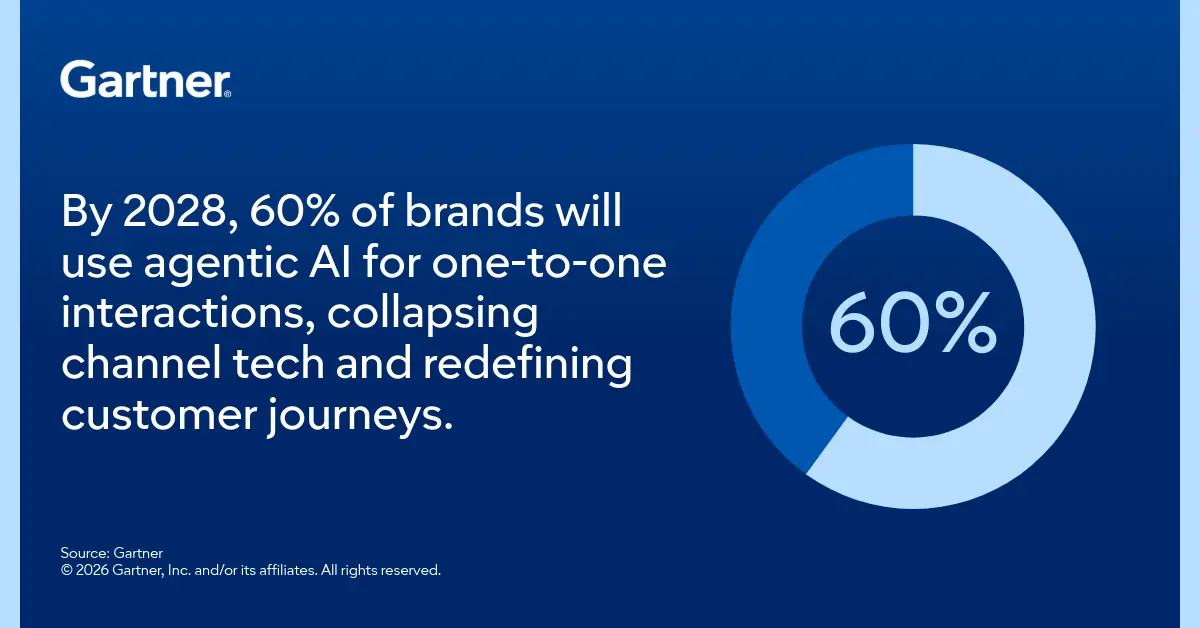
Prediction No. 1: Brands will adopt agentic AI to deliver one‑to‑one customer interactions
The impact:
AI agents will take over many routine customer engagements — from notifications to reorders to personalized guidance — shifting marketing from channel‑based execution to fluid, autonomous, agent‑driven journeys. This will collapse traditional martech architectures and move marketers into roles focused on supervising intelligent systems rather than running discrete campaigns.
Prediction No. 2: Influencer budgets will shift toward creator and content authenticity
The impact:
With AI-generated media accelerating and social-originated content increasingly dominating search results, brands will focus heavily on verifying creator identities and ensuring content authenticity. Deepfake risks and rising misinformation will push authenticity to the center of influencer strategy, making validated, trustworthy creator content more valuable than high-volume engagement.
Prediction No. 3: CMOs will move toward fully composable, AI-dependent marketing organizations
The impact:
As AI automates more execution work, marketing organizations will flatten and reorganize around modular, flexible structures. Human–AI hybrid roles will emerge, team boundaries will blur, and individual contributors will operate more autonomously. Skills like digital dexterity, strategic thinking, and cross-functional problem solving will become core to how marketing teams create value.
Prediction No. 4: Ambient smart devices will become a major channel for brand experiences
The impact:
A growing ecosystem of AI-enabled wearables, sensors, and connected devices will shift brand engagement from explicit searches to ambient, context-driven interactions. Voice and visual interfaces will power real‑time, passive discovery moments, enabling deeper personalization while creating new challenges around data privacy, continuous tracking and consumer consent.
Prediction No. 5: GenAI shopping tools will generate less than 10% of e‑commerce revenue
The impact:
Despite industry optimism, consumer-facing shopping agents will see limited adoption due to low trust and fears of biased recommendations. Even AI‑enthusiastic consumers hesitate to let digital agents make autonomous purchase decisions. As a result, GenAI tools will support early‑stage discovery and research more than actual transactions, keeping revenue contribution relatively small.
Future of Marketing FAQs
Where will marketing be in 10 years?
The future of marketing will be shaped by smarter AI, shifting discovery habits, and new consumer expectations. Key marketing trends point toward more personalized, authentic, and connected experiences across every touchpoint.
What are the latest trends in marketing?
The latest trends in marketing include AI‑powered personalization, rising creator influence, short‑form video dominance, social commerce growth, and a shift toward more authentic, human‑centered content across digital channels.
Attend a Conference
Join Gartner analysts and your peers to accelerate growth
Gather alongside your peers in Denver to gain insight on emerging trends, receive one-on-one guidance from a Gartner expert and create a strategy to tackle your priorities head-on.
7 – 9 Jun 2027
Gartner Marketing Symposium/Xpo™
Denver, CO

Drive stronger performance on your mission-critical priorities.