Chief marketing officers (CMOs) have long driven growth through customer insight. Yet as AI reshapes business models, many CMOs experience cognitive dissonance. They recognize their role is changing but often underestimate the personal transformation needed to lead effectively. Why does this disconnect persist?
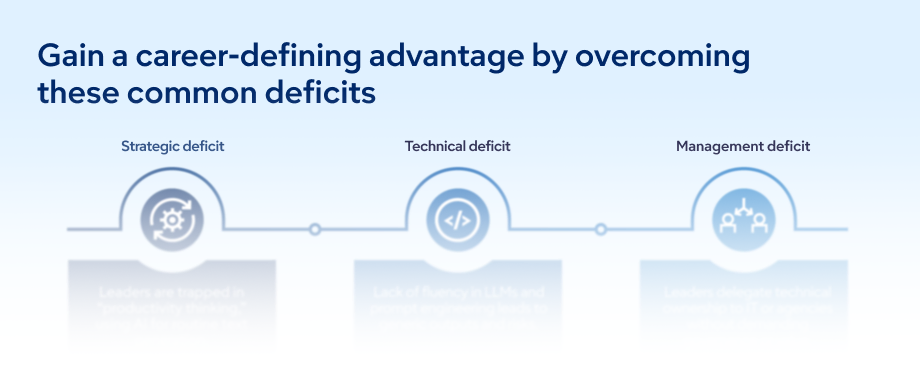
Category error — the productivity trap: CMOs often first encounter AI in operational contexts like content generation, analytics, and workflow automation. This installs a view of AI as a productivity tool, not a strategic growth driver, making upskilling seem like a team issue rather than a leadership priority.
Delegation drift — deference to IT: When AI is seen as “efficiency tech,” governance shifts to IT, which handles platforms, security, and compliance. CMOs support adoption but delegate technical ownership and learning, remaining removed from AI-driven transformation.
Status memory — legacy thinking from the digital era: Today’s CMOs rose to prominence during digital transformation, when tech fluency was a key part of their success. But rather than the long tail of one transformation, AI is redefining priorities, decision making, and experimentation in entirely new ways. Leadership-level fluency is essential, yet many still see AI as “automation for the team,” not a capability that redefines their own role.
- Strategic blind spot — AI and the growth mandate: What is often missed is that AI is now central to the growth mandate itself. AI influences how customer signals are interpreted, how decisions are automated or augmented, how experimentation scales, and how advantage is sustained. This moves AI upstream into prioritization and resource allocation, which are the very decisions CMOs own.
The irony is that while CMOs expect AI to replace team roles, their own position is at risk if they do not update their skills and strategic focus. To stay relevant, CMOs must move past legacy thinking, build AI literacy, and lead AI-driven growth.
The longer CMOs continue without evolving their personal skills and orientation toward AI, the more likely a CEO may view the CMO as replaceable by AI.